The fight for equality by 1954
The legal work of the NAACP
African Americans had been fighting for equality since before slavery was abolished. In 1909, the National Association for the Advancement of Colored People The National Association for the Advancement of Colored People was created in 1909 to eliminate race-based discrimination across the United States of America. was created to combine efforts and funding to improve the legal position of African Americans.
In 1950 the NAACP, including the lawyer Thurgood Marshall, started to question the legality of This meant that white people and black people had to live separately. The areas of society affected by segregation included churches, hospitals, theatres and schools. places of education in the South. They began to challenge the 'separate but equal' doctrine of the Plessy v Ferguson (1896) court ruling.
1950 McLaurin v Oklahoma State Regents
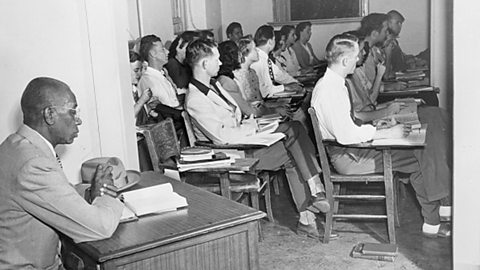
In the court case McLaurin v Oklahoma State Regents, the The ultimate court of appeal in the USA. It makes the final decision on whether a law is permitted by the US Constitution. looked at the experience of student George McLaurin at the University of Oklahoma. The court ruled that the university had violated the 14th A change made to the US Constitution after it came into force in 1789. to the US A set of laws by which a country is governed. which said that states should grant all citizens equal rights. McLaurin had been allowed to study at the university but had been required to eat at a specified table and use a specified table in the library, and he couldn’t sit inside the classroom during lessons. The judgement of the Supreme Court forced the university to accept McLaurin as an When the separation of something is ended. For example, when groups of people are mixed together after previously being kept separate. student.
Sweatt v Painter
On 5 June 1950, the same day of the verdict in McLaurin v Oklahoma State Regents, the Supreme Court judged that Heman Sweatt’s treatment by the University of Texas had been If something is unconstitutional, it means that it breaks rules about how the US government should be run. In the court case Sweatt v Painter, Thurgood Marshall presented the successful case on behalf of Sweatt. Sweatt had applied to study at the university. However, to ensure the segregation of races, the university had built a law school solely for African Americans. This new law school was in a different city and had only around 16,500 books in the library, compared to around 65,000 in the law school for white students only.
National impact
The Supreme Court ruled that the treatment of both McLaurin and Sweatt had been against the US Constitution. Although this brought no immediate change nationally, it challenged the decision made in Plessy v Ferguson and gave hope that segregation could be ended through the Supreme Court.
More guides on this topic
- Anti-Communism c.1945-1954 - Cambridge OCR A
- Civil rights in the USA 1954-1964 - Cambridge OCR A
- Broadening of the campaigns for civil rights - Race - Cambridge OCR A
- Broadening of the campaigns for civil rights - Women's rights - OCR A
- Broadening of the campaigns for civil rights - Gay rights - OCR A
- Politics and protest - Cambridge OCR A
- Social problems and attempts to tackle them - Cambridge OCR A
