Emergence of the civil rights movement in the 1950s
Explore the origins of the US civil rights movement through animation and archive footage.
Learn more about the civil rights movement in this podcast.
Listen to the full series on BBC Sounds.
The An organised set of activities that brought about a change in the treatment of people from different races in American society. emerged in America in the 1950s. Its emergence was accelerated by events that gained national attention from being reported in the media. Americans were able to witness the impact of the movement through reporting and images on television, in cinema news broadcasts and in newspapers.
Several events gained widespread media attention in both the north and south of the country. They captured the attention of campaigners, the government and President Dwight D Eisenhower. Some of these were:
- the case of Brown v Board of Education of Topeka
- the murder of Emmett Till
- the Montgomery Bus Boycott
Brown v Board of Education of Topeka
The Plessy v Ferguson court case in 1896 ruled that segregation of people based on race was legal, providing facilities were 'separate but equal'. This ruling meant that schools in the South continued to be segregated, as the authorities argued that the facilities were 'separate but equal'. In 1954, Thurgood Marshall, a lawyer from the National Association for the Advancement of Colored People The National Association for the Advancement of Colored People was created in 1909 to eliminate race-based discrimination across the United States of America. took up the case of an eight-year-old black schoolgirl called Linda Brown, who lived in Topeka, Kansas. Linda lived near a school for white children but she had to travel a mile to a school for black children.
Marshall acted on behalf of Linda’s father, Oliver Brown. Marshall argued that the Topeka Board of Education was acting unlawfully because education could not be treated as ‘separate but equal’. He said that the education available to black children was not, in reality, equal to that available to white children.
The The ultimate court of appeal in the USA. It makes the final decision on whether a law is permitted by the US Constitution. ruled in Brown’s favour. The ruling was based on the idea that black people had a right to equal educational opportunities. Chief Justice Earl Warren stated that all schools should desegregate 'with all deliberate speed'.‘ However, the court did not set a timescale for school Removal of laws that separate people from different races in public places and day-to-day life. because:
- racism was well established in southern society and could not be wiped out overnight
- this was the first challenge to the legal segregation of education, so the court was worried about how people would react
- the court was concerned that its judgement might be ignored by state governments and that this would make it look weak
The phrase ‘with all deliberate speed’ was so vague that opponents took it as meaning desegregation could happen slowly.
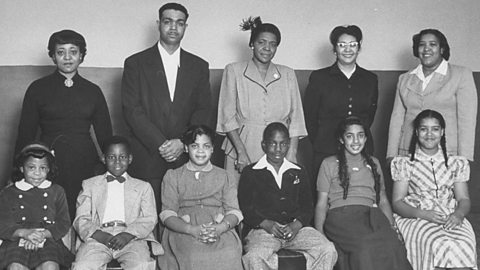
The role of the NAACP in Brown v Board of Education of Topeka
The NAACP had been essential to the success of Brown v Board of Education of Topeka as it had given the plaintiffs, a group of people who brought the case to court, highly qualified and experienced lawyers, such as Thurgood Marshall. The Brown family would not have been able to afford such a high standard of legal support. The NAACP took responsibility for funding the case, which resulted in Marshall presenting an argument with which all nine Supreme Court justices agreed.
More guides on this topic
- Anti-Communism c.1945-1954 - Cambridge OCR A
- African Americans c.1945-1954 - Cambridge OCR A
- Broadening of the campaigns for civil rights - Race - Cambridge OCR A
- Broadening of the campaigns for civil rights - Women's rights - OCR A
- Broadening of the campaigns for civil rights - Gay rights - OCR A
- Politics and protest - Cambridge OCR A
- Social problems and attempts to tackle them - Cambridge OCR A
