'There is' and 'there are'
The words for 'is' and 'are' in German come from the verb sein. The German forms are ist and sind.
But to say 'there is' or 'there are', you have to use a different construction - es gibt.
Here are some things to remember:
- es gibt means both 'there is' and 'there are'
- whatever noun es gibt refers to has to go in the accusative case, which means that the phrase is followed by the The indefinite article goes before a noun and indicates that the person, place or thing cannot be identified, ie it could be one of many. In English it would be 'a' or 'an', eg I took a suitcase on holiday. forms einen, eine, ein ('a') or the The definite article goes before a noun and indicates that the person, place or thing can be identified, ie is specific. In English it would be 'the' or 'this', eg I took the suitcase on holiday. forms den, die das ('the') for singular words or die for plural
- sometimes, es gibt will not need the definite or indefinite article after it at all, especially with certain plural nouns
Examples in use
es gibtfollowed by the accusative
- Es gibt einen guten Film im Kino. – There is a good film on at the cinema.
- Es gibt eine leckere Suppe zum Abendessen. – There’s a delicious soup for supper.
- Es gibt ein Kaninchen im Garten. – There is a rabbit in the garden.
es gibtfollowed by no definite article
- Es gibt frische Brötchen zum Frühstück. – There are fresh rolls for breakfast.
- Es gibt viele Sehenswürdigkeiten in Wien. – There are lots of sights in Vienna.
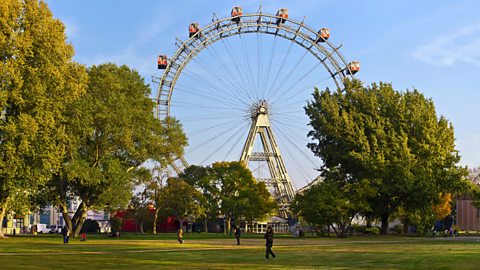
'Is there?' and 'Are there?'
When asking questions with es gibt, just swap the verb and the subject round, as you would with other verbs in the present tense:
- Gibt es eine Bank in der Nähe? – Is there a bank nearby?
- Was gibt es zu Mittag? – What’s for lunch?
- Was gibt es in Wien zu tun? – What can you do in Vienna?
Hilfsvokabeln - Helpful vocabulary
- die Sprache(f) – language
- nur (adv) – only
- unterschiedlich (adj) – different
- der Akzent (m) – accent
- beide (adj) – both
- die Hauptstadt (f) – capital city
Question
Test your knowledge of 'is' and 'have' in German. Translate this text into English. Then check your answers.
Die Schweiz hat drei offizielle Sprachen.
In Deutschland und Österreich gibt es nur eine offizielle Sprache - Deutsch - aber es gibt unterschiedliche Akzente.
In der Schweiz gibt es einen total anderen Akzent.
Österreich und die Schweiz sind beide kleiner als Deutschland.
Ihre Hauptstädte sind Wien und Bern.
Berlin ist die deutsche Hauptstadt.
Switzerland has three official languages.
In Germany and Austria there is only one official language - German - but there are different accents.
In Switzerland they have a completely different accent.
Austria and Switzerland are smaller than Germany.
Their capital cities are Vienna and Bern.
Berlin is the German capital city.
Did you know?
Three languages, one nation?

The four national languages of Switzerland are German, French, Italian and Romansh. Only German, French and Italian are considered to be the three official languages.
Swiss German – Schweizerdeustch – is the most widely spoken language in Switzerland. The German spoken in Bern is very different from that spoken in Vienna or Berlin.
Apart from accents, which vary as they do anywhere, the vocabulary may also be different.
For example, the word for 'cream'. If you order Kuchen or ein Eis and want cream with it, you have to order Schlagsahne or Schlagrahm in Germany, but Schlagobers in Austria or Switzerland.
