Mixtures
A Two or more substances that are not joined together. The substances can be elements, compounds, or both. contains different substances that are not chemically joined to each other. For example, a packet of sweets may contain a mixture of different coloured sweets. The sweets are not joined to each other, so they can be picked out and put into separate piles.
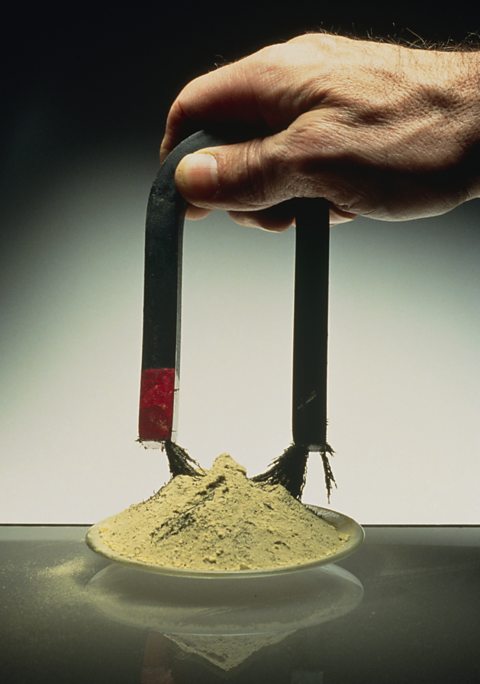
A mixture of iron filings and sulfur powder can easily be separated using a magnet. The iron filings are attracted to the magnet but the sulfur powder is not.
Dissolving
Dissolving is one way to make a mixture. For example, when salt is stirred into water, the salt dissolves in the water to make salt solution. In a solution:
- the substance that dissolves is called the The dissolved substance in a solution.
- the substance that the solute dissolves in is called the The liquid in which the solute dissolves to form a solution.
In salt solution, salt is the solute and water is the solvent. The particles of solute and solvent are completely mixed together.
Science presenter Jon Chase defines the terms solute, solvent and solution
In general, solids become more soluble as the temperature increases. This is why sugar dissolves better in hot water than in cold water.
A saturated solution is one in which no more solid can dissolve in the liquid at a given temperature. The concentration of a solution can be changed by changing the quantity of solvent or solute.
