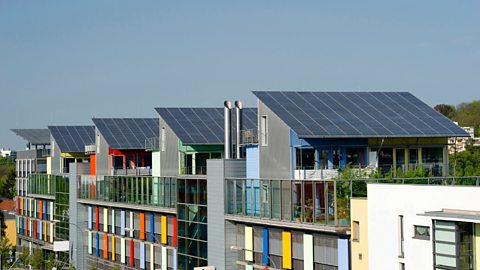
Germany's greenest city
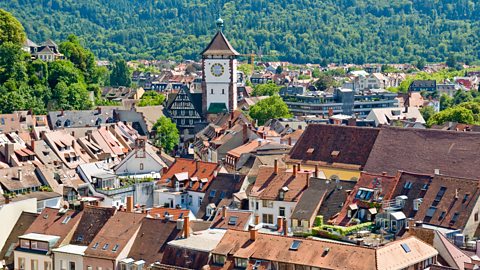
Freiburg im Breisgau is a small city in south-west Germany. With 2,000 hours of sunshine a year, it's Germany’s warmest city, and it has one of the oldest universities in the country. But Freiburg also has the reputation of being Germany’s greenest city – die umweltfreundlichste Stadt Deutschlands.
Hilfsvokabeln– Helpful vocabulary
- ausgezeichnet (adj) – honoured
- berühmt (adj) – famous
- dicht (adj) – dense
- fast (adv) – almost
- in der Nähe – near/close to
- das Radverkehrsnetz (nt) – cycle network
- rund (adv) – around (approximately)
- die Stadtbahnhaltestelle (f) – a tram stop
- das Tempolimit (nt) – speed limit
Question
Match up these German and English phrases which describe the German city of Freiburg.
| German | English |
| 1. Die Stadt Freiburg im Breisgau liegt in Süddeutschland. | A. Overall, 69 per cent of the total amount of waste is recycled in Freiburg. |
| 2. Es gibt ungefähr 220 000 Einwohner in Freiburg und Freiburg ist die viertgrößte Stadt in Baden-Württemberg. | B. The people of Freiburg want less traffic in the town centre and 70 per cent of all people live near a tram stop. |
| 3. Freiburg ist eine berühmte, umweltfreundliche Stadt und sie hat viele Umweltpreise gewonnen. | C. In 1970 there were almost no cycle paths. Today there is a dense, almost 420 kilometre long, cycle network. |
| 4. Freiburg hat ein sonniges und warmes Klima und ist für Solarenergie bekannt. | D. The transport policy in Freiburg is also environmentally-friendly. |
| 5. Insgesamt wird 69 Prozent der gesamten Abfälle in Freiburg recycelt. | E. The city of Freiburg im Bresgau is located in southern Germany. |
| 6. Die Verkehrspolitik in Freiburg ist auch umweltfreundlich. | F. Freiburg has a sunny and warm climate and is known for solar energy. |
| 7. 1970 gab es fast keine Radwege. Heute gibt es ein dichtes, rund 420 Kilometer langes Radverkehrsnetz. | G. Freiburg is a famous, environmentally-friendly city and it has won lots of environmental prizes. |
| 8. 90 Prozent der Freiburger wohnen in Straßen mit einem Tempolimit von 30 km/h oder weniger, das die Straßen sicherer für Kinder und Radfahrer macht. | H. There are approximately 220,000 inhabitants in Freiburg and Freiburg is the fourth largest city in Baden-Wurttemberg. |
| 9. Die Freiburger wollen weniger Verkehr in der Stadtmitte und rund 70 Prozent aller Menschen wohnen in der Nähe einer Stadtbahnhaltestelle. | I. 90 per cent of the people of Freiburg live in streets with a speed limit of 30km/h or less which makes the streets safer for children and cyclists. |
| German | 1. Die Stadt Freiburg im Breisgau liegt in Süddeutschland. |
|---|---|
| English | A. Overall, 69 per cent of the total amount of waste is recycled in Freiburg. |
| German | 2. Es gibt ungefähr 220 000 Einwohner in Freiburg und Freiburg ist die viertgrößte Stadt in Baden-Württemberg. |
|---|---|
| English | B. The people of Freiburg want less traffic in the town centre and 70 per cent of all people live near a tram stop. |
| German | 3. Freiburg ist eine berühmte, umweltfreundliche Stadt und sie hat viele Umweltpreise gewonnen. |
|---|---|
| English | C. In 1970 there were almost no cycle paths. Today there is a dense, almost 420 kilometre long, cycle network. |
| German | 4. Freiburg hat ein sonniges und warmes Klima und ist für Solarenergie bekannt. |
|---|---|
| English | D. The transport policy in Freiburg is also environmentally-friendly. |
| German | 5. Insgesamt wird 69 Prozent der gesamten Abfälle in Freiburg recycelt. |
|---|---|
| English | E. The city of Freiburg im Bresgau is located in southern Germany. |
| German | 6. Die Verkehrspolitik in Freiburg ist auch umweltfreundlich. |
|---|---|
| English | F. Freiburg has a sunny and warm climate and is known for solar energy. |
| German | 7. 1970 gab es fast keine Radwege. Heute gibt es ein dichtes, rund 420 Kilometer langes Radverkehrsnetz. |
|---|---|
| English | G. Freiburg is a famous, environmentally-friendly city and it has won lots of environmental prizes. |
| German | 8. 90 Prozent der Freiburger wohnen in Straßen mit einem Tempolimit von 30 km/h oder weniger, das die Straßen sicherer für Kinder und Radfahrer macht. |
|---|---|
| English | H. There are approximately 220,000 inhabitants in Freiburg and Freiburg is the fourth largest city in Baden-Wurttemberg. |
| German | 9. Die Freiburger wollen weniger Verkehr in der Stadtmitte und rund 70 Prozent aller Menschen wohnen in der Nähe einer Stadtbahnhaltestelle. |
|---|---|
| English | I. 90 per cent of the people of Freiburg live in streets with a speed limit of 30km/h or less which makes the streets safer for children and cyclists. |
- Die Stadt Freiburg im Breisgau liegt in Süddeutschland. – E. The city of Freiburg im Bresgau is located in southern Germany.
- Es gibt ungefähr 220 000 Einwohner in Freiburg und Freiburg ist die viertgrößte Stadt in Baden-Württemberg. – H. There are approximately 220,000 inhabitants in Freiburg and Freiburg is the fourth largest city in Baden-Wurttemberg.
- Freiburg ist eine berühmte, umweltfreundliche Stadt und sie hat viele Umweltpreise gewonnen. – G. Freiburg is a famous, environmentally-friendly city and it has won lots of environmental prizes.
- Freiburg hat ein sonniges und warmes Klima und ist für Solarergie bekannt. – F. Freiburg has a sunny and warm climate and is known for solar energy.
- Insgesamt wird 69 Prozent der gesamten Abfälle in Freiburg recycelt. – A. Overall, 69 per cent of the total amount of waste is recycled in Freiburg.
- Die Verkehrspolitik in Freiburg ist auch umweltfreundlich. – D. The transport policy in Freiburg is also environmentally-friendly.
- 1970 gab es fast keine Radwege. Heute gibt es ein dichtes, rund 420 Kilometer langes Radverkehrsnetz. – C. In 1970 there were almost no cycle paths. Today there is a dense, almost 420 kilometre long, cycle network.
- 90 Prozent der Freiburger wohnen in Straßen mit einem Tempolimit von 30 km/h oder weniger, das die Straßen sicherer für Kinder und Radfahrer macht. – I. 90 per cent of the people of Freiburg live in streets with a speed limit of 30km/h or less which makes the streets safer for children and cyclists.
- Die Freiburger wollen weniger Verkehr in der Stadtmitte und rund 70 Prozent aller Menschen wohnen in der Nähe einer Stadtbahnhaltestelle. – B. The people of Freiburg want less traffic in the town centre and 70 per cent of all people live near a tram stop.
Question
Choose one of these texts and translate it into English. Then check your answers.
Text one
- Ich wohne in einem Dorf und es ist sehr schön hier. Aber es gibt nichts für junge Leute hier. Es gibt kein Kino, keinen Jugendklub und kein Sportszentrum. Man muss immer in die Stadt fahren, um einen Film zu sehen oder sich mit Freunden zu treffen. Man sollte nicht mit dem Auto fahren, weil das Autoabgase produziert, aber was kann ich machen? Es gibt nur zwei Busse pro Tag und es gibt keine Fahrradwege. Es ist umweltfreundlicher in einer Stadt.
Text two
- Ich wohne nicht gern in der Stadt. Wir wohnen in der Nähe von dem Flughafen und es gibt zu viel Lärm von Flugzeugen. Es gibt immer zu viel Vekehr wegen des Flughafens und die Straßen sind voll mit Autos. Die Luft ist mit Autoabgasen verpestet und wenn ich Rad fahre, kann ich kaum atmen, weil es zu viel Luftverschmutzung gibt. Obwohl die Stadt sehr laut und schmutzig ist, versuche ich umweltfreundlich zu sein und ich recycle fast alles. Zu Hause trennen wir den Müll in drei Gruppen: Altglas, Altpapier und Restmüll, und wir kompostieren auch den Abfall. In der Zukunft werde ich wegziehen und ich möchte auf dem Land wohnen, wo die Luft sauber ist.
Text one
- I live in a village and it is very nice (pretty/beautiful) here. But there is nothing for young people here. There isn’t a cinema, a youth club or a sports centre (gym) (literally: There is no cinema, no youth club and no sports centre/gym). You always have to drive into town to watch a film or to meet friends. You shouldn’t drive a car because it produces exhaust fumes but what can I do? There are only two buses a day and there are no cycle paths. It is environmentally friendlier in a town.
Text two
- I don’t like living in the town/city. We live near (close to) the airport and there is too much noise from aeroplanes. There is always too much traffic because of the airport and the streets (roads) are full of cars. The air is polluted with exhaust fumes (car emissions) and when I cycle, (ride a bike) I can hardly breathe because there is too much air pollution. Although the town is very loud and dirty, I try to be environmentally-friendly and I recycle almost everything. At home we separate the rubbish into three groups: old glass, old paper and general rubbish (the rest) and we also compost the waste. In the future I will move away and I would like to live in the country (side) where the air is clean.
Did you know?
Freiburg was badly bombed during the Second World War and left in ruins. When the city was rebuilt, streets were widened to allow tram tracks to be laid, integrated cycle paths were built, and the city centre was completely pedestrianised. The local government has continued to develop the city into Germany’s greenest city and has attracted investment from solar industries and other environmental agencies.
All new houses in Freiburg must be energy-efficient. Recently, there has been an increase in the building of Passivhäuser. A ‘passive house’ has no active heating system. Instead, the house stores the heat from the sun through proper insulation, triple-glazed windows and good ventilation.
The Green Party – Bündnis90/Die Grünen – is the most popular political party in Freiburg. The Oberbürgermeister (mayor) of Freiburg was the first member of the Green Party to become the mayor of a large Germany city.