Environmentally-friendly transport
Fährst du umweltfreundlich? – Are you environmentally-friendly when you travel?
The environmental impact of transport should not be underestimated. Emissions of carbon dioxide are a major factor in causing air pollution and global warming.
Question
Read the following statements.
- flexibel
- das umweltschädlichste Verkehrsmittel
- bequemer ohne andere Fahrgäste zu fahren
- Es ist nötig, wenn man ins Ausland fahren will
- man muss vielleicht oftmals umsteigen
- Es gibt oft keinen Sitzplatz
- sie produzieren weniger Kohlendioxid
- klimafreundlich
- zuverlässig
Which statement applies to which mode of transport listed below?
- Autofahren
- öffentliche Verkehrsmittel
- das Fliegen
Autofahren
- flexibel – flexible (it means you can travel when you want)
- bequemer ohne andere Fahrgäste zu fahren – more comfortable travelling without other passengers
- zuverlässig – reliable
öffentliche Verkehrsmittel
- es gibt oft keinen Sitzplatz – often there are not enough seats
- man muss vielleicht oftmals umsteigen – you might have to change often
- sie produzieren weniger Kohlendioxid – they produce less carbon dioxide
- klimafreundlich – climate friendly
das Fliegen
- das umweltschädlichste Verkehrsmittel – the most environmentally-damaging mode of transport
- es ist nötig, wenn man ins Ausland fahren will – it is necessary when you want to travel abroad
Question
Read these German sentences about the pros and cons of using a car and then complete the English sentences with the correct information.
German
- Die Busse sind oft spät und teuer.
- Es gibt oft Staus.
- Autos sind schneller als öffentliche Verkehrsmittel.
- Man braucht ein Auto, wenn man in einem Dorf wohnt.
- Es ist teuer in die Stadtmitte zu parken.
- Wenn das Wetter nicht gut ist, ist ein Auto praktischer als ein Fahrrad.
- Autos produzieren Autoabgase, die gefährlich für die Umwelt sind.
English
- Buses are often __________ and __________.
- There are often __________ __________.
- __________ are __________ than __________ __________.
- You need a __________, when you live in a __________.
- It is __________ to __________ in the __________.
- When the __________ is not good, a __________ is more practical than a __________.
- Cars produce __________ __________ which are __________ for the __________.
- Buses are often late and expensive.
- There are often traffic jams.
- Cars are faster than public transport.
- You need a car when you live in a village.
- It is expensive to park in the town centre.
- When the weather is not good, a car is more practical than a bike.
- Cars produce exhaust fumes which are dangerous for the environment.
Did you know?
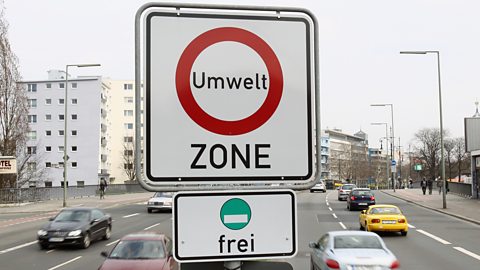
In order to prove acceptable emission levels, car owners are required to display a special badge – eine Umweltplakette – on their windscreens to be able to enter the green zone – die Umweltzone – in many German cities and towns.
This law applies to everyone, including tourists, who drive in Germany. Failing to display the badge can result in a fine – eine Geldstrafe.
Similar schemes exist in other German-speaking countries. All lorries driving in and around the Austrian capital of Vienna – Wien – are required by law to display stickers which show the emission levels produced by the vehicle.
In Switzerland, all cars must be tested for emission levels before they can be registered. An anti-pollution certificate must be kept in the vehicle at all times.