The gurdwara and the scriptures
A day in the life of Prem, a young, Sikh, physiotherapy student
The gurdwara
The Sikh place of To show devotion to God and/or religion through actions - for example, prayer. is known as the Sikh place of worship. Literally, the 'doorway to the Guru'.. This translates to ‘the door of the Guru’. The gurdwara can be recognised from the Sikh triangular flag., which is an orange flag displayed outside the building. The flag has a blue Symbolises the Sikh faith: it shows a double-edged sword, a chakram and two single-edged swords. on it, which is the symbol of Sikhism.
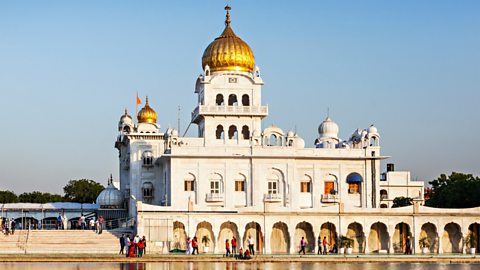
Wherever possible, there are four entrances to the gurdwara to represent the fact that all humanity is welcome. There is always a light on within the gurdwara to reflect the belief that Sikhs believe in one God called Waheguru which means ‘Wonderful Lord’ or ‘Wonderful Teacher’. is always present and available to anyone who might need comfort.
There are no pictures or representations of Waheguru within the gurdwara. To try to create Waheguru in the form of pictures would be seen as The worship of an idol, object or person instead of God..
The Guru Granth Sahib
The The Guru Granth Sahib is the most important Sikh holy book. It is a collection of songs, prayers and hymns from the Sikh Gurus and other holy men, as well as teachings from other faiths. It is treated as a living Guru. is the Sikh holy scripture. Sikhism teaches that it is the word of God and therefore Cannot make mistakes and is not flawed.. Many Sikhs believe that the Guru Granth Sahib is the Eternal Guru, and the word of God within the Guru Granth Sahib will be forever important. The Guru Granth Sahib is what gives the gurdwara its religious status. Therefore, any building that holds the Guru Granth Sahib is known as a gurdwara.
For Sikhs, the most important aspect of their religion is The Sikh belief that there is one God.. Therefore, there are no religious pictures, idols or statues within the gurdwara. The focus of worship within the gurdwara is the Guru Granth Sahib. A key feature of the gurdwara is found within the The prayer hall in the gurdwara, which is the Sikh place of worship.. Here the Guru Granth Sahib is placed on a raised platform under a canopy, in order to show respect for it. This means that the Guru Granth Sahib is higher than the Congregation in a Sikh gurdwara. when they are sitting on the floor as part of worship.
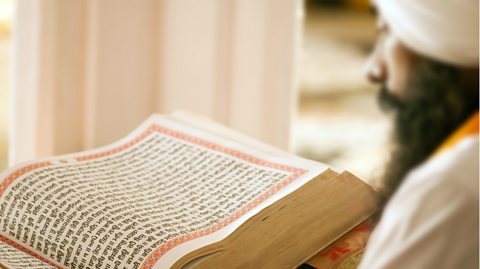
Respect for the Guru Granth Sahib must be shown in the following ways:
- Sikhs wear head coverings inside the gurdwara and in the presence of the Guru Granth Sahib.
- Sikhs remove their shoes and wash their hands before entering the gurdwara.
- The Guru Granth Sahib is placed on a Raised dais or platform on which the Guru Granth Sahib is placed in the gurdwara.. This is under the A small bed on which the Guru Granth Sahib is placed in the prayer hall. It has a wooden frame covered with webbed material, with three pillows and a white cloth. The Guru Granth Sahib rests upon the pillows. .
- The sangat sit on the floor in the darbar sahib to ensure their heads are not higher than the Guru Granth Sahib.
- Sikhs make offerings to the Guru Granth Sahib when they enter the prayer hall.
- Sikhs never turn their backs on the Guru Granth Sahib.
- A Reader of the Guru Granth Sahib, who officiates at ceremonies. This can be a man or a woman. is an appointed reader of the Guru Granth Sahib. When the Guru Granth Sahib is being read, a Fan waved over scriptures, made of yak hairs or nylon; symbol of the authority of the Guru Granth Sahib., which is a special fan made from yak hair, is waved above it.
- The Guru Granth Sahib is placed in a separate room at night and put to bed.
