Pentonville prison
- Pentonville prison was built in London in 1842 and became the model on which 90 new prisons in Britain were based between 1842 and 1877 in Britain.
- Pentonville was built to house the increasing number of criminals who were no longer being To send a convicted criminal to a prison camp overseas, such as in America or Australia. to Australia or executed.
- Pentonville prison aimed to Punishment that should put people off committing crime. and reform criminals. It was also intended to be a tough system of punishment that gave society confidence that prisoners were being punished for their crimes.
The separate system
Prisoners at Pentonville prison spent nearly all their time alone and in their cells, for as many as 23 hours in each day. This was called the separate system, and it was developed to keep prisoners away from other inmates. The aim of this system was to keep prisoners away from the bad influences of other prisoners and allow time for them to reflect on their crimes.
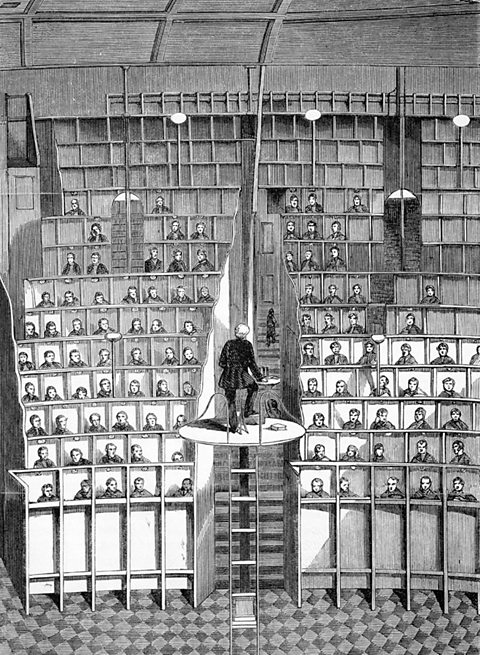
Every part of the prison was designed to isolate prisoners, with thick walls and repetitive work tasks. When prisoners were in their cells, they would sleep on a hammock and perform hard work, such as weaving on a loom or breaking rocks. Prisoners were given time outside to exercise, but they wore masks so that they could not see anyone. They also had to hold a rope at intervals to stop them from communicating with the other prisoners.
Criticism of the separate system
The separate system prevented prisoners from mixing and being negatively influenced by one another. However, this system placed inmates in solitary confinement, which had a negative impact on their mental health. Prisoners who had been confined on their own often suffered from depression and Losing contact with reality and becoming delusional. Many prisoners died by suicide. The separate system also proved expensive as prisoners had to be housed in separate cells.
The silent system
In the late 19th century, there was a growing fear in Britain of more serious and violent crime. By the 1860s, there was some demand for tougher conditions in prisons. This was because prisons were being used to punish the most serious criminals as they were no longer hanged or transported. Some people believed that there was a ‘criminal type’ who could not be reformed and so needed to be The action of discouraging someone from doing something or preventing something from happening - often by creating a fear of the consequences. by tougher prisons.
The government responded by introducing tougher conditions in prisons as part of the 1865 Prisons Act. The new measures included the silent system, in which:
- prisoners were expected to be always silent and were whipped if they broke this rule
- prisoners were forced to sleep on hard wooden bunks, rather than hammocks
- prisoners were expected to take part in hard and often pointless labour, such as turning the crank, walking on a giant treadmill and unpicking lengths of old ships’ rope to make string
- food was dull and repetitive
These conditions marked a change in prisons as they were no longer intended to reform prisoners.
More guides on this topic
- Crime and punishment in Britain overview - Edexcel
- Crime and punishment in medieval England, c.1000-c.1500 - Edexcel
- Crime and punishment in early modern England, c.1500-c.1700 - Edexcel
- Crime and punishment in modern Britain, c.1900 - Edexcel
- Crime and punishment in Whitechapel, c.1870-c.1900 - Edexcel
