Change and continuity in law enforcement, c.1700-c.1900
For hundreds of years, the local community had been responsible for patrolling the streets and catching criminals. In the early 18th century, policing continued to be carried out by:
- parish constables - who dealt with minor crimes
- watchmen - who kept an eye on private property
- soldiers - who dealt with more serious incidents, such as rebellions and riots
This changed in the 19th century, when Britain’s first professional and full-time police force was established in London.
The Bow Street Runners
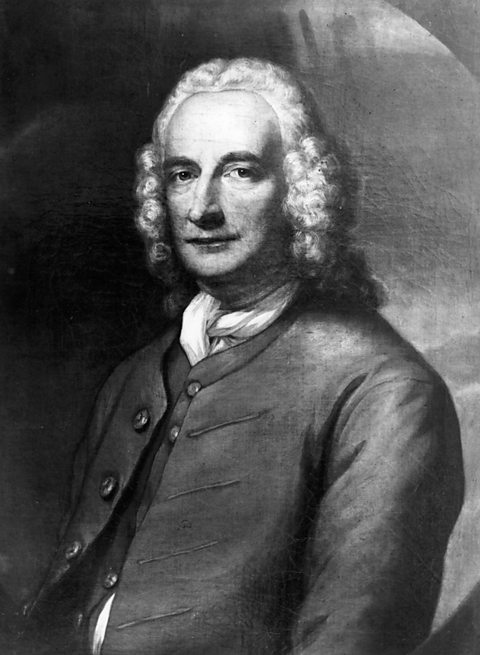
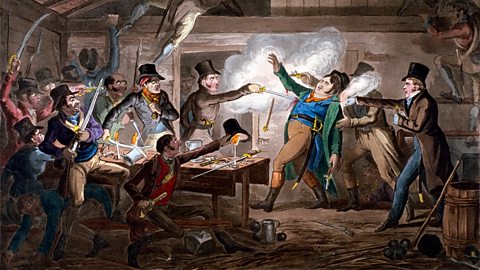
The first attempt to improve policing in London was made by brothers Henry and John Fielding, who were A judge who hears cases in court. at Bow Street Magistrates Court. In 1748 they decided that more men were needed on London’s streets to deter criminals. They established the Bow Street Runners.
The Bow Street Runners were a group of volunteers that patrolled London’s streets in the evening. The aim of their presence was to prevent crime, but they also investigated crimes and presented evidence in court for a cost. Thief takers were the main officials. In 1754, the Bow Street Runners introduced fees and began to collect rewards from victims if they were successful in achieving a conviction. By 1785, the Bow Street Runners were paid directly by the government.
The Fielding brothers introduced a horse patrol around London to stop highwaymen and contributed to the end of Using force or the threat of force to steal money or property from travellers on the roads. Additionally, the Fielding brothers published information about crime, criminals and stolen goods in a newspaper called The Public Hue and Cry. This enabled information to be shared across the country because magistrates and gaolers would pass the newspaper on when they travelled.
The impact of the work of the Fielding Brothers
The Fielding brothers were the first to contribute to an organised system of preventing crime and street policing in London in the 18th century. Their objectives were The action of discouraging someone from doing something or preventing something from happening - often by creating a fear of the consequences. being organised and collecting surveillance. Their success led to the Middlesex and Westminster detective offices being set up. In 1792, the Middlesex Justices Act established further offices, each with six constables employed to detect crimes and arrest suspects.
However, by 1800, there was still no official government organised system of constables, watchmen or runners due to the cost and impact of increased taxation. In addition, many people in Britain were concerned that a government-provided police force could be used to tell them what to do and limit their freedom.
The Metropolitan Police
The Metropolitan Police Act was introduced in Parliament by the Home Secretary, Sir Robert Peel, in 1829. It applied only to London, where it replaced the system of watchmen and parish constables with a larger professional and full-time police force. The aim of this police force was to deter crime by having a presence on the streets.
The police uniform was a blue overcoat with tails that represented ‘service’ and a top hat that represented ‘authority’. It was designed to look civilian rather than military, so that the police would be seen as different from the army. This was because some people were worried that the new police force would try to control people. They deliberately looked and behaved differently from the army and didn’t carry firearms.
A range of reasons explain why the Metropolitan Police were introduced in 1829:
- The Home Secretary, Sir Robert Peel, was determined to reduce the amount of crime and persuaded other politicians that a police force could do this without reducing people’s freedom.
- The British government was gradually becoming more involved in people’s lives and was able to use taxes to pay for the police force.
- Most people were concerned that crime was increasing and supported the introduction of the police force.
- The government and landowners feared unrest in Britain after the French Revolution and supported the use of a police force to maintain order.
- Constables and watchmen found it difficult to patrol the streets in growing cities, such as London. This led residents to support a larger and professionally paid police force.
Policing after 1829
The success of the Metropolitan Police in London led to further changes across Britain:
| Year | Development |
| 1835 | Towns were allowed to set up their own police forces under the Municipal Corporations Act. |
| 1839 | In London, the Bow Street Runners and the Metropolitan Police joined together. Under the County Police Act , counties across Britain were allowed to set up their own police forces and employ one officer per 1,000 people. |
| 1842 | The Metropolitan Police introduced a detective unit to investigate and solve crime. This was called the Criminal Investigation Department (CID) and it employed 200 detectives. |
| 1856 | The police force was no longer regarded with suspicion. It became compulsory for all towns and counties to set up a police force. |
| 1869 | A national crime records system was set up to save and share information about crime across the different police forces. |
| 1878 | The Metropolitan Police detective unit was reorganised into the CID and this system was used across Britain. |
| Year | 1835 |
|---|---|
| Development | Towns were allowed to set up their own police forces under the Municipal Corporations Act. |
| Year | 1839 |
|---|---|
| Development | In London, the Bow Street Runners and the Metropolitan Police joined together. Under the County Police Act , counties across Britain were allowed to set up their own police forces and employ one officer per 1,000 people. |
| Year | 1842 |
|---|---|
| Development | The Metropolitan Police introduced a detective unit to investigate and solve crime. This was called the Criminal Investigation Department (CID) and it employed 200 detectives. |
| Year | 1856 |
|---|---|
| Development | The police force was no longer regarded with suspicion. It became compulsory for all towns and counties to set up a police force. |
| Year | 1869 |
|---|---|
| Development | A national crime records system was set up to save and share information about crime across the different police forces. |
| Year | 1878 |
|---|---|
| Development | The Metropolitan Police detective unit was reorganised into the CID and this system was used across Britain. |
More guides on this topic
- Crime and punishment in Britain overview - Edexcel
- Crime and punishment in medieval England, c.1000-c.1500 - Edexcel
- Crime and punishment in early modern England, c.1500-c.1700 - Edexcel
- Crime and punishment in modern Britain, c.1900 - Edexcel
- Crime and punishment in Whitechapel, c.1870-c.1900 - Edexcel
