Change and continuity in punishment, c.1700-c.1900
Ideas about the purpose of punishment changed throughout the years c.1700 to c.1900. More people believed that the punishment given should fit the crime committed. Ideas about punishment changed from believing it should act as a A thing that discourages or is intended to discourage someone from doing something. to believing criminals should be given the opportunity to To make changes to something or someone, for improvement. and be To restore someone to a normal life. To make someone better, or to get someone to recover from something.
The end of the Bloody Code
The Bloody Code was abolished in the early 19th century by the reforms of Sir Robert Peel, who was Home Secretary in the 1820s. By 1841, only murder and To betray or plot against the government or monarchy. remained capital crimes, which means they were punishable by the death penalty. A group of people (usually 12 in number) who listen to the facts of a case in a court and give their verdict. in Britain were unwilling to find people guilty of crimes when they thought the punishment would be too harsh. This led to criminals feeling more confident that they would escape punishment for crime, and as a result the crime rate increased in the 18th century. It was recognised that the Bloody Code was too harsh and no longer acted as a deterrent against crime.
Public executions were also no longer providing the opportunity to deter others from crime. Instead:
- they became forms of entertainment - where drunk and disorderly crowds might form
- the large crowds became difficult to manage
- the gatherings began to attract crime - providing opportunities for Stealing money or other valuables from someone's pocket, bag or person without them noticing. and prostitution
The use of transportation
By the late 18th century, To send a convicted criminal to a prison camp overseas, such as in America or Australia. had become the most frequently used punishment in Britain. Convicts were held in A disused warship that was used as a temporary prison. before being transported to Australia to help settle the newly discovered land. Transportation was seen as a good alternative to the death penalty because it was still a serious punishment. About 160,000 people were transported to Australia, of which one in six were women.
The British authorities were in favour of transportation because:
- They believed it would deter criminals and be a successful punishment.
- They believed it was a more humane alternative to the death penalty, so juries were more likely to convict criminals.
- They believed it would reduce crime in Britain by removing criminals.
- They believed it would help to reform criminals through hard work.
- Britain didn’t have prisons designed to hold the large numbers being convicted in courts.
- Prisoners would be useful sources of labour to build and later populate colonies.
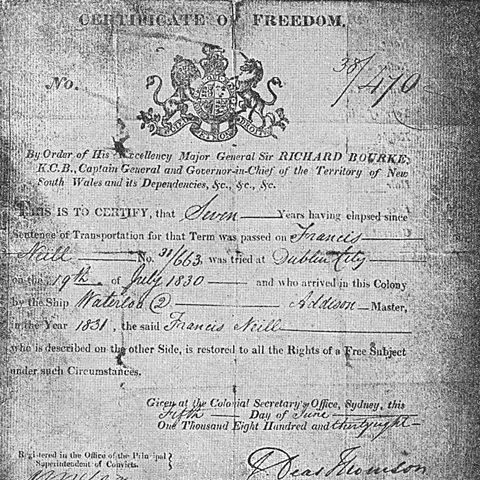
Transportation was used as a punishment for theft, and especially for those who had committed more than one offence. The government also used transportation to punish those who had taken part in political protests, but these only made up a small number of the overall criminals transported.
Once in Australia, the convicts were assigned to a master, whom they had to work for. Good behaviour and hard work gave the convicts the opportunity of early release.
If convicts continued to commit crime, they were whipped. Prisoners who failed to complete their sentence and returned to Britain without permission were sentenced to death.
The end of transportation
The use of transportation began to decline in the 1840s and officially ended in 1868. People argued that transportation should no longer be used as a punishment because:
- It was seen wrongly by some as a holiday to a warmer country.
- It was seen as an opportunity for convicts because wages were higher in Australia.
- Settlers in Australia were unhappy that convicts were being sent there, as it was feared it would lead to increased crime rates once the convicts were released and entered into society.
- The use of transportation did not lead to a decrease in crime in Britain.
- Transportation was costing the British government millions of pounds every year. Maintenance of transported people in Australia was also costing more than planned.
- Australia was becoming a popular place to settle.
Prisons were cheaper to run and replaced the use of transportation as a punishment.
More guides on this topic
- Crime and punishment in Britain overview - Edexcel
- Crime and punishment in medieval England, c.1000-c.1500 - Edexcel
- Crime and punishment in early modern England, c.1500-c.1700 - Edexcel
- Crime and punishment in modern Britain, c.1900 - Edexcel
- Crime and punishment in Whitechapel, c.1870-c.1900 - Edexcel
