Responses to plague - national government
Although there was still a lack of understanding of the real causes of plague, governments were more proactive in trying to prevent its spread during this period. Some of the measures they took were effective.
Isolation (1518)
In 1518, Henry VIII introduced the policy of As part of medical or public health measures - the act of keeping people who are infected, or are thought to be infected, with a contagious disease away from uninfected people. in London. His order stated that:
- Houses infected with the plague should be clearly identified.
- Bundles of straw should be hung from the windows of infected houses for a period of 40 days.
- If anyone left the house, they had to carry a white stick so that people knew to avoid them in the streets.
Mayors in other English towns followed this example and took their own action to shut up infected houses. Some areas started to introduce ‘pesthouses’, which were buildings outside the city walls where plague victims were placed in A period of time during which a person is isolated due to a contagious disease - to prevent the disease being passed to other people.
1578 Plague Orders
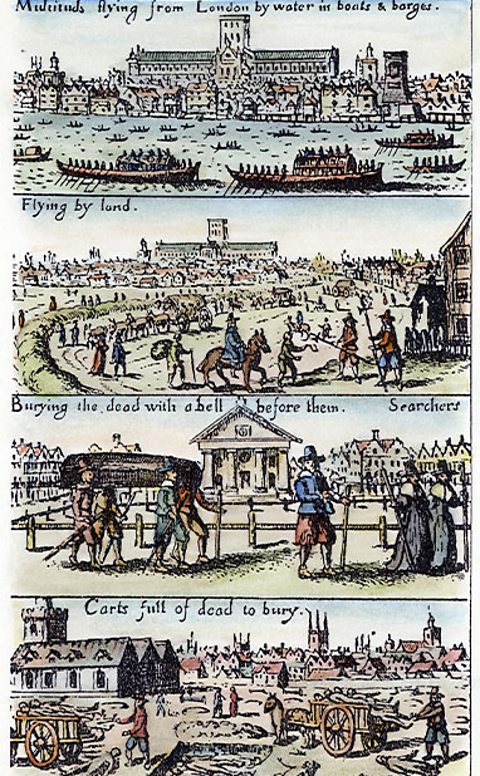
Elizabeth I’s 1578 Plague Orders were a list of 17 national orders that had to be enforced by Someone responsible for maintaining law and order in a county. Often abbreviated to JP. during an outbreak. The new printing press was used to send the orders to all towns and counties. The orders were posted on doors and in public places for people to read.
The orders went further than Henry VIII’s proclamation and included the following measures:
- Parishes had to appoint ‘viewers’ or ‘searchers’ and report on how the infection was spreading.
- People who assisted mayors in running towns and cities. had to collect money to support the sick in their town.
- Infected houses in towns had to be completely shut up for at least six weeks, with all members of the family still inside regardless of whether they were sick or healthy. Watchmen were appointed to enforce this order.
- Streets had to be cleaned and cleared of dogs, cats and pigeons.
- Barrels of tar had to be burned in the streets to clear smells.
- Churches had to say special prayers.
- The bedding and clothing of plague victims had to be burned.
1604 Plague Act
James I’s 1604 Plague Act extended the financial help available to sick families and introduced harsh punishments for anyone breaking the policy of isolation. For example, a plague victim found out of their house mingling with others risked being hanged.
The effectiveness of the government's response to plague
Ways these measures were effective
- Isolation policies would have been effective in cases of pneumonic plague, where the disease is airborne and transmitted through coughs and sneezes.They would also have helped if - as some historians think - fleas from humans and body lice were capable of carrying plague.
- Cleaning the streets was helpful for general hygiene. It may also have helped to control the rat population, which would have been useful in controlling the spread of the plague.
Limits to the effectiveness of these measures
- Nobody knew that fleas on rats were carrying the disease, so there was a limit to the effectiveness of these measures. Several plague orders show that people believed that Smells from decomposing material, such as animal and human waste, that were thought to cause disease. and God were among the causes.
- The measures were not enough to prevent the deaths of thousands of people in this period. In the final outbreak of plague in England - the Great Plague of 1665 - about 100,000 people died in London. This was around 20 per cent of the city’s population.
