Changes in the accusative case
Here is a table showing the changes in the accusative case with the The definite article goes before a noun and indicates that the person, place or thing can be identified, ie is specific. In English it would be 'the' or 'this', eg I took the suitcase on holiday. and the The indefinite article goes before a noun and indicates that the person, place or thing cannot be identified, ie it could be one of many. In English it would be 'a' or 'an', eg I took a suitcase on holiday..
Note that the only words that change their form in the accusative case are the masculine words, ie the der words. All the other forms are the same as the nominative case.
| Definite | Indefinite | |
| Masculine | den | einen/keinen |
| Feminine | die | eine/keine |
| Neuter | das | ein/kein |
| Plural | die | ––/keine |
| Masculine | |
|---|---|
| Definite | den |
| Indefinite | einen/keinen |
| Feminine | |
|---|---|
| Definite | die |
| Indefinite | eine/keine |
| Neuter | |
|---|---|
| Definite | das |
| Indefinite | ein/kein |
| Plural | |
|---|---|
| Definite | die |
| Indefinite | ––/keine |
The following words change in the same way as ein and kein:
- mein – my
- dein – your (informal, singular)
- sein – his
- ihr – her
- unser – our
- euer – your (informal, plural)
- Ihr – your (formal, singular and plural)
- ihr – their
In these examples, the object (accusative) is written in bold text.
Masculine form in the accusative
- Ich habe den Zwiebelkuchen bestellt. - I ordered the onion tart.
The onion tart was ordered by me (ich).
- Ich habe einen Zwiebelkuchen bestellt. - I ordered an onion tart.
An onion tart was ordered by me (ich).
Feminine form in the accusative
- Meine Mutter möchte die Aprikose. - My mother would like the apricot.
The apricot would be liked by my mother.
- Meine Mutter möchte eine Aprikose. - My mother would like an apricot.
An apricot would be liked by my mother.
Neuter form in the accusative
- Claudia isst das Brötchen. - Claudia is eating the bread roll.
The bread roll is being eaten by Claudia.
- Claudia isst ein Brötchen. - Claudia is eating a bread roll.
A bread roll is being eaten by Claudia.
Plural form in the accusative
- Der Hund frisst die Pfifferlinge. - The dog is eating the mushrooms.
The mushrooms are being eaten by the dog.
Did you know?
Seasonal food is celebrated all year round in the German-speaking countries.
Spargel (asparagus) is available in almost every restaurant until Johannistag on 24 June. It is traditionally eaten with ham and new potatoes – Schinken und Kartoffeln. It's planted deep in the ground where it's deprived of light, so remains white in colour as no chlorophyll is produced to turn it green.
Pfifferlinge are trumpet-shaped mushrooms which are served in restaurants from June to September.
In July, the Austrian town of Wachau holds an apricot festival. The usual word for an apricot is Aprikose, but the word Marille is more common in Austria. The Marillenknödel (apricot dumpling) is a typical dish in Austria.
Zwiebelkuchen (onion tart) is very popular in autumn – im Herbst – in southern Germany, Switzerland and the south Tyrol.
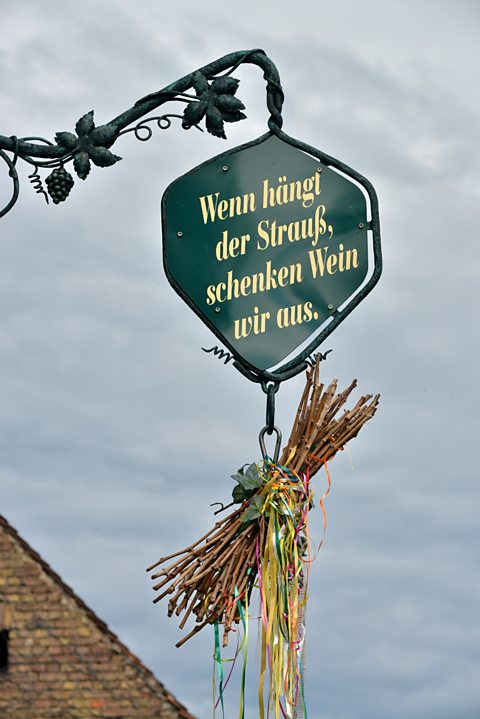
At certain times of the year, local farmers open up their farmhouses and set up temporary eateries to sell their own produce directly. Known as a Strausse or a Strausswirtschaft, a decorated broom – Besen – at the entrance indicates when they are open to the public.
