Practise using the dative
Hilfsvokabeln– Helpful vocabulary
- erzählen – to tell/explain (to)
- geben – to give (to)
- gehören – to belong (to)
- helfen – to (give) help (to)
- passieren – to happen (to)
- schenken – to give (to someone as a present)
- zeigen – to show (to)
Pronouns in the dative case
In the dative case the personal pronouns are:
| German | English |
| mir | me |
| dir | you (singular, informal) |
| ihm | him |
| ihr | her |
| ihm | it |
| uns | us |
| euch | you (plural, informal) |
| Ihnen | you (singular or plural, formal) |
| ihnen | them |
| German | mir |
|---|---|
| English | me |
| German | dir |
|---|---|
| English | you (singular, informal) |
| German | ihm |
|---|---|
| English | him |
| German | ihr |
|---|---|
| English | her |
| German | ihm |
|---|---|
| English | it |
| German | uns |
|---|---|
| English | us |
| German | euch |
|---|---|
| English | you (plural, informal) |
| German | Ihnen |
|---|---|
| English | you (singular or plural, formal) |
| German | ihnen |
|---|---|
| English | them |
- Sie hat ihm ein Andenken von Berlin geschenkt. – She gave (to) him a souvenir from Berlin.
She is giving a souvenir to him, so 'to him' is the indirect object and must be in the dative case.
- Kannst du mir helfen? – Can you help me? (Can you give help to me?).
After helfen you need to use the dative case. Me in the dative case is mir.
Dative prepositions
You also use the dative case after certain prepositions:
- aus – out of, made from
- außer – except for
- bei – at the house of, at
- gegenüber – opposite
- mit – with, by (transport)
- nach – after, to (a place)
- seit – since
- von – from, of, by
- zu – to
Examples in use:
- Nach dem Besuch (m) im Museum haben wir viele Andenken gekauft. – After the visit to the museum, we bought lots of souvenirs.
- Sie ist mit der Straßenbahn (f) gefahren. – She travelled by tram.
- Ich bin seit dem Wochenende (nt) in Berlin. – I have been in Berlin since the weekend.
- Ich habe viele Geschenke von meinen Freunden (pl) bekommen. – I got a lot of presents from my friends.
Question
Look at these sentences and fill in the gap with the dative case.
Key: (m) = masculine, (f) = feminine, (nt) = neuter, (pl) = plural
- Til schenkte __________ Freundin (f) ein Poster von Berlin. – Til gave his girlfriend a poster of Berlin.
- Sie konnte _____ Mann (m) nicht helfen. – She could not help the man.
- Die Tasche gehörte _____ Kind. (nt) – The bag belonged to the child.
- Ich habe _____ Taxifahrer (m) viel Trinkgeld gegeben. – I gave the Taxi driver a tip.
- Mia schenkt _____ Freunden (pl) viel Schokolade. – Mia gives her friends lots of chocolate.
- Was hast du _____ Reiseleiter (m) gesagt? – What did you say to the tour guide?
- Wir zeigen _____ Schülern (pl) die Reste der Berliner Mauer. – We are showing the pupils the remains of the Berlin Wall.
- Was ist __________ Tante (f) in Berlin passiert? – What happened to your aunt in Berlin?
- Til schenkte seiner Freundin ein Poster von Berlin.
- Sie konnte dem Mann nicht helfen.
- Die Tasche gehörte dem Kind.
- Ich habe dem Taxifahrer viel Trinkgeld gegeben.
- Mia schenkt ihren Freunden viel Schokolade.
- Was hast du dem Reiseleiter gesagt?
- Wir zeigen den Schülern die Reste der Berliner Mauer.
- Was ist deiner Tante in Berlin passiert?
Did you know?
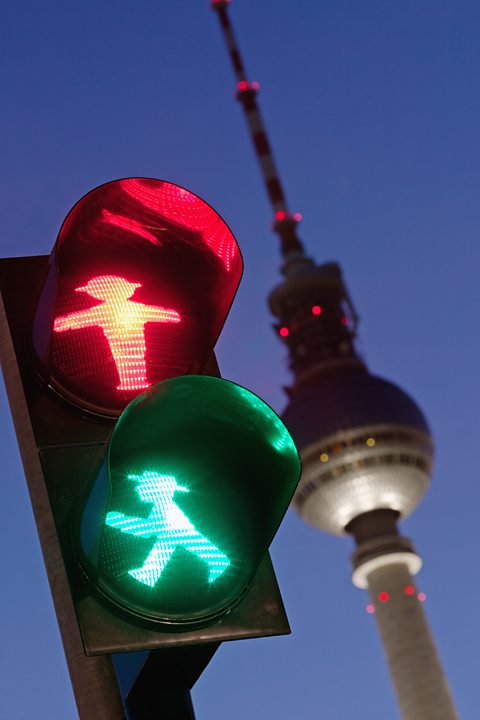
If you visit Berlin, you can buy all sorts of souvenirs – Andenken.
When Germany was divided into East and West Germany, there were two different forms of Ampelmännchen (literally: little traffic light men) used on pedestrian crossings. The main difference was that the Ampelmännchen in the east wore little hats.
After the reunification of Germany, many things from everyday life in East Germany disappeared, but the Ampelmännchen survived and are a much-loved symbol in Berlin, with images of them emblazoned on countless souvenirs.
The Bear – der Bär – is the symbol of Berlin and colourful little bears are also a popular souvenir. Life-sized sculptures of painted bears can be seen all over the city. The raised arms of the bear symbolise openness and friendliness – Offenheit und Freundlichkeit.
You can also bring back remnants of the Berlin Wall – die Reste der Berliner Mauer – which divided East and West Berlin between 1961 and 1989.
