Holiday preferences
Not everyone enjoys the same types of holidays, so it's important to be able to name your travel preferences.
Using 'gern'
One of the easiest ways to say that you like something in German is to put the word gern directly after the verb.
- Wir fahren gern in die Berge. – We like going to the mountains.
- Wir gehen gern zelten/campen. – We like going camping.
- Wir machen gern eine Kreuzfahrt. – We like going on a cruise.
- Wir fahren gern auf das Land. – We like going to the countryside.
Question
Match the English sentences with the German.
Remember to count on A word that is related to a word in another language. A cognate looks or sounds similar to a word in another language and also has the same meaning, eg Name (German) and name (English); Nord (German) and north (English); Computer (German) and computer (English). when translating.
To improve your pronunciation, repeat the sentences after hearing them.
1. Wir machen einen Strandurlaub.
2. Wir fahren gern ins Ausland.
3. Wir machen gern einen Skiurlaub.
4. Wir machen gern eine Stadttour.
5. Wir verbringen den Urlaub bei Verwandten.
6. Wir verbringen den Urlaub bei Freunden.
- A. We spend the holidays staying with friends.
- B. We like going on a city break.
- C. We like to go on a ski break.
- D. We spend the holidays staying with relatives/family.
- E. We like to go to on a beach holiday.
- F. We like to go abroad.
- Wir machen gern einen Strandurlaub. – E. We like to go to on a beach holiday.
- Wir fahren gern ins Ausland. – F. We like to go abroad.
- Wir machen gern einen Skiurlaub. – C. We like to go on a ski break.
- Wir machen gern eine Stadttour. – B. We like going on a city break.
- Wir verbringen den Urlaub bei Verwandten. – D. We spend the holidays staying with relatives/family.
- Wir verbringen den Urlaub bei Freunden. – A. We spend the holidays staying with friends.
Did you know?
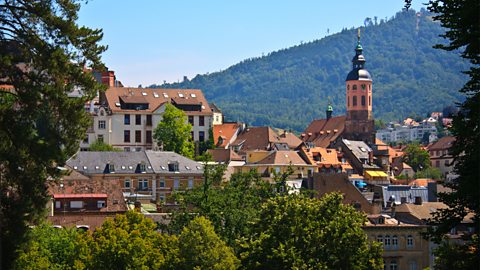
There is a long tradition in German-speaking countries of visiting a spa town, known as Kurort or Heilbad, in order to relax – sich entspannen – and bring about a sense of wellbeing. Certain towns were selected as spa towns based on their natural hot springs, minerals and thermal baths, dating back to Roman times.
The word 'spa' in German translates to Bad, a cognate with the English word 'bath', like the English spa town Bath. Many German towns include the word Bad in their names.
One of Germany's most well-known spa towns is Baden-Baden. Originally called just Baden, the town was renamed to distinguish it from other places of the same name, especially Baden near Zürich in Switzerland and Baden near Vienna, Austria. So Baden-Baden means 'the spa (or baths) in the Baden area'.