Questions about holidays
When discussing holidays, you may want to ask someone the following questions:
Wohin fährst du auf Urlaub?– Where do you (singular) go on holiday?
Wohin fahren Sie in den Urlaub?– Where do you (polite) go on holiday?
Wohin fahrt ihr auf Urlaub?– Where do you (plural) go on holiday?
Using 'nach' (to)
When answering the questions, remember to use nach to mean 'to' in front of countries and places that have no The definite article goes before a noun and indicates that the person, place or thing can be identified, ie is specific. In English it would be 'the' or 'this', eg I took the suitcase on holiday. in front of them, eg
- Nizza > nach Nizza – to Nice (place with no definite article)
- Spanien > nach Spanien – to Spain (country with no definite article)
Using 'in' (to)
But with countries that do have an article as part of the name, eg die Schweiz or die Türkei, you must use in with the accusative case to mean 'to', eg
- in die Schweiz – to Switzerland (literally: into the Switzerland)
- in die Türkei – to Turkey (literally: into the Turkey)
Remember that in can also mean 'in' but needs to be followed by the dative case if the country following it has a definite article:
- Griechenland > nach Athen in Griechenland – to Athens in Greece (place + country without definite article)
- die Türkei > nach Antalya in der Türkei – to Antalya in Turkey (place + country with definite article)
- die Schweiz > nach Basel in der Schweiz – to Basel in Switzerland (place + country with definite article)
Question
Look at the labels on the map and try asking and answering questions about holiday destinations.
Example
- Informal - A
Q: Wohin fährst du auf Urlaub?
A: Ich fahre nach Chicago in Amerika.
Using the pattern in the example, create your own questions and answers:
- Informal, singular - L
- Formal - F
- Informal, plural - J
- Informal, singular - C
- Formal - D
Informal, singular - L
Q: Wohin fährst du in den Urlaub?
A: Ich fahre nach Budapest in Ungarn.
Formal - F
Q: Wohin fahren Sie auf Urlaub?
A: Ich fahre nach Nizza in Frankreich.
Informal, plural - J
Q: Wohin fahrt ihr in den Urlaub?
A: Wir fahren nach Warschau in Polen
Informal, singular - C
Q: Wohin fährst du auf Urlaub?
A: Ich fahre nach Eindhoven in der Niederlande.
Formal - D
Q: Wohin fahren Sie auf Urlaub?
A: Ich fahre nach Genf in der Schweiz.
Did you know?
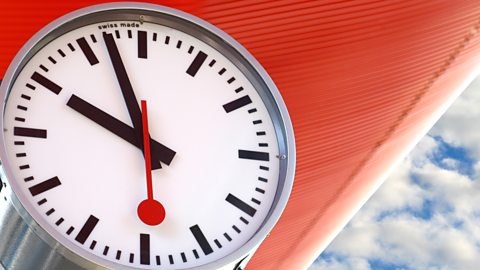
The Swiss are famous for their precision timing, especially when it comes to train arrivals and departures.
All railway clocks in Switzerland have the same, very basic design, with the distinctive red second hand specifically designed to look like a station master's signal.
Despite their simple design, the mechanics of Swiss railway clocks are highly sophisticated. The minute hand is controlled via a centralised master clock, which sends an electric impulse every minute. The second hand, however, works independently of the master clock. This is because it takes just under a minute to rotate fully - approximately 58.5 seconds. As a result, the red second hand pauses momentarily when it reaches the top of the clock, until the impulse from the master clock kicks in after a full minute.