Opposition to the Vietnam War
By the mid-1960s, the USA was heavily involved in the A war between communist North Vietnam and non-communist South Vietnam for control of the whole of Vietnam; the USA sent American troops to protect South Vietnam. It supported South Vietnam against North Vietnam. As American casualties increased, more and more young people were The process where men were selected for compulsory military service. into the armed forces. The average age of an American soldier in Vietnam was 19.
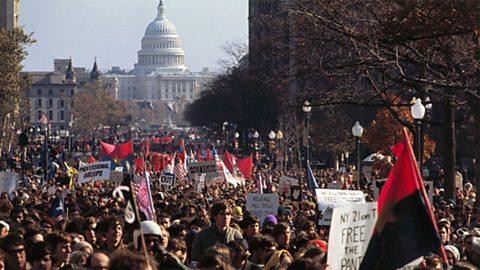
Student opposition
Many young people thought the war was having an unnecessarily cruel impact on Vietnamese civilians. Many also felt that young Americans were risking their lives for something that had nothing to do with them.
Young people, many of whom were still at college or university, protested in increasingly large numbers against American involvement in the war:
- In 1965, Students for a Democratic SocietyStudents for a Democratic Society. An organisation that campaigned to allow students to have more say over what they were taught and how they were treated at university. openly spoke out against President Lyndon B Johnson’s handling of the war.
- In 1968, there were many protests against the war across the country, in universities such as Boston, Colombia and Harvard.
- In 1969, over 500,000 people marched in a demonstration against the war in Washington, DC.
As part of these protests, young people would publicly burn their The document that said that a person had been recruited into the armed forces by the government. or even the American flag, which was a criminal offence.
Kent State shootings
In 1970 at A university in Ohio, USA renowned for activism after students protesting the Vietnam War were shot at by the National Guard in the Kent State Shootings of 1970. in Ohio, students held protests against President Richard Nixon and America’s increased involvement in the Vietnam War. Ohio’s A person who is elected to lead a state’s government in the USA. sent the National Guard in to calm tensions in the area after students and police clashed.
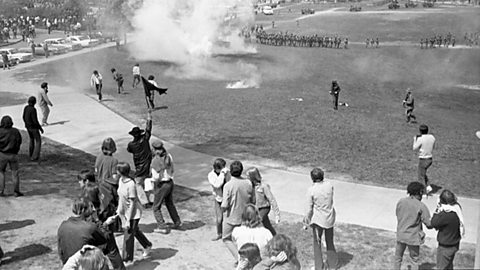
The presence of over 1,000 National Guard soldiers increased hostility between the protesters and government officials who were attempting to end the protests. On 4 May the students refused to disperse from their protest. The National Guard marched upon the crowd of over 3,000 people. Some students threw rocks at the guardsmen, who then opened fire. Four students were killed and eleven more were injured.
Around 5 million students went on A situation when workers refuse to work - as an act of protest - often because of disagreements about pay or working conditions. across America in response to the shootings. Pressure from young people over the Vietnam War was one of the reasons why President Johnson did not stand for re-election in 1968.
Many people in America did not support the young protesters’ views. However, the political involvement of young people was recognised by The legislative body of the US government, made up of the Senate and the House of Representatives. in 1971, when the voting age was lowered from 21 to 18.
Protests abroad
There were many protests outside the USA. These protests usually aimed to put pressure on governments to end support for America’s involvement in the war in Vietnam.
An example of this was seen in London in 1968. Around 10,000 people, who were mainly young, held a public demonstration in Trafalgar Square. The demonstrators aimed to put pressure on the UK government to denounce the American war effort in Vietnam. However, this did not happen. America did not leave Vietnam until 1975.
The event was peaceful until the protesters marched towards the US embassy and broke through a police barricade. During the violent clash which followed, police officers and protesters were injured. Hundreds of people were arrested.
Opposition from significant individuals
Some individuals spoke out against the war effort throughout the conflict. These people came from a wide range of backgrounds and included members of Congress, musicians and Rights everyone is entitled to regardless of the colour of their skin, their beliefs, sexuality, gender or other personal characteristics. These rights could include the right to vote, or the right to a good education etc. campaigners.
Robert Kennedy
John F Kennedy had escalated America’s involvement in Vietnam while he was president. However, when his brother, Robert Kennedy, ran for president in 1968, he called for America to leave the conflict.
The escalation policy in Vietnam, far from strengthening and consolidating international resistance to aggression, is injuring our country.
Robert Kennedy gave speeches to explain that continuing the war was not beneficial to America. His opinion was that America could not win the war and that continuing it would weaken the economy. This view was shared by many who sat in Congress. Robert Kennedy was assassinated in 1968.
Dr Martin Luther King Jnr
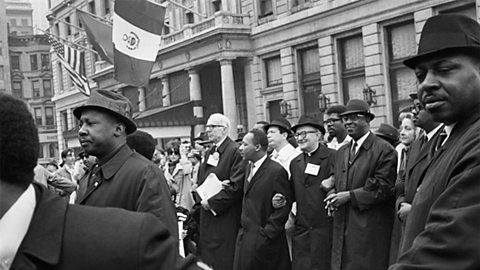
Martin Luther King had publicly supported President Johnson’s attempts to improve welfare. However, he made a speech in April 1967 to outline his opposition to the Vietnam War. The speech was titled ‘Beyond Vietnam’. King’s speech focused on the human and economic cost of the war. He argued that the money being spent on the war would be better spent in America, supporting the poorest in society, and that the men being sent to war were often from the poorer sections of communities. King attended anti-Vietnam demonstrations until his assassination in April 1968.
More guides on this topic
- Anti-Communism c.1945-1954 - Cambridge OCR A
- African Americans c.1945-1954 - Cambridge OCR A
- Civil rights in the USA 1954-1964 - Cambridge OCR A
- Broadening of the campaigns for civil rights - Race - Cambridge OCR A
- Broadening of the campaigns for civil rights - Women's rights - OCR A
- Broadening of the campaigns for civil rights - Gay rights - OCR A
- Social problems and attempts to tackle them - Cambridge OCR A
