Feminism and women’s rights
Learn more about the lives of women in the USA in this podcast.
Listen to the full series on BBC Sounds.
There were many protests for the rights of women in the 1960s and 1970s. Someone who supports the belief that women should have the same rights and opportunities as men. such as Betty Friedan and the A feminist campaign for equal rights whose members believed in using more direct action to achieve its aims. fought to increase opportunities for women, which were limited due to inequality between men and women in work and in wider society. More information on this subject can be found in the guide - Broadening the campaigns for civil rights - Women's rights.
National Organization for Women (NOW)
The An organised set of activities that brought about a change in the treatment of people from different races in American society. and free speech activists at universities convinced some women that they needed to take action to achieve equality with men. Feminists, including Friedan, set up the National Organization for Women (NOW) in 1966.
They wanted the government to do more to enforce laws to end To treat someone differently or unfairly because they belong to a particular group. against women and provide better job opportunities. To achieve this, they protested through marches and strikes to persuade politicians to get their ideas into law.
The campaign for an Equal Rights Amendment
By the beginning of the 1970s, NOW had around 40,000 members. They had managed to get around $30 million in backpay for women who had not been paid properly between 1966 and 1970. In 1970, NOW organised a strike in support of women’s rights across the USA.
NOW wanted an A change made to the US Constitution after it came into force in 1789. to be added to the US A set of laws by which a country is governed. to guarantee equal rights for women. These rights included:
- laws to guarantee maternity leave from work when women had children
- laws to ensure women had access to contraception and abortion
- laws to provide equal access to education and employment opportunities
However, not all women agreed with NOW. Some thought NOW was too extreme. Others thought that NOW wasn’t addressing the issues facing poorer and black American women, as it was mainly white middle-class women who had created NOW. There were also some feminists who thought that the actions of NOW had not gone far enough.
Women’s liberation movement
Other feminists, who thought that NOW had not gone far enough in its demands, were called the women’s liberation movement.
They challenged male dominance of business and the media. They did this in several ways:
- They rejected makeup and bras, as they saw them as things that had been invented by men to control women.
- They tried to highlight businesses they thought were Discrimination against a person on the basis of their sex or gender. by organising When protesters sit inside or outside a business to protest against its rules.
- Some of them deliberately broke sexist rules.
The 1968 Miss America beauty pageant
One of the most well-known protests by the women’s liberation movement was at the Miss America beauty pageant in 1968. Protesters gave out leaflets and shouted feminist slogans outside where the competition was taking place, arguing that it was degrading for women. They also drew media attention by throwing away their bras and makeup, and symbolically crowning a sheep as Miss America.
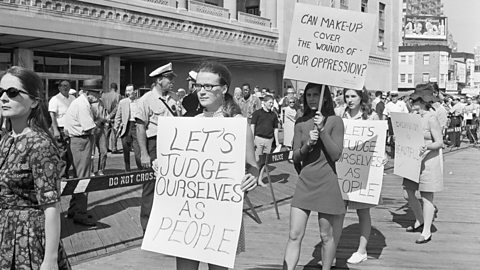
While protests like this drew a lot of attention to the movement, they also made the movement seem too extreme to some people. Some more moderate feminists thought it distracted the media and politicians from legal attempts to improve rights for women.
More guides on this topic
- Anti-Communism c.1945-1954 - Cambridge OCR A
- African Americans c.1945-1954 - Cambridge OCR A
- Civil rights in the USA 1954-1964 - Cambridge OCR A
- Broadening of the campaigns for civil rights - Race - Cambridge OCR A
- Broadening of the campaigns for civil rights - Women's rights - OCR A
- Broadening of the campaigns for civil rights - Gay rights - OCR A
- Social problems and attempts to tackle them - Cambridge OCR A
