Key points about describing accommodation in Spanish

Video - Accommodation
Watch the video of Lolo talking about travelling in Southern Spain and discussing different accommodation options.
Lolo talks about transport and accommodation options
Cuando estoy de vacaciones, me gusta ir a la costa para disfrutar del mar. Un ejemplo perfecto para estas vacaciones es el pueblo de Nerja. Nerja es un pueblo pequeño de la costa de Málaga. Creo que Nerja es una mejor opción que el campo porque las playas están cerca y puedes caminar hasta allí.
La mejor manera para ir a Nerja es en autobús desde el centro de Málaga. No podemos ir en tren como en otros muchos lugares de España. Pero eso no es un problema, porque el servicio de autobuses es barato y hay uno casi cada hora. Además, podemos disfrutar de los bonitos paisajes de camino a Nerja.
En Nerja, hay diferentes opciones de alojamiento. Las dos más comunes son el clásico hotel o buscar una casa típica estilo Málaga por una app en el móvil.
Aunque el hotel puede ser más cómodo, en Nerja encontramos las casas típicas de la costa malagueña, las cuales son totalmente blancas y bonitas. Por eso, sin duda alguna, yo intentaría quedarme en una casa estilo Málaga para vivir la experiencia completa.
Pero si quieres ahorrar algo de dinero y conocer a más gente, puedes buscar un buen albergue o un camping cerca de la playa.
Translation
When I'm on holiday, I like to go to the coast to enjoy the sea. A perfect example of this holiday is the town of Nerja, a small town on the coast of Malaga. I think Nerja is a better option than the countryside because the beaches are very close and you can walk to them.
The best way to get to Nerja is by bus from the center of Malaga. We can't go by train like in many other places in Spain. But that's not a problem, because the bus service is cheap and there's one almost every hour. Additionally, we can enjoy the beautiful landscapes on the way to Nerja.
In Nerja, there are different accommodation options. The two most common are the classic hotel or finding a typical Malaga-style house through app on your phone.
Although the hotel may be more comfortable, in Nerja there are the typical houses of the Malaga coast, which are totally white, and beautiful. That's why, without a doubt, I would try to stay in a Malaga-style house to live the full experience.
But if you want to save some money and meet more people, you can look for a good hostel or a campsite near the beach.
Vocabulary - Talking about accommodation and different places
Useful nouns for talking about accommodation and interiors include:
| Spanish | English | Spanish | English |
|---|---|---|---|
| Check your connection, refresh the page and try again. | accommodation | Check your connection, refresh the page and try again. | image, picture |
| Check your connection, refresh the page and try again. | tree | Check your connection, refresh the page and try again. | place, position |
| Check your connection, refresh the page and try again. | architecture | Check your connection, refresh the page and try again. | light |
| Check your connection, refresh the page and try again. | bathroom | Check your connection, refresh the page and try again. | table |
| Check your connection, refresh the page and try again. | bed | Check your connection, refresh the page and try again. | apartment, floor (of building) |
| Check your connection, refresh the page and try again. | house | Check your connection, refresh the page and try again. | floor, plant (ground floor) |
| Check your connection, refresh the page and try again. | kitchen, cooking | Check your connection, refresh the page and try again. | ground floor |
| Check your connection, refresh the page and try again. | building | Check your connection, refresh the page and try again. | door |
| Check your connection, refresh the page and try again. | space, room | Check your connection, refresh the page and try again. | chair, seat |
| Check your connection, refresh the page and try again. | room, bedroom | Check your connection, refresh the page and try again. | living room |
| Check your connection, refresh the page and try again. | home |
Other useful vocabulary includes:
| Spanish | English |
|---|---|
| Check your connection, refresh the page and try again. | pollution |
| Check your connection, refresh the page and try again. | large town, city |
| Check your connection, refresh the page and try again. | technology |
| Check your connection, refresh the page and try again. | pollution |
| Check your connection, refresh the page and try again. | village, small town |
| Check your connection, refresh the page and try again. | noise |
| Check your connection, refresh the page and try again. | tent, shop |
Useful verbs include:
| Spanish | English |
|---|---|
| Check your connection, refresh the page and try again. | to increase |
| Check your connection, refresh the page and try again. | to pollute |
| Check your connection, refresh the page and try again. | to improve |
| Check your connection, refresh the page and try again. | to live |
Grammar - Opinion phrases

Useful simple opinions in Spanish include:
Me gusta - I like
No me gusta - I don’t like
Me encanta - I love
Using these opinion phrases with plural nouns:
These three opinion phrases change their ending depending on whether the item you are describing is singular or plural.
Add n to the end of gusta and encanta when talking about a plural noun.
For example:
Me gusta el hotel. - I like the hotel .
Me gustan las casas blancas típicas. - I like the typical white houses.
Me encantan los restaurantes italianos. - I love Italian restaurants.
Other opinion phrases include:
| Spanish | English |
|---|---|
| Odio | I hate |
| Prefiero | I prefer |
| Pienso que | I think that |
| Creo que | I believe that |
| En mi opinión | In my opinion |

For example:
Odio la lluvia. - I hate the rain.
Prefiero ir de vacaciones al extranjero. - I prefer going on holiday abroad.
Pienso que España es un país bonito. - I think Spain is a pretty country.
Creo que los colombianos son muy simpáticos. - I believe that Colombians are very friendly.
En mi opinión el hotel es muy cómodo. - In my opinion the hotel is very comfortable.
More complex opinion phrases include:
| Spanish | English | Example |
|---|---|---|
| Es mejor | It’s better | Esta casa es mejor que el piso. - This house is better than the apartment. |
| Es peor | It’s worse | Viajar en coche es peor que viajar en tren. - Travelling by car is worse than travelling by train. |
| Una ventaja es | One advantage is | Una ventaja es la variedad de actividades en la ciudad. - One advantage is the variety of activities in the town/city. |
| Una desventaja es | One disadvantage is | Una desventaja es el ruido del tráfico. - One disadvantage is the sound of the traffic. |
| Me parece | It seems to me that | Me parece que la calidad de las instalaciones es buena. - It seems to me that the quality of the facilities is very good. |
| Me acuerdo con | I agree with | Me acuerdo contigo. - I agree with you. |
| Apoyo | I support | Apoyo la idea de más energía verde. - I support the idea of more green energy. |
| … me molesta | … bothers me | La contaminación en la ciudad me molesta mucho. - The pollution in the town/city bothers me a lot. |
Opinion phrases followed by infinitives:
Se puede… - you can, one can… . For example:
Se puede caminar a la playa. - You can walk to the beach.
Hay que … - You must, one must… .
For example:
Hay que probar la paella. - You must try the paella.
Se necesita… meaning 'you need to…' or 'one needs to…', can be followed by a The name of a thing such as an object, a place or a person. Nouns are often described as naming words. or a verb in the Form of the verb that has not been conjugated. Usually translated with 'to' in English, eg to play. form.
For example:
Se necesita ver esta playa estupenda - You need to see the marvellous beach.
Further complex opinion phrases include:
| Spanish | English |
|---|---|
| Por una parte… por otra parte | On one hand… on the other hand |
| No aguanto | I can’t stand |
| Me preocupo por | I’m worried about |
For example:
Por una parte me gusta ir de camping … pero por otra parte prefiero quedarme en un hotel porque es más cómodo. - On one hand I like camping but on the other hand I prefer staying in a hotel because it’s more comfortable.
No aguanto el camping. - I can’t stand camping.
Me preocupo por los efectos del turismo en este pueblo. - I’m worried about the effects of tourism in this village.
Opinion phrases - Mini quiz
Translate the following sentences into Spanish:
I love beaches.
Me gustan las playas.
Gusta needs an n on the end as playas (beaches) is plural.
The noise in the city bothers me a lot.
El ruido en la ciudad me molesta mucho.
To say something bothers you, put the noun first (what bothers you) followed by the phrase me molesta.
I’m worried about the pollution.
Me preocupo por la contaminación.
To say you are worried about something, use the phrase me preocupo por followed by the noun that you are worried about.
Reading practice
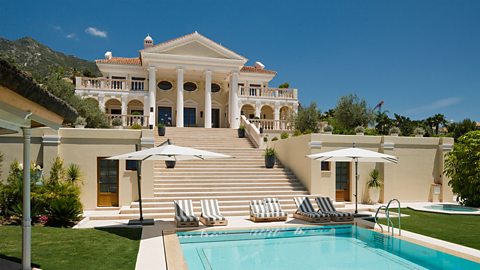
You receive an email from your friend who has just been to stay in an amazing house.
Read the text and answer the questions that follow.
El fin de semana pasado fui a Málaga, en el sur de España, para quedarme con mis primos.
Su casa es mi casa ideal. Es enorme. Hay siete dormitorios y cada dormitorio tiene un baño. En mi casa sólo hay dos baños para toda la familia.
Además, la mayoría de las habitaciones tienen increíbles vistas a la playa.
En la segunda planta hay una gran cocina moderna y un gran salón.
En la planta baja hay muchos sofás y sillas cómodas y un cine donde vimos una película.
En el exterior, en el jardín hay una piscina y un jacuzzi.
Nadamos cada día y tomamos el sol, pero no nos sentamos en el jacuzzi porque tuvimos demasiado calor. Fue realmente relajante.
Espero volver con mi amiga pronto.
Lola
- Whose house did Lola go to last weekend?
Her cousins’ house
The text says: …para quedarme con mis primos. – …to stay with her cousins.
- How many bedrooms are there in the house?
Seven
The text says: Hay siete dormitorios… – There are seven bedrooms…
- How many bathrooms are there in her own house?
Two
The text says: En mi casa sólo hay dos baños. – in my house there are only two bathrooms.
- What can you see from most of the bedrooms?
The beach
The text says: …la mayoría de las habitaciones tienen increíbles vistas a la playa. - …most rooms have incredible beach views.
- Where is the cinema?
On the ground floor
The text says En la planta baja hay muchos sofás y sillas cómodas y un cine. - On the ground floor there are lots of sofas and comfortable chairs and a cinema.
- Why didn’t they use the jacuzzi?
They were too hot
The text says: …no nos sentamos en el jacuzzi porque tuvimos demasiado calor. – …we didn’t sit in the jacuzzi because we were too hot.
Vocabulary - Describing accommodation and places
Useful adjectives for describing the physical appearance of buidlings and accomodation include:
| Spanish | English | Spanish | English |
|---|---|---|---|
| alto/a | tall, high | grande | big, great |
| antiguo/a | ancient | hermoso/a | beautiful |
| bajo/a | short, low | histórico/a | historic |
| enorme | enormous | pequeño/a | small |
| feo/a | ugly | viejo/a | old |
Other useful adjectives include:
| Spanish | English | Spanish | English |
|---|---|---|---|
| agradable | pleasant, nice | increíble | incredible |
| alegre | cheerful | genial | great |
| animado/a | lively | limpio/a | clean |
| bonito/a | pretty, nice | situado/a | situated, located |
| caro/a | expensive | sucio/a | dirty |
| cómodo/a | comfortable | típico/a | typical |
| emocionante | exciting | tranquilo/a | calm, quiet, relaxed |
| famoso/a | famous |
All Foundation Tier vocabulary listed in this guide can be found on the vocabulary sheet below.
Grammar - How to use adjectives
Adjectives can be used to describe someone or something.
In Spanish, adjectives usually go after the noun. For example:
Hay una casa (noun) típica (adjective). (There is a typical house.)
Es un hotel (noun) famoso (adjective). (It’s a famous hotel.)
In Spanish, adjectives must agree with the The name of a thing such as an object, a place or a person. Nouns are often described as naming words.. For Follow the regular pattern with regard to their endings, when they agree with a noun. , change the o to a when using it for a feminine noun, and add s for a plural noun. For example:
| Masculine | Feminine | English | |
|---|---|---|---|
| Singular | Check your connection, refresh the page and try again. | Check your connection, refresh the page and try again. | famous |
| Plural | Check your connection, refresh the page and try again. | Check your connection, refresh the page and try again. | famous |
Adjectives that end in a consonant, such as l, do not change ending whether the noun is singular and masculine or singular and feminine.
For plural nouns ending in a consonant, add es. For example:
| Masculine | Feminine | English | |
|---|---|---|---|
| Singular | Check your connection, refresh the page and try again. | Check your connection, refresh the page and try again. | ideal |
| Plural | Check your connection, refresh the page and try again. | Check your connection, refresh the page and try again. | ideal |

For example:
El hotel tiene dormitorios (noun) ideales (ideal). - The hotel has ideal bedrooms.
Es una ciudad industrial. - It’s an industrial town.
Adjectives that go before a noun
Some adjectives can go before the noun they are describing, but they still have to agree. For example:
la segunda planta - the second floor
muchos hoteles - lots of hotels
Common adjectives that usually come before the noun include:
| Check your connection, refresh the page and try again. | a little | Check your connection, refresh the page and try again. | none |
| Check your connection, refresh the page and try again. | a lot | Check your connection, refresh the page and try again. | first |
| Check your connection, refresh the page and try again. | next | Check your connection, refresh the page and try again. | second |
| Check your connection, refresh the page and try again. | last | Check your connection, refresh the page and try again. | third |
| Check your connection, refresh the page and try again. | some, any |
Adjectives - Mini quiz
Complete the following phrases:
La _____ ______.
The famous beach.
La playa famosa.
laya means ‘beach’ and is feminine singular and so the ending famosa, meaning ‘famous’, is a.
Adjectives usually follow the noun in Spanish, so famosa comes after playa.
Las _____ ______.
The white houses.
Las casas blancas.
Casas means ‘house’ and is feminine plural and so the ending on blancas, meaning 'white’, is as.
Adjectives usually follow the noun in Spanish, so blancas comes after casas.
La ______ ______.
The ideal town.
La ciudad ideal.
Ciudad means ‘town’. Ideal is an adjective that does not change its ending according to whether it is masculine or feminine.
La ______ ______.
The third floor.
La tercera planta.
Tercera means third and ends in a to agree with planta, meaning floor.
Tercera is one of the few adjectives that does not follow the regular pattern and comes before the noun.
To find out more about using adjectives in Spanish, have a look at the Adjectives in Spanish and Position of adjectives guides.
Listening practice
Listen to this advert for a holiday villa and answer the questions in English about it.
- What does the advert describe about the villa's location and amenities?
The villa's garden and patio allow for enjoying the sun throughout the day.
The advert mentions: La casa tiene su propio jardín y patio donde se puede disfrutar del sol durante todo el día. - The house has its own garden and patio where you can enjoy the sun all day long.
- What is the duration of the walk from the villa to the sea, according to the advert?
It takes only five minutes to walk from the villa to the sea.
The advert states: Camina por un camino hermoso entre árboles y casas, ¡y llegarás al mar en tan solo cinco minutos! - Walk along a beautiful path between trees and houses and you will get to the sea in just five minutes!
- What does the advert say about the ongoing renovations at the villa?
The advert suggests that although there are ongoing works, they are worth it.
The advert mentions: Aunque hay algunas obras en curso ¡te aseguramos que vale la pena! - Although there are some building works going on we assure you they are worth it!
- What feature of the villa means there is no need for a pool?
The villa is very close to the coast so there is no need for a pool.
The advert mentions: ¿Piscina?¡No es necesaria! Estamos a pocos pasos de la costa, así que puedes nadar en el mar sin preocupaciones. - Swimming pool? It's not necessary! We are a few steps away from the coast so you can swim in the sea, no problem.
Click or tap on Show more to read the transcript and translation of what the advert says.
Transcript
¡Descubre nuestra villa vacacional de tus sueños! ¿Quieres visitarla ahora mismo? Está lista para impresionarte. Aunque hay algunas obras en curso ¡te aseguramos que vale la pena!
La casa tiene su propio jardín y patio, donde se puede disfrutar del sol durante todo el día. ¿Piscina? ¡No es necesaria! Estamos a pocos pasos de la costa, así que puedes nadar en el mar sin preocupaciones.
Camina por un camino hermoso entre árboles y casas, ¡y llegarás al mar en tan solo cinco minutos! Increíble ¿verdad? Esta es la oportunidad perfecta para vivir una experiencia única cerca del mar. ¡Te esperamos para vivir unas vacaciones maravillosas!
Translation
Discover the holiday villa of your dreams! Do you want to visit right now? We are ready to impress you. Although there are some building works going on we assure you they are worth it!
The house has its own garden and patio where you can enjoy the sun all day long. Swimming pool? It's not necessary! We are a few steps away from the coast so you can swim in the sea, no problem.
Walk along a beautiful path between trees and houses and you will get to the sea in just five minutes! Incredible, isn't it? This is the perfect opportunity to enjoy a unique experience by the sea. We are waiting for you to enjoy a wonderful holiday.
Vocabulary sheet
Click or tap on the image below for a list of useful vocabulary to use when describing accommodation.

Higher Tier - Grammar - Opinions phrases
Higher Tier opinion phrases include:
Agradezco… followed by the infinitive - I am grateful for… For example:
Agradezco poder quedarme en un hermoso hotel - I am grateful for being able to stay in a beautiful hotel.
¡Basta! - Enough!
Vale la pena, vale la pena followed by infinitive - it's worth it, it’s worth …ing.
For example:
Vale la pena ver la fuente en esta casa antigua. - It’s worth seeing the fountain in this old house.
Now you have revised the vocabulary and grammar needed to talk about accommodation in Spanish, have a look at the Describing transport options in Spanish guide.
Careers advice and tips from BBC Bitesize
Future careers, further studies and the world of work - we're here to help with advice from experts and from young people who've found their path.

More on Travel and tourism, including places of interest
Find out more by working through a topic
- count4 of 4

- count2 of 4