Key points about describing transport options in Spanish
The Something that does not follow the usual or ‘regular’ pattern. verb ir (to go) is one of the most-used in Spanish.
Use ir to talk about travel and transport in the present, past and future The verb formation that describes the time at which the action occurred, eg past, present or future. .
A word such as at, for, with, into or from which is usually followed by a noun or pronoun. Prepositions are used to show where something is in place or time. link nouns, pronouns, or phrases to other words within a sentence and are useful for giving directions.
This guide contains a video as well as a video comprehension and reading practice.
Video - Describing transport options
Watch the video of Lolo talking about travelling in Southern Spain and discussing different accommodation options.
Lolo talks about transport and accommodation options
Cuando estoy de vacaciones, me gusta ir a la costa para disfrutar del mar. Un ejemplo perfecto para estas vacaciones es el pueblo de Nerja. Nerja es un pueblo pequeño de la costa de Málaga. Creo que Nerja es una mejor opción que el campo porque las playas están cerca y puedes caminar hasta allí.
La mejor manera para ir a Nerja es en autobús desde el centro de Málaga. No podemos ir en tren como en otros muchos lugares de España. Pero eso no es un problema, porque el servicio de autobuses es barato y hay uno casi cada hora. Además, podemos disfrutar de los bonitos paisajes de camino a Nerja.
En Nerja, hay diferentes opciones de alojamiento. Las dos más comunes son el clásico hotel o buscar una casa típica estilo Málaga por una app en el móvil.
Aunque el hotel puede ser más cómodo, en Nerja encontramos las casas típicas de la costa malagueña, las cuales son totalmente blancas y bonitas. Por eso, sin duda alguna, yo intentaría quedarme en una casa estilo Málaga para vivir la experiencia completa.
Pero si quieres ahorrar algo de dinero y conocer a más gente, puedes buscar un buen albergue o un camping cerca de la playa.
Translation
When I'm on holiday, I like to go to the coast to enjoy the sea. A perfect example of this holiday is the town of Nerja, a small town on the coast of Malaga. I think Nerja is a better option than the countryside because the beaches are very close and you can walk to them.
The best way to get to Nerja is by bus from the center of Malaga. We can't go by train like in many other places in Spain. But that's not a problem, because the bus service is cheap and there's one almost every hour. Additionally, we can enjoy the beautiful landscapes on the way to Nerja.
In Nerja, there are different accommodation options. The two most common are the classic hotel or finding a typical Malaga-style house through app on your phone.
Although the hotel may be more comfortable, in Nerja there are the typical houses of the Malaga coast, which are totally white, and beautiful. That's why, without a doubt, I would try to stay in a Malaga-style house to live the full experience.
But if you want to save some money and meet more people, you can look for a good hostel or a campsite near the beach.
Vocabulary- Describing travel and transport
Useful vocabulary for describing journeys:
| Spanish | English | Spanish | English |
|---|---|---|---|
| barato/a | cheap | práctico/a | practical, convenient |
| caro/a | expensive | ruidoso/a | noisy |
| lento/a | slow | tranquilo/a | quiet |
| rápido/a | fast | viejo/a | old |
| fácil | easy | el billete | ticket |
| cómodo/a | comfortable, convenient | un retraso | delay |
| incómodo/a | uncomfortable | el tráfico | traffic |
| moderno/a | modern | ¿Dónde está…? | Where is…? |
Useful verbs to describe travel include:
| Spanish | English | Spanish | English |
|---|---|---|---|
| Check your connection, refresh the page and try again. | to get off | Check your connection, refresh the page and try again. | to pay for |
| Check your connection, refresh the page and try again. | to catch (a bus/train etc) | Check your connection, refresh the page and try again. | to lose |
| Check your connection, refresh the page and try again. | to wait | Check your connection, refresh the page and try again. | to forget |
| Check your connection, refresh the page and try again. | to queue up | Check your connection, refresh the page and try again. | to pick up |
| Check your connection, refresh the page and try again. | to go on a trip | Check your connection, refresh the page and try again. | to leave |
| Check your connection, refresh the page and try again. | to arrive | Check your connection, refresh the page and try again. | to get on |
| Check your connection, refresh the page and try again. | to carry | Check your connection, refresh the page and try again. | to travel |
| Check your connection, refresh the page and try again. | to look for |
Have a look at the image to see how to talk about forms of transport in Spanish.
Click or tap on Show more to see a list of useful vocabulary for describing forms of transport.
| Spanish | English |
|---|---|
| el aeropuerto | airport |
| el autobús | bus |
| el avión | plane, aeroplane |
| el barco | boat |
| el coche | car |
| la estación | station |
| pie, a pie | foot, on foot |
| el vuelo | flight |
Grammar - Forming 'ir' (to go) in the present, past and future tenses
The verb ir (to go) is one of the most high frequency verbs in Spanish.
It is an irregular verb, which means it does not follow the regular pattern of other verbs. It has to be learned separately.
Click or tap on Show more to see how to conjugate the verb ir in the three most common tenses:
the present tense
the preterite (past) tense
the immediate future tense
Present tense of ir - to go
| Spanish | English |
|---|---|
| Check your connection, refresh the page and try again. | I go |
| Check your connection, refresh the page and try again. | you (sing. informal) go |
| Check your connection, refresh the page and try again. | he/she/it goes /you (sing. formal) go |
| Check your connection, refresh the page and try again. | we go |
| Check your connection, refresh the page and try again. | you (plural informal) go |
| Check your connection, refresh the page and try again. | they/ you (plural formal) go |
For example:
Voy al colegio en autobús. - I go to school on the bus.
Vamos de vacaciones en avión. - We go on holiday by plane.
¿Vas a la ciudad? - Are you going to the city?
Preterite (past) tense of ir - to go
| Spanish | English |
|---|---|
| Check your connection, refresh the page and try again. | I went |
| Check your connection, refresh the page and try again. | you (singular informal) went |
| Check your connection, refresh the page and try again. | he/she/it/you (singular formal) went |
| Check your connection, refresh the page and try again. | we went |
| Check your connection, refresh the page and try again. | you (plural informal) went |
| Check your connection, refresh the page and try again. | they/you (plural formal) went |
For example:
Ayer fui al colegio en coche. – Yesterday I went to school by car.
El año pasado fuimos de vacaciones en avión. – Last year we went on holiday by plane.
Mis padres fueron a un hotel el fin de semana pasado. - My parents went to a hotel last weekend.
Immediate future tense of ir - to go
The immediate future tense is the most common way of talking about future plans. It is formed with the present tense of ir (to go), followed by a and the infinitive.
| Spanish | English |
|---|---|
| Check your connection, refresh the page and try again. | I’m going to go |
| Check your connection, refresh the page and try again. | you (singular informal) are going to go |
| Check your connection, refresh the page and try again. | he/she/it goes /you (singular formal) is going to go |
| Check your connection, refresh the page and try again. | we’re going to go |
| Check your connection, refresh the page and try again. | you (plural informal) ‘re going to go |
| Check your connection, refresh the page and try again. | they/you (plural formal) ‘re going to go |
Mañana voy a ir al colegio a pie. – Tomorrow I’m going to walk to school.
El año próximo vamos a ir de vacaciones en barco. – Next year we’re going to go on holiday by boat.
Mis padres van a ir a un hotel el fin de semana próximo. - My parents are going to go to a hotel next weekend.
The verb 'ir' - Mini quiz
Complete the following sentences:
______ a la piscina.
We’re going to the pool.
Vamos
Vamos is the present tense ‘we’ form of ir.
¿ ____ al partido de fútbol?
Are you (singular informal) going to the football match?
Vas
Vas is the present tense ‘you' (singular informal) form of ir.
Ayer ______ al supermercado.
Yesterday they went to the supermarket.
fueron
Fueron is the preterite tense ‘they’ form of ir.
La semana próxima ___________ de vacaciones en barco.
Next week I’m going to go on holiday by boat.
voy a ir
Voy a ir is the immediate future tense, which is formed with the present tense of the ‘I’ form of ir (to go) followed by a and the verb in the infinitive, which in this case is also ir.
Video - Comprehension
Watch the video then answer the questions.
Rafa talks about how he gets around his hometown
- Yesterday, Rafa's dad gave him a lift to school because…
a) he woke up late
b) the bus broke down
c) it was raining
According to Rafa, how much does a bus pass cost per month?
Why does Rafa prefer to catch the bus to school instead of the train or underground?
Give three reasons why Rafa sometimes walks home from school instead of catching the bus.
What does Rafa want to do next year?
- Answer - a). Yesterday, Rafa's dad gave him a lift to school because he woke up late.
Rafa says: Normalmente voy al instituto en autobús, pero ayer fui con mi padre en coche porque no me desperté hasta muy tarde. Teníamos prisa.
I normally go to school by bus, but I went with my dad by car yesterday because I didn't wake up until very late. We were in a rush.
- Answer - €50.
Rafa says: Tengo un abono. Cuesta cincuenta euros al mes, pero te sale más económico que comprar billetes de ida y vuelta cada día.
I have a bus pass. It costs fifty euros a month but works out cheaper than buying return tickets every day.
- Answer - He always meets/bumps into his friends.
Rafa says: La red de transporte público de Madrid es estupenda. También hay trenes y metros. Pero yo prefiero viajar en autobús porque siempre me encuentro con mis amigos.
The public transport network in Madrid is fantastic. There are also trains and an underground. But I prefer to travel by bus as I always bump into my friends.
- Answer - Any 3 of:
to avoid travelling in rush hour
there's lots of traffic
there are lots of traffic jams
the bus is very uncomfortable
there are so many people
the bus takes so long
he likes walking if it's sunny because there are lots of pretty places along the way
Rafa says: A veces, vuelvo a casa a pie para evitar viajar en durante la hora punta. Hay mucho tráfico y siempre hay atascos. El autobús es muy incómodo porque hay tanta gente y ¡tarda tanto! Tardo media hora andando, pero si hace sol me gusta porque hay sitios bonitos por el camino.
Sometimes, I go home on foot to avoid travelling at rush hour. There is a lot of traffic and there are always traffic jams. The bus is uncomfortable because there are so many people and it takes a long time! It takes me half an hour to walk, and I like it if it's sunny because there are pretty places to see along the way.
- Answer - Learn to drive.
Rafa says: No tengo permiso de conducir, pero el año que viene quiero aprender a conducir. Así, no tengo que depender de mi padre.
I don't have a driving licence. But I want to learn to drive next year. That way, I don't have to depend on my dad.
Click or tap on Show more to read the transcript and the translation of what Rafa says.
Hola. ¿Qué tal? Soy Rafa y son las ocho y veinte. Tengo que irme al instituto.
Te vienes conmigo? Me acompañas?
Bueno, ¿cómo se llega a mi instituto?
Normalmente voy al instituto en autobús, pero ayer fui con mi padre en coche porque no me desperté hasta muy tarde. Teníamos prisa. Pero hoy, me levanté a tiempo. Entonces voy a la parada de autobús.
Tengo un abono. Cuesta cincuenta euros al mes, pero te sale más económico que comprar billetes de ida y vuelta cada día.
La red de transporte público de Madrid es estupenda. También hay trenes y metros. Pero yo prefiero viajar en autobús porque siempre me encuentro con mis amigos.
Vale, ha llegado. ¡Tengo que subirme!
Bueno, acabo de salir del instituto.
A veces, vuelvo a casa a pie para evitar viajar en la hora punta. Hay mucho tráfico y siempre hay atasco. El autobús es muy incómodo porque hay tanta gente y tarda tanto.
Tardo media hora andando pero si hace sol me gusta porque hay sitios bonitos por el camino.
¡Ay! ¡Qué tonto! Creo que me he perdido. ¿Dónde estoy?
Perdone, ¿cómo se llega a la Latina…?
Suelo llegar a la casa sobre las cinco y cuarto.
Yo no tengo permiso de conducir. Pero el año que viene quiero aprender a conducir. Así, no tengo que depender de mi padre.
Bueno, he llegado. Gracias por acompañarme.
Vale, adiós.
Translation:
Hello. How are you? I’m Rafa and it is 8.20. I have to go to school.
Are you coming with me? Are you keeping me company?
Right, how do we get to my school?
I normally go to school by bus, but I went with my dad by car yesterday because I didn't wake up until very late. We were in a rush! But today I got up in time. So I am going to the bus stop.
I have a bus pass. It costs fifty euros a month but works out cheaper than buying return tickets every day.
The public transport network in Madrid is fantastic. There are also trains and an underground. But I prefer to travel by bus as I always bump into my friends.
OK, it’s arrived. I have to get on!
Right, I have just come out of school.
Sometimes, I go home on foot to avoid travelling at rush hour. There is a lot of traffic and there are always traffic jams. The bus is uncomfortable because there are so many people and it takes a long time!
It takes me half an hour to walk, and I like it if it's sunny because there are pretty places to see along the way.
Oh. How silly. I think I am lost. Where am I?
Sorry, how do you get to la Latina…
I normally get home at 5.15.
I don't have a driving licence. But I want to learn to drive next year. That way, I don't have to depend on my dad.
Right, I have arrived. Thank you for accompanying me.
OK, bye.
Vocabulary - How to give directions and buy tickets
Useful vocabulary for landmarks and describing directions includes:
| Spanish | English | Spanish | English |
|---|---|---|---|
| Check your connection, refresh the page and try again. | on the right hand side | Check your connection, refresh the page and try again. | (street) corner |
| Check your connection, refresh the page and try again. | on the left hand side | Check your connection, refresh the page and try again. | to turn |
| Check your connection, refresh the page and try again. | town hall | Check your connection, refresh the page and try again. | left |
| Check your connection, refresh the page and try again. | to look for | Check your connection, refresh the page and try again. | to pass |
| Check your connection, refresh the page and try again. | road, street | Check your connection, refresh the page and try again. | the square |
| Check your connection, refresh the page and try again. | continue | Check your connection, refresh the page and try again. | bridge |
| Check your connection, refresh the page and try again. | to cross | Check your connection, refresh the page and try again. | to follow, continue |
| Check your connection, refresh the page and try again. | right | Check your connection, refresh the page and try again. | to take |
| Check your connection, refresh the page and try again. | to find |

Use ordinal numbers when giving or understanding directions:
| Spanish | English |
|---|---|
| Check your connection, refresh the page and try again./Check your connection, refresh the page and try again. | first |
| Check your connection, refresh the page and try again./Check your connection, refresh the page and try again. | second |
| Check your connection, refresh the page and try again./Check your connection, refresh the page and try again. | third |
| Check your connection, refresh the page and try again./Check your connection, refresh the page and try again. | fourth |
| Check your connection, refresh the page and try again./Check your connection, refresh the page and try again. | last |
For example:
Toma la segunda calle a la derecha. – Take the second road on the right.
Gira a la izquierda y luego toma la primera calle a la izquierda. - Turn left and then take the first road on the left.
All Foundation Tier vocabulary listed in this guide can be found on the vocabulary sheet below.
Grammar - How to use prepositions of place
Prepositions link nouns, pronouns, or phrases to other words within a sentence. They connect the people, objects, time and locations of a sentence.
Prepositions are usually short words, and they are normally placed directly in front of The name of a thing such as an object, a place or a person. Nouns are often described as naming words..
Useful prepositions for understanding and describing location include:
| Check your connection, refresh the page and try again. | at the end of | Check your connection, refresh the page and try again. | behind |
| Check your connection, refresh the page and try again. | at the back of | Check your connection, refresh the page and try again. | in, on |
| Check your connection, refresh the page and try again. | next to | Check your connection, refresh the page and try again. | opposite |
| Check your connection, refresh the page and try again. | underneath, below | Check your connection, refresh the page and try again. | between, among |
| Check your connection, refresh the page and try again. | in front of | Check your connection, refresh the page and try again. | toward, towards |
| Check your connection, refresh the page and try again. | inside | Check your connection, refresh the page and try again. | up to, as far as, until |
| Check your connection, refresh the page and try again. | after | Check your connection, refresh the page and try again. | for, in order to |

For example:
El banco está enfrente del supermercado. - The bank is opposite the supermarket.
El colegio está al lado de la piscina. - The school is next to the swimming pool.
El campo de fútbol está detrás del colegio. - The football pitch is behind the school.
Several prepositions are followed by de and then the definite article (el/la/los/las) and the noun.
If the preposition followed by de is then followed by a masculine singular noun, de and el contract to become del.
The preposition of time and place a also contracts when followed by a masculine singular noun to become al.
Prepositions of place - Mini quiz
Complete the following sentences:
La piscina está ____ ____ mercado.
The pool is opposite the market.
La piscina está enfrente del mercado.
Enfrente means ‘opposite’ and is followed by ‘de’ plus the article.
Mercado is masculine and the article is el.
De and el contract to form del.
Vaya _____ la plaza.
Go towards the square.
Vaya hacia la plaza.
Hacia is the Spanish word for towards.
Tome la ______ calle a la ______.
Take the first road on the right.
Tome la primera calle a la derecha.
Primera means ‘first’ and needs to agree with calle which is feminine, and so ends in a.
Derecha means ‘right’.
El banco está _____ ____ centro comercial.
The bank is behind the shopping mall.
El banco está detrás de centro comercial.
Detrás de means ‘behind’.
As centro commercial is masculine, de and e contract to form del.
Find out more about prepositions in the Prepositions of place and time in Spanish guide.
Reading practice
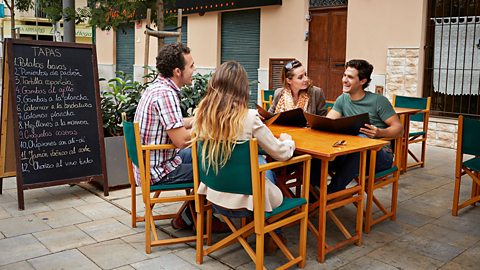
As part of a treasure hunt activity you read some directions to two different secret locations.
Translate each text into English to find out where you need to go.
Puzzle number 1
Desde la estación, ve hacia la Calle Principal.
Sigue todo recto hasta el banco.
Luego, gira a la izquierda en la esquina con el restaurante.
Sigue por esa calle hasta llegar a la plaza.
En la plaza, toma la calle enfrente del ayuntamiento.
La casa está a la derecha.
From the station, go towards the main street.
Go straight to the bank.
Then, turn left at the corner with the restaurant.
Continue along that street until you reach the square.
In the square, take the street in front of the town hall.
The house is on the right.
Puzzle number 2
Desde el parque, ve hacia la Plaza Mayor.
Cruza la plaza y toma la segunda calle a la derecha.
Sigue recto hasta llegar al templo.
Gira a la izquierda justo después del templo y continúa por esa calle.
Después del puente, gira a la derecha.
La casa está al final de la calle a mano izquierda.
From the park, go towards the main square.
Cross the square and take the second street on the right.
Continue straight until you reach the temple.
Turn left just after the temple and continue along that street.
After the bridge, turn right.
The house is at the end of the street on the left.
Vocabulary sheet
Click or tap on the image below for a list of useful vocabulary to use when describing transport options.

Now you have revised the important vocabulary and key grammar points for describing transport options why not thave a look at the Talking about family and friends in Spanish guide?
Careers advice and tips from BBC Bitesize
Future careers, further studies and the world of work - we're here to help with advice from experts and from young people who've found their path.

More on Travel and tourism, including places of interest
Find out more by working through a topic
- count2 of 4
- count3 of 4