Key points about describing holiday activities
Use the Are used to communicate that something must be done without specifying who should do it, where there is no natural subject (like I, you, he, etc.).hay to talk about about things to do on holiday.
Use A word such as at, for, with, into or from which is usually followed by a noun or pronoun. Prepositions are used to show where something is in place or time. of place to describe where something is in relation to somewhere else.
Build up vocabulary on sightseeing, culture and food to talk about what to do on holiday.
Vocabulary - Describing different buildings
Useful vocabulary for describing places of interest includes:
| Spanish | English | Spanish | English |
|---|---|---|---|
| Check your connection, refresh the page and try again. | castle | Check your connection, refresh the page and try again. | swimming pool |
| Check your connection, refresh the page and try again. | building | Check your connection, refresh the page and try again. | square |
| Check your connection, refresh the page and try again. | station | Check your connection, refresh the page and try again. | port, harbour |
| Check your connection, refresh the page and try again. | trip, excursion | Check your connection, refresh the page and try again. | restaurant |
| Check your connection, refresh the page and try again. | hotel | Check your connection, refresh the page and try again. | synagogue |
| Check your connection, refresh the page and try again. | church | Check your connection, refresh the page and try again. | supermarket |
| Check your connection, refresh the page and try again. | mosque | Check your connection, refresh the page and try again. | temple |
| Check your connection, refresh the page and try again. | museum | Check your connection, refresh the page and try again. | shop, tent |

For example:
La ciudad tiene un antiguo castillo y una sinagoga. – The town has an ancient castle and a synagogue.
En la plaza hay una iglesia enfrente del templo. – In the square there is a church opposite the temple.
Vocabulary - Natural features
Useful vocabulary for talking about landscape features includes:
| Spanish | English |
|---|---|
| Check your connection, refresh the page and try again. | forest, wood |
| Check your connection, refresh the page and try again. | countryside |
| Check your connection, refresh the page and try again. | coast |
| Check your connection, refresh the page and try again. | island |
| Check your connection, refresh the page and try again. / Check your connection, refresh the page and try again. | sea |
| Check your connection, refresh the page and try again. | mountain |
| Check your connection, refresh the page and try again. | scenery |
| Check your connection, refresh the page and try again. | beach |

For example:
Hay un pequeño bosque cerca del hotel – There’s a small wood near the hotel
Hay un gran lago donde se puede nadar – There’s a big lake where you can swim
Grammar - Impersonal verbs

Impersonal verbs in English include verbs such as ‘one does’ or ‘one goes’. Although these sound very formal in English, they are used a lot more commonly in Spanish.
The most common impersonal verb in Spanish is Check your connection, refresh the page and try again. which means ‘there is’ or ‘there are’.
For example:
Hay un museo de música en la ciudad. - There’s a music museum in the city.
Hay que followed by the infinitive is an impersonal way of saying ‘One has to do something’.
For example:
Hay que visitar el Prado en Madrid. . One has to visit the Prado in Madrid.
Using the impersonal pronoun 'se'
To turn any Spanish Word used to describe an action, state of being or an occurrence. into an impersonal verb, use the pronoun se and the he/she form of the verb.
For example:
Se necesitan euros en España. - One needs euros in Spain.
If there is a The person or thing doing the action or being described. in the sentence, use the singular verb ending (the he/she ending) for a single subject, and the ‘they’ verb ending for plural subjects.
For example:
Se ve el mar desde el hotel. - You can see the sea from the hotel.
Las tiendas se abren a las nueve. - The shop opens at nine.
Modal verbs with the impersonal 'se'
The following Shows possibility, intent, ability, or necessity. Used alongside the infinitive form of the main verb of a sentence. Common examples of modal verbs include can, should, and must. often are used with the impersonal se:
se puede – one can
se debe – one must
se necesita – one needs
For example:
Se puede ir al mercado. - One can go to the market.
Se debe ver el castillo. - One must see the castle.
Se necesita mucho dinero comprar recuerdos. - One needs lots of money to buy souvenirs.
Impersonal verbs - Mini quiz
Complete the following sentences:
En México ______ sopa de pescado.
In Mexico one eats fish soup.
infinitive = comer
En México se come sopa de pescado.
Use the impersonal se with come in the he/she form.
____ ________ tratar la comida.
One must try the food.
Infinitive = deber
Se debe tratar la comida.
Use the impersonal se with debe in the he/she form.
______ ir a la playa.
You can go to the beach.
Infinitive = poder
Se puede ir a la playa.
Use the impersonal se with puede in the he/she form.
Find out more about impersonal verbs in the Impersonal verbs in Spanish guide.
Reading practice

Read this leaflet advertising day trips from Benidorm.
Viajes González - Excursiones turísticas desde Benidorm
Excursión en autocar a Valencia - Valencia tiene muchos monumentos históricos como la catedral, además de los famosos edificios modernos de la Ciudad de los Artes y las Ciencias. La visita incluye también entrada gratis al museo de las Fallas.
Excursión en autocar a Guadalest - Visita uno de los pueblos más antiguos e históricos de España con su increíble castillo. El pueblo está situado en una región rica en cultura tradicional y tiene vistas preciosas a la montaña.
Excursión al parque temático (El Mundo de los Dinosaurios) - Pasa un día en este parque exótico con más de 30 modelos de tamaño real de estos animales prehistóricos. Hay también parque infantil, zona de picnic y un cine 3-D.
Paseo marítimo a la Isla de Benidorm - Un viaje tranquilo en barco hasta la isla, donde hay servicio de bar/restaurante. Desde la isla se pueden disfrutar de las magníficas vistas a toda la costa.
Now read what sort of trip these people are looking for and decide on the best excursion for each person.
1. Mónica
I'd like to go on a relaxing trip where I can see good views of the coast and perhaps have a nice meal. I'm not very keen on long coach journeys.
The answer is excursion 4
She wants a relaxing trip and doesn't want a long coach journey, so a quiet boat journey might suit her. A restaurant is mentioned so she'll be able to have a meal and also see views of the coast.
2. Antonio
I'd like to learn more about the history of the region. It would also be nice to get away from the coast and into the mountains.
The answer is excursion 2
It's to an historic old town with a castle and he'll also be able to see the mountains.
3. Elena
I always like trips where I can see something a bit different and learn some new information but it's important that my eight-year-old daughter will also enjoy the trip.
The answer is excursion 3
A dinosaur theme park should provide her with something a bit different and, as well as the dinosaurs, her daughter might enjoy the children's playpark, the picnic area and the 3D cinema.
4. Jorge
I like looking at historical places and I'm also interested in learning more about the arts and culture of the region.
The answer is excursion 1
Valencia offers plenty of historical monuments as well as an arts and sciences zone and the trip includes free entrance to the 'Fallas' museum.
Click or tap on Show more to read a translation of the brochure.
Viajes González - Tourist trips from Benidorm
Coach trip to Valencia - Valencia has a lot of historic monuments such as the cathedral, besides the famous modern monuments of the City of Arts and Sciences. The visit also includes free entry to the Fallas museum.
Coach trip to Guadalest - Visit one of the oldest and most historic villages in Spain with its incredible castle. The village is situated in a region rich in traditional culture and has beautiful views of the mountains.
Excursion to the World of Dinosaurs theme park - Spend a day in this exotic park with more than 30 life size models of these prehistoric animals. There is also a children's park, a picnic area and a 3D cinema.
Boat trip to Benidorm Island - a gentle boat trip to the island where there are bar/restaurant facilities. From the island you can see enjoy magnificent views of the whole coast.
Vocabulary - Holiday activities
Useful verbs to describe what you like to do on holiday:
| Spanish | English |
|---|---|
| comer comida típica de la región | to eat typical regional food |
| comprar recuerdos | to buy souvenirs |
| ir de compras | to go shopping |
| descansar | to rest, relax |
| nadar | to swim |
| leer | to read |
| pasarlo bien | to have a good time |
| tomar el sol | to sunbathe |
| dar un paseo | to go for a walk |
| ir a un parque temático | to go to a theme park |
| ir de vacaciones | to go on holiday |
| probar | to try |

For example:
Nos lo pasamos bien en España. – We had a good time in Spain.
Siempre compro muchos recuerdos cuando estoy de vacaciones. – I always buy a lot of souvenirs when I’m on holiday.
Prefiero tomar el sol y leer cerca de la piscina. – I prefer sunbathing and reading by the pool.
A mi madre le gusta probar comida típica. – My mother likes eating typical food.
Normalmente vamos a un parque temático. – Normally we go to a theme park.
Vocabulary - Talking about food and drink
Useful phrases to describe what you eat and drink on holiday include:
A mi padre le gusta beber vino por las noches. - My dad likes to drink wine at night.
Me encanta el pollo pero odio el pescado. - I love chicken but I hate fish.
Cuando estoy de vacaciones en España pruebo la paella, el pescado y el pollo. - When I’m on holiday in Spain I try paella, fish and chicken.
Para la comida como una sopa o una ensalada de tomate. – For lunch I eat soup or a tomato salad.
Para la cena tomo huevos o pescado pero nunca tomo carne. – For dinner I have eggs or fish but I never have meat.
Prefiero comer un bocadillo de queso o de jamón. – I prefer eating a cheese or ham sandwich.

Other useful vocabulary to describe typical food and drink that you might eat on holiday includes:
| Spanish | English | Spanish | English |
|---|---|---|---|
| Check your connection, refresh the page and try again. | drink | Check your connection, refresh the page and try again. | ham |
| Check your connection, refresh the page and try again. | sandwich | Check your connection, refresh the page and try again. | bread |
| Check your connection, refresh the page and try again. | coffee, café | Check your connection, refresh the page and try again. | fish |
| Check your connection, refresh the page and try again. | sweet | Check your connection, refresh the page and try again. | chicken |
| Check your connection, refresh the page and try again. | meat | Check your connection, refresh the page and try again. | cheese |
| Check your connection, refresh the page and try again. | salad | Check your connection, refresh the page and try again. | soup |
| Check your connection, refresh the page and try again. | fruit | Check your connection, refresh the page and try again. | tomato |
| Check your connection, refresh the page and try again. | egg | Check your connection, refresh the page and try again. | wine |
All Foundation Tier vocabulary listed in this guide can be found on the vocabulary sheet below.
Grammar - How to use prepositions of place in Spanish
Prepositions are words used to link nouns, pronouns, or phrases to other words within a sentence. They act to connect the people, objects, time and locations of a sentence.
Prepositions are usually short words, and they are normally placed directly in front of nouns.
Common prepositions of place in Spanish include:
| Spanish | English | Spanish | English |
|---|---|---|---|
| a | at/to | en | on |
| al lado de | next to | sobre | upon |
| detrás de | behind | encima de | above/ on top of |
| delante de | in front of | enfrente de | opposite |
| entre | between | dentro de | inside |
| bajo/debajo de | below/under | al fondo de | at the back of |
For example:
El castillo está enfrente del puerto. - The castle is opposite the port.
El museo está al lado de la piscina. - The museum is next to the swimming pool.
El campo de fútbol está detrás del mercado. - The football pitch is behind the market.
How to say 'in' and 'inside'
En means ‘in’ and dentro de means 'inside'. For example:
en Leeds - in Leeds
dentro de la caja - inside the box
The verb entrar (to go in) is normally followed by en. For example:
Entro en la tienda. - I enter the shop.
Prepositions with 'de' followed by a masculine noun
Several prepositions are followed by de and then the definite article (el/la/los/las) and the noun.
However if the preposition followed by de is then followed by a masculine singular noun, de + el contract to become del:
The preposition 'a' followed by a masculine noun
The preposition of time and place a, also contracts when followed by a masculine singular noun to become al:
Prepositions of place - Mini quiz
Complete the following sentences:
El mercado está _________ playa.
The market is in front of the beach.
El mercado está delante de la playa.
Delante de means in front of.
La estación está _______ el parque y en centro comercial.
The station is between the park and the shopping centre.
La estación está entre el parque y en centro comercial.
Entre means between.
La tienda está _________ castillo.
The shop is next to the castle.
La tienda está al lado del castillo.
Al lado de means ‘next to’.
The noun el castillo (the castle) is masculine and de and el must be contracted to form del.
El museo está _________ hotel.
The museum is opposite the hotel.
El museo está enfrente del hotel.
Enfrente de means ‘opposite.
The noun el hotel (the hotel) is masculine and de and el must be contracted to form del.
Find out more about using prepositions of place in the Prepositions of place and time in Spanish guide.
Listening practice
Listen to these students talk about their holidays on a podcast and complete the table. The first recording has been completed as an example.
| Type of holiday | Advantage | Disadvantage |
|---|---|---|
| Example: Cookery holiday | They cooked incredible food, everything was delicious. | He ate too much and is fatter now |
| 1. Beach holiday | ||
| 2. School trip |
Example - Cookery holiday
Click or tap on Show more to see the translation.
Transcript:
El año pasado fui de vacaciones de cocina a Italia con mi familia. Cocinamos comida increíble, como pizza, diferentes ensaladas y, por supuesto, helado. Todo fue delicioso pero comí demasiado y ahora estoy más gordo.
Translation:
Last year I went on a cooking vacation to Italy with my family. We cook amazing food, like pizza, different salads and of course ice cream. Everything was delicious but I ate too much and now I'm fatter.
2. Beach holiday
Click or tap on Show more to see the translation.
Transcript:
No me gusta ir a la playa en España porque en agosto hace demasiado calor, pero me gusta tomar el sol cerca de la piscina porque puedo nadar en el agua fría.
Translation
I don't like going to the beach in Spain because it's too hot in August, but I like sunbathing near the pool because I can swim in the cold water.
3. School trip
Click or tap on Show more to see the translation.
Transcript:
En mayo fui a Barcelona con mi colegio. Fue divertido ir de excursión con mis amigos, pero visitamos demasiados museos.
Translation
In May, I went to Barcelona with my school. It was fun to go on a trip with my friends, but we visited too many museums.
Click or tap on Show more to see the completed table.
| Type of holiday | Advantage | Disadvantage |
|---|---|---|
| Example: Cookery holiday | They cooked incredible food, everything was delicious. | He ate too much and is fatter now |
| 1. Beach holiday | Sunbathing by the pool | Beach in August is too hot |
| 2. School trip | Fun to be with friends | Visited too many museums |
Vocabulary sheet
Click or tap on the image below for a list of useful vocabulary to use when talking about holiday activities.

Higher Tier - Vocabulary
Useful vocabulary includes:
| Spanish | English |
|---|---|
| el alojamiento | accommodation |
| el lago | lake |
| el río | river |
| divertirse | to enjoy oneself, have a good time |
| ir al parque infantil | to go to the children’s park |
| el arroz | rice |
For example:
Hay un gran lago donde se puede nadar. - There’s a big lake where you can swim.
Durante mis vacaciones me divierto mucho. - during my holidays I have a good time.
All vocabulary listed in this guide can be found on the vocabulary sheet below.
Higher Tier - Grammar - Impersonal verbs
Parece que is an impersonal verb that means ‘it seems that’.
For example:
Parece que es interesante. - It seems to be interesting.
Vale la pena means ‘it’s worth it’.
For example:
Ir a Perú es caro pero vale la pena. – It’s expensive to go to Peru but it is worth it.
Vale la pena followed by the infinitive means ‘it’s worth doing something’.
For exmaple:
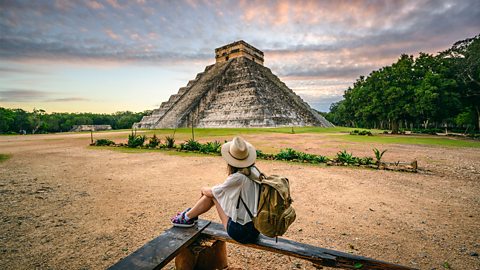
Vale la pena visitar Chichen Itza en México. – It’s worth visiting Chichen Itza in Mexico.
Higher Tier - Vocabulary sheet
Click or tap on the image below for a list of useful Higher Tier vocabulary to use when talking about holiday activities.
Now you have revised the important vocabulary and key grammar points for talking about holiday activities, why not have a look at the Holiday destinations in Spanish guide?
Careers advice and tips from BBC Bitesize
Future careers, further studies and the world of work - we're here to help with advice from experts and from young people who've found their path.

More on Travel and tourism, including places of interest
Find out more by working through a topic
- count3 of 4
- count4 of 4