What do you know?
What is the climate of a tropical rainforest?
Tropical rainforests are hot and wet. They have high temperatures and heavy rainfall throughout the year.
Key points
- Tropical rainforests lie along the equator, mainly between the Tropics of Cancer and Capricorn.
- Rainforests have four main layers: the emergent, the canopy, the under canopy and the forest floor.
- There are many causes of rainforest deforestation, which leads to loss of habitats, soil erosion, flooding and global warming.
- International agreements, 'debt for nature' swaps and selective logging and replanting of trees can all be used to help reduce deforestation.
Game - The rainforest
Play a Planet Planners mission to deal with the issues that the rainforest brings.
You can also play the full game
What are tropical rainforests?
Tropical rainforests lie along the An imaginary line that runs around the Earth. The equator marks the dividing line between the Northern and Southern hemispheres., between the Tropics of An imaginary line that runs parallel to the Equator at 23.5° north. and An imaginary line that runs parallel to the Equator at 23.5° south.. This part of the Earth receives the most solar energy and so air rises, creating clouds and heavy rainfall. Examples of tropical rainforest areas are the Amazon rainforest in South America and the Congo rainforest in Africa.
The Indian rainforest and its layers, plants and animals
Trekking through the Amazon rainforest is something that's high up on many travellers' to-do lists. But this is not the only tropical rainforest with natural beauty to behold. South America, Africa, and India also have an abundance of wildlife and wonder. But what is it that makes this biome home to so many species of plants and wildlife?
Tropical rainforests form a broad, discontinuous belt around the world, centred at the equator and extending from the Tropic of Cancer in the north to the Tropic of Capricorn in the south. The climate in this biome is humid, and there’s no winter or summer. Instead, it’s hot and wet all year, providing the perfect climate for plants to flourish.
Much like deciduous forests, tropical rainforests are made up of a number of layers.
Ground Layer: Very dark and steamy due to the heat, with only 2% of light penetrating through. It contains a lot of dead and quickly decaying plant matter, such as leaves that rot away. The rapid decomposition releases nutrients that are quickly absorbed by the plants and trees, leaving the soil relatively infertile.
Shrub Layer (0–10m): Made up of smaller plants, including orchids. It grows thickly near openings in the forest, rivers, and small clearings. Depending on the forest, you might find alligators, jaguars, snakes, and insects such as ants and tarantulas here.
Under Canopy (10–20m): Made up of young trees growing quickly as they compete to reach the sunlight. In the South American rainforest, you’ll find insects, sloths, and howler monkeys here.
Main Canopy (20–30m): Acts like an umbrella, shading the layers below. These trees are tall and straight with few branches. Creepers called lianas root in the ground and have leaves and flowers up in the canopy. Epiphytes grow on the trunks and branches of trees, obtaining nutrients directly from the air or rainwater.
Emergent Layer (30–40m): Made up of one or two of the tallest trees in the rainforest. These trees have wide buttress roots that provide stable support. This layer is alive with birds, insects, and butterflies.
Trees and wildlife have learned to flourish in this environment, making the rainforest biome the most biodiverse in the world.
Take the Teak tree, for example. It has a long, straight trunk that allows water to run down quickly to the forest floor. It can grow as wide as 1.5 meters across and as tall as 30–40 meters. Its branches spread out horizontally so the leaves can capture as much light as possible. It’s a deciduous tree, shedding its leaves during dry seasons to conserve water. Its wide buttress roots form a triangular base that supports the tree during high winds.
The rainforest is home to some weird and wonderful animals—from pythons in Africa and Asia to the Indian Elephant. When fully grown, the Indian Elephant has no predators other than humans. They travel in herds and can group their young together for protection. Their trunks help them reach high branches or search for food on the ground. They strip bark from trees using their tusks and even bore into the ground in search of water. Their large ears help keep them cool in the tropical heat—flapping them can reduce their body temperature by up to 5°C as heat is released from capillaries near the surface.
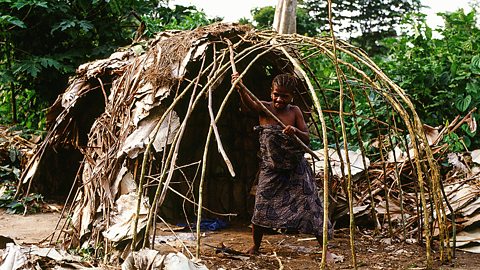
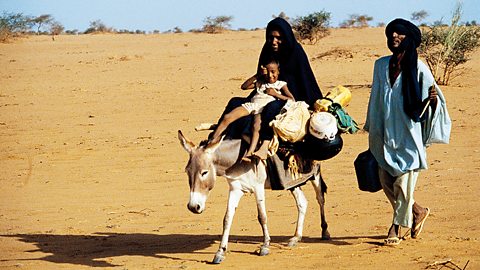
Some tribes still inhabit tropical rainforests around the world. These people hunt for food and have learned to survive among the plants and animals.
Humans use resources from tropical rainforests such as rubber, bamboo, and wood. We also harvest food like cocoa beans, coffee beans, and nuts. However, deforestation is happening at an unsustainable rate. If this continues, it could have a huge impact on the entire planet.
As you can see, the hot and wet conditions allow many plants and wildlife to flourish, and many have adapted to survive in this tropical biome.
The layers of a rainforest
Rainforests have four main layers: the emergent, the canopy, the under canopy and the forest floor. The top emergent layer of the rainforest receives the most sunlight, while the forest floor at the bottom receives the least amount of sunlight. Each layer experiences different levels of water, sunlight, and air circulation.
| Emergent | The tallest trees in the forest, some over 50 m in height. Parrots and bats live here. Parrots have sharp beaks to crack open nuts and large toes to grip the tall trees, which sway in the wind. |
| Canopy | The canopy receives high levels of solar energy. Monkeys and sloths live here. Monkeys have strong tails to help them to swing through the trees. |
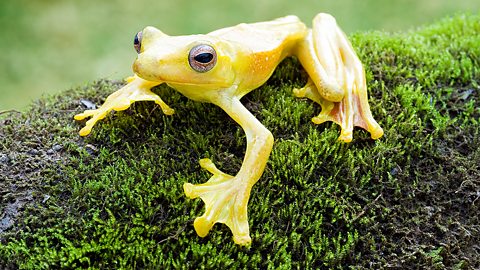
| Under canopy | A lower level of trees that only receives around 2 to 15 per cent of the sunlight falling on the forest. Frogs and snakes thrive in the damp conditions here. The flying frog has web-like feet, which allow it to glide through the air. |
| Forest floor | The forest floor is very dark and often covered in fallen leaves. Jaguars and gorillas are found in some rainforests. Jaguars have camouflaged fur, which allows them to blend into the forest. They are also excellent swimmers. |
Question
Which rainforest layer do monkeys live in?
Monkeys live in the canopy layer. They have strong tails to help them to swing through the trees.
Life in the rainforest for people
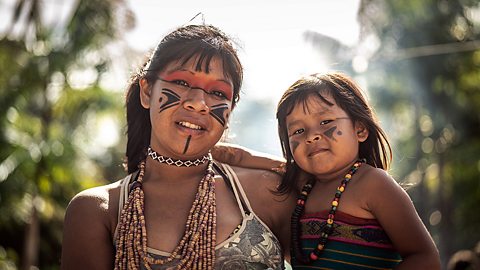
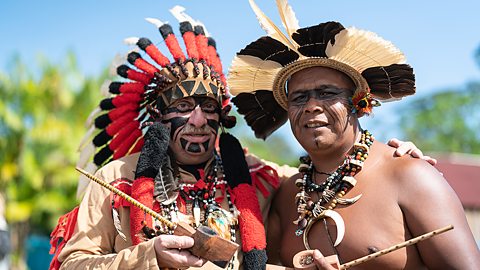
Image caption, We do not know how many people live within the world’s rainforest. Some areas of rainforest are vast with indigenous tribes who have never had contact with the outside world.
1 of 5
Question
Which country has granted rainforest people ownership of land?
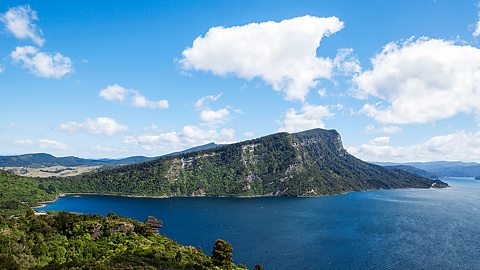
The country of New Zealand has granted ownership of the Te Urewera National Park to the Tūhoe people. They are now the legal guardians of the rainforests there.
Game - LIC deforestation
Play a Planet Planners mission to deal with the issues that rainforests face in a low-income country.
You can also play the full game
What are the causes and effects of rainforest deforestation?
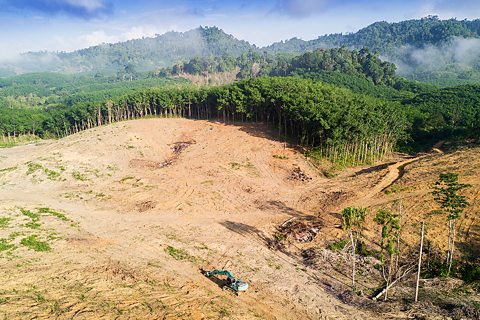
An estimated 12 million hectares of rainforest had been lost annually since 2010. This is an area approximately the size of England each year. Deforestation has slowed down in recent years, but still remains a concern.
Causes of The clearing of forested land for example for building on. include:
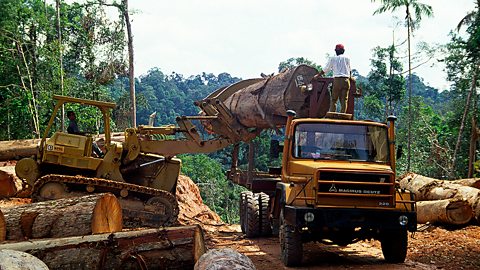
- The removal of trees to create logs that can be sold. for timber and Wood that is used to make paper.
- large-scale farming
- Growing crops or rearing animals to feed yourself and your family. Subsistence farmers do not grow food to sell, so only sell food if they grow more than they need.
- mining
- A method of generating electricity using the power of water in motion. This is usually done through building a dam and allowing water to flow through part of the dam, where it is turned into electricity.
- settlements and road building
Deforestation leads to a loss of An environment where a particular species of animal or plant lives. for people of the rainforest and many animals. Loss of tree cover exposes soil. Heavy rainfall can then cause When soil is taken away by things like the wind and water. Loss of soil through erosion makes it harder to grow crops. and flooding. On a global scale, loss of rainforests contributes to An increase in atmospheric temperatures that can be caused by human activity.. This is because trees store carbon.
Rainforests can be managed to prevent deforestation. The table below summarises some ways that this can be achieved.
| Type of management | Explanation |
|---|---|
| International agreements and debt for nature swaps | These are agreements between different countries. For example, the Paris Agreement on climate change (2015) aims to protect the world’s forests. This happens when a country’s debt is reduced in exchange for rainforest conservation (protecting the forests from harm). There are renewed calls for countries like China to swap ‘debt for nature’ with nations that owe them money, such as Laos and Cambodia. |
| Selective logging | This means only removing the trees that are worth the most money. Selective logging protects the rest of the forest. |
| Replanting | Replanting areas of lost forest can help repair the damage already done. |
Question
On a global scale, what problem is caused by rainforest deforestation?
Deforestation of rainforests contributes to global warming. This is because trees store carbon. This is a global consequence as it affects everyone on the planet.
Game - Rainforest sustainability
Play a Planet Planners mission to develop sustainable forestry industries and help people live more in tune with nature.
You can also play the full game
Test your knowledge
Revise for your exams with BBC Bitesize
Get ready for the GCSEs with quizzes, past papers, flashcards, podcasts and more resources!

More on Global biomes
Find out more by working through a topic
- count3 of 5
- count4 of 5
- count5 of 5
- count1 of 5