What do you know?
Where are the coldest places on Earth found?
The coldest places on Earth are found at, or close to, the North and South Pole. Mountainous areas are also very cold.
Key points
- Cold environments are found at higher latitudes and higher altitudes. They include polar, tundra and mountain, or alpine, biomes.
- Cold environments face challenges from development. This includes tourism, fishing, mining and energy.
- Climate change is affecting cold environments. As global temperatures rise, the world’s ice sheets and glaciers have begun to melt.
What are cold environments?
Cold environments are found at:
- higher Imaginary lines that run east to west around the Earth, parallel to the Equator or 0° latitude. They can be measured in degrees (°)., where Heat and light emitted by the sun. It can be used to generate electricity and to heat water. is lower
- higher The height of the land, measured in relation to sea level., because there is a decrease in air temperature of around 0.6 to 0.7 °C for every 100 m gained in height
Cold environments include polar, tundra and mountain (or A cool climate found in mountainous areas.) A large region of Earth that has a certain climate and certain types of living organisms like a large-scale ecosystem eg. a tropical rainforest.. They are home to many people.
Polar biomes
Polar biomes are areas close to the North and South Pole that have long, cold winters. Average How warm or cool something or someone is. Air temperature is usually measured in degrees Celsius (°C). are mostly below freezing. Very little Any moisture that falls from the clouds, such as snow, rain, hail and sleet. falls. Small plants, such as A small flowerless plant that grows in damp places. Mosses don’t have roots and so can grow in places where there is very little useable soil. and A type of plant with no stems or leaves that grows in water or on damp surfaces., can survive the harsh conditions. Polar bears live in the Arctic and have two layers of fur to keep them warm.
Tundra biomes
Tundra biomes are found in The continent that surrounds the South Pole. and in the Any part of the Earth that lies to the north of the Equator. below the polar biome, eg Russia, Greenland, Canada, Alaska and Scandinavia. Snow covers the ground for much of the year and Ground that remains frozen for a period of two years or more. restricts plant growth to small species such as grasses and low shrubs. Species such as reindeer are found in the Places located at high latitudes. Tundra regions have very cold climates.. Reindeer can see Rays that originate from the sun. Over-exposure to these rays can be harmful for humans. (UV) light, which helps them to see during the long, dark winters, when there is very little sunlight.
Mountain, or alpine, biomes
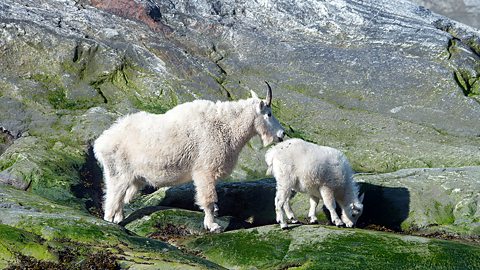
Mountain, or alpine, biomes are found throughout the world, at high altitudes, such as the Alps in Europe and the Himalayas in Asia. These regions are usually windy and cold. Low-growing plants can survive, whereas taller plants like trees would get blown over. Mountain goats live in high altitudes. They have two toes with rough pads to improve grip. They can climb steep cliffs and rarely slip.
Question
What animals live in the tundra?
Despite the freezing conditions, many animals have evolved to live in the cold tundra biome. In the northern tundra mammals such as reindeer, lemmings, Arctic hares, Arctic foxes, and polar bears can be found, as well as many bird species including snowy owls, and ptarmigans. Several species of penguins live in the Antarctic.
Life for people in cold environments
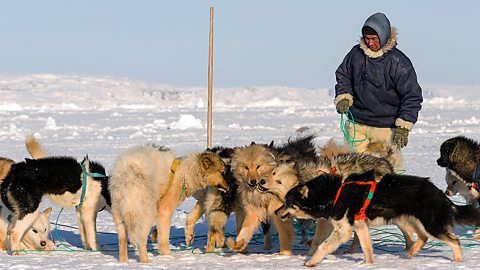
Image caption, An Inuit hunter with his dogs near Kullorsuaq, Greenland
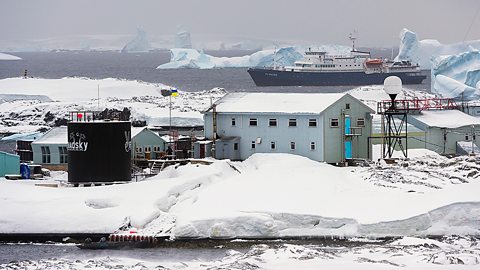
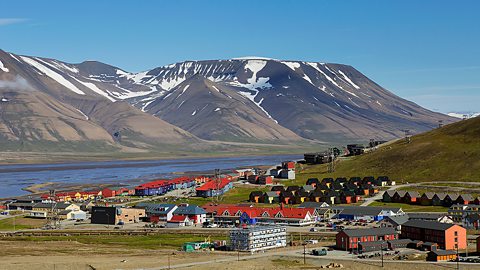
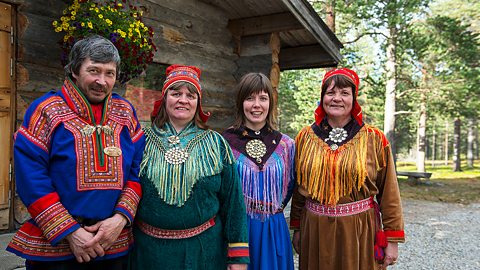
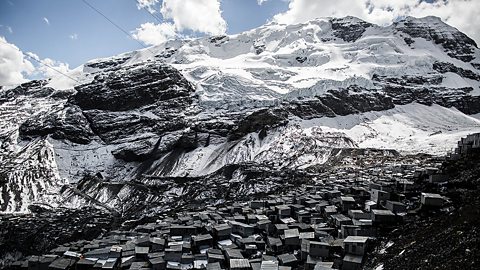
Many people live in cold environments. These include researchers in Antarctica and people living in Svalbard in Norway, Alaska and Greenland, Lapland in northern Europe and La Rinconada in Peru.
1 of 5
Question
What is the world’s most northerly permanent town?
Longyearbyen in Svalbard is the world’s most northerly permanent town. Also in Svalbard is the smaller settlement of Ny-Ålesund, which is over 100 km to the north of Longyearbyen, and home to a number of research and science institutions. The Canadian military base of Alert in Nunavut is the northernmost inhabited place in the world. It lies around 800 km from the North Pole.
What challenges are cold environments facing?
Tourism
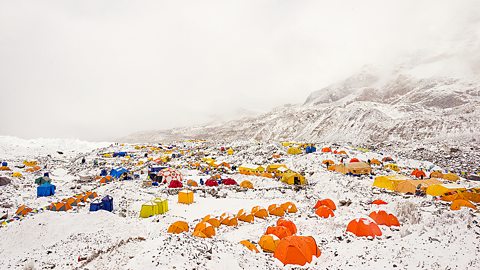
An estimated 800 people reach the summit of Mount Everest every year. Everest is the tallest mountain in the world. The mountain can become crowded with people, and litter has become an additional challenge. People are leaving food wrappers and equipment, such as tents, on the mountain when they leave. Human waste, from mountaineers who need to use the toilet, is also left behind. This litter is bad for the environment and can be dangerous for people.
Fishing
In the US state of Alaska, nearly one in 10 people work in fishing or fishing-related industries. Salmon is very valuable and so the fish numbers in Alaska are carefully monitored to prevent When too many fish are caught in any one area of water. This means that the fish cannot repopulate and so may disappear completely..
Mining and energy
32 new gas fields are opening in the Yamal Peninsula, northern Russia. They could provide enough gas to heat a quarter of the homes in Europe for 35 years. Special ships, capable of breaking through thick ice, will transport the gas. The gas pipelines are blocking the migration routes of Yamal reindeer herders.
Climate change
The long-term change of temperature and typical weather patterns. is affecting cold environments. As global temperatures rise, the world’s A large layer of ice covering the land. and A large mass of ice, slowly moving downhill through gravity. have begun to melt. The melting of sea ice around Greenland has meant that the Inuit people have lost hunting grounds and find it difficult to move from village to village.
This is also affecting polar bears, as they rely on the sea ice to hunt for seals. Polar bears are struggling to find enough food and have to travel further to find food. Some studies suggest that polar bears could die out completely by 2100.
Question
What are the challenges Mount Everest faces?
Mount Everest faces challenges from people. An estimated 800 people reach the summit every year. They cause problems with overcrowding and litter.
Test your knowledge
Play Planet Planners on Roblox! game
Explore global locations, solve real-life challenges and make the big decisions that shape the future.

More on Global biomes
Find out more by working through a topic
- count1 of 5
- count2 of 5

- count3 of 5
- count4 of 5