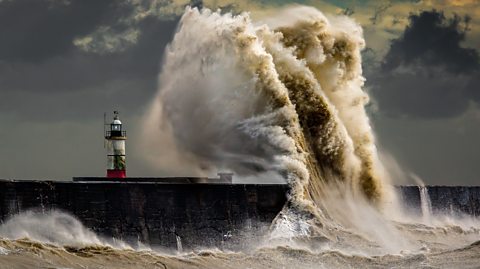
What you need to know about extreme weather events
It's the beginning of wet weather season in the UK (though, let's be frank, when does it end) and storms appear to be brewing.
Have you ever wondered, while watching the news, why storms always have human names? I mean, a ferocious, battering, nigh on arctic wind, coming over to blow down leaves and whip off roofs and everyone's calling it… Brian???
Well, wonder no more, because here at BBC Bitesize, we've answered some of the weirdest weather wonderings we found on the web.
Why are storms given human names?
People have been naming storms for centuries now, with early examples dating all the way back to the 1500s - but why?
Well, simply, it makes it easier to communicate about severe weather events, providing clarity and simplicity for both weather agencies and the public.
Storms in the UK are named by the western storm naming group, made up by the UK Met Office, Ireland's Met Éireann or the Netherlands' KNMI. Storms are given names when thought to present "medium" or "high" potential impact.
This is judged primarily on wind, though things like snow and rain are sometimes considered in the process.
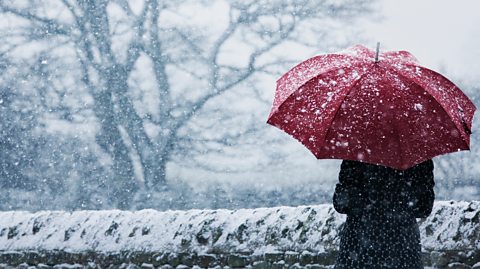
What storms will hit the UK in 2025/2026?
Since 2015, the western storm naming group has taken storm names via public suggestion, selecting their favourites to make up the 21 name list for that year's storms.
Read below for the selected storm names for September 2025 - August 2026:
- Storm Amy
- Storm Bram
- Storm Chandra
- Storm Dave
- Storm Eddie
- Storm Fionnuala
- Storm Gerard
- Storm Hannah
- Storm Isla
- Storm Janna
- Storm Kasia
- Storm Lilith
- Storm Marty
- Storm Nico
- Storm Oscar
- Storm Patrick
- Storm Ruby
- Storm Stevie
- Storm Tadhg
- Storm Violet
- Storm Wubbo
The UK storm name list only includes 21 letters of the alphabet, to stay in step with the US National Hurricane Center. In America, storm names are taken in rotation from six separate lists of names, and so don't include the letters Q, U, X, Y or Z - as there wouldn't be sufficient options.
What is a tropical storm?
A tropical storm is a powerful low-pressure weather system, characterised by strong winds and heavy rainfall that can be disruptive and dangerous.
Seen from above, a tropical storm would resemble a massive whirlpool of spinning clouds, rotating around a centre known as 'the eye'. Measuring up to 644 kilometres wide and up to 8 km high, tropical storms move quickly in the atmosphere, reaching speeds of up to 60 km/h.
These tend to be at their most powerful while over the ocean, slowly weakening as they reach land due to a lack of heat and moisture they can find above the ocean.
To read more about the development of tropical storms, check out this article from BBC Bitesize.
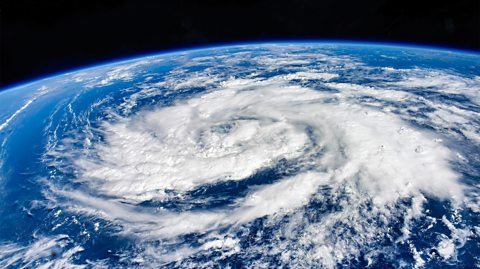
What is a hurricane?
Hurricane is the name given to a tropical cyclone that forms in the Atlantic or east Pacific ocean.
Hurricanes develop in the same way as any other tropical storm, and will be designated as a hurricane when wind speeds reach up to 74mph.
Hurricane is the preferred lingo for meteorologists in the US, whilst those formed in places like China and Japan are given the name typhoons, and those in the Indian Ocean are mostly called cyclones.
What is a tsunami?
A tsunami is a wave, or series of waves, that build up in the ocean before crashing onto land.
Usually caused by earthquakes or volcanic eruptions under the sea, tsunamis grow taller as they approach land, creating a sort of wall of water and debris. Tsunamis can reach speeds of up to 500mph - similar to a plane or jet.
Tsunamis usually occur around the pacific ocean, in areas like Indonesia or Japan. As a matter of fact, the name 'tsunami' comes from Japanese, meaning 'harbour waves' - in reference to their effect on coastal or harbour towns.
Due to their general area of occurrence, it's highly unlikely that the UK will be hit by any kind of tsunami wave.