It makes the world go round
For thousands of years, money has been used in various forms across the world and, without it, life would look very different. Trading has long been practised through time, but the first people to use gold and silver coinage are said to be the Lydians from Turkey, in the late 7th century BC.
In more recent decades, how our money in the UK looks and how it has been used has changed dramatically. But how has it changed through the generations?
Here, BBC Bitesize takes a closer look at the history of the UK currency, how prices and shopping habits have changed and more. You can also take our IYKYK quiz to guess the price of several food items from over half a century ago!
What is money and why do we use it?
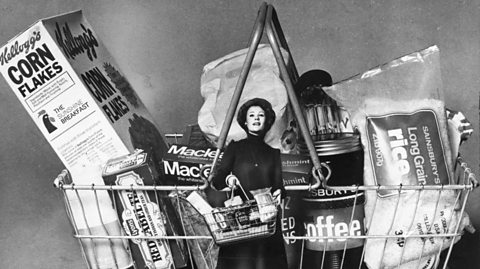
Playing a key role in our daily lives, money is used in its different forms around the world. But what is money and why do we need it?
Developed over time, money is what we use to pay for things that we need and, on other occasions, things we want. Things we need in everyday life vary from food to clothing, bills and more
Things we want are usually items that are not a necessity. Coins and notes are the usual physical forms of money, as well as bank cards, but as technology has developed, we have also been able to make purchases and exchange money electronically, such as using a banking app or purchasing goods online.
Money enables us to support ourselves, live comfortably and have the freedom to choose how we wish to live. People earn money through working, as well as selling items or fundraising.
Where possible, people save money and budget to be able to afford things in the future or for security. Financial responsibility is very important and is all about knowing how to spend your money wisely.
What is currency?
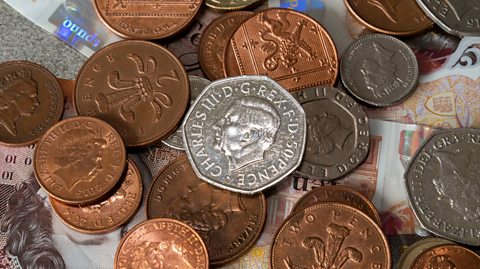
The term currency means a system of money that a particular country uses. The one you’ll likely be most familiar with is the British Pound Sterling, which is used across the UK.
Represented using the symbol £ for pounds and p for pence, the coins used in the UK are the penny, 2 pence, 5 pence, 10 pence, 20 pence, 50 pence, £1 and £2, whereas the notes are £5, £10, £20 and £50. Different countries have different official currencies and even share the same type or name with others.
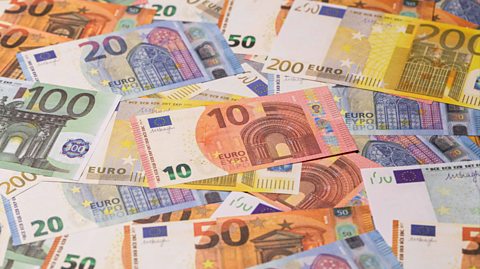
The euro (€) is used by many EU (European Union) countries, the United States has the US Dollar ($) and in Australia they have the Australian Dollar, sometimes abbreviated to A$ to distinguish itself from other countries' currencies.
Not all currencies have the same value, and this can change over time. You can convert money from one to another and the foreign exchange rate compares the value of one currency with another.
How has money changed in the UK?
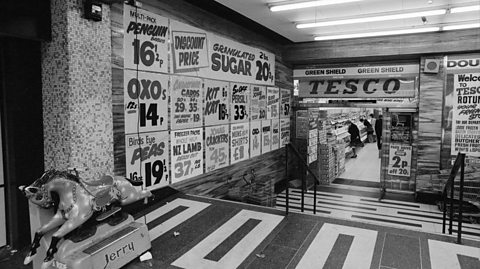
In the UK, the money we use didn’t always look like it does today. Many will remember the days of pre-decimalisation, the currency system before 1971 which used pounds, shillings and pence.
During this era, generations only knew there were 12 pennies to the shilling, 20 shillings to the pound and one pound was made up of 240 pence. Instead, decimalisation meant the pound would now be divided into 100 “new pence.”
The decision to go decimal was announced back in the 1960s and the change to the current decimal system was officially made on 15 February 1971, which became known as Decimal Day. In the years prior, several coins we still use today were gradually introduced, whereas others from the pre-decimalised era were demonetised.
One coin which survived much longer was the sixpence, worth 2.5p, which remained in circulation until 1980. And while it’s now been decades since the change, the physical look of money in the UK has also evolved.
It was in 2016 that new notes began to circulate that were made of polymer – the plastic material being more resilient than the previous paper form. Back in 2017, the new shape for the £1 coin was also introduced and while it is roughly the same size as the design prior, it is instead gold and silver coloured and has 12 edges.
For over 1000 years, the link between The Royal Mint, the official maker of UK coins, and the British monarchy has continued, with coins through the centuries featuring monarchs and milestone moments in history. Today, you’ll see more coins and notes with a portrait of King Charles III coming into circulation, following the death of his mother, the late Queen Elizabeth II, in 2022.
What is inflation?

When talking about money, you’ll likely have heard of the term inflation - meaning the rise in the cost of goods and services over a period of time. The term inflation rate means the amount by which things are getting more expensive.
Inflation reduces the purchasing power of money, meaning more money is needed to buy the same items. When inflation is low, things are more affordable - whereas when it is high, prices rise and it will cost more to buy items you both need and want.
An index is used to track how the price of items change over time and the result is usually produced as a percentage. If inflation is high and income does not increase at the same rate, this can impact people’s day-to-day lives, as well as businesses as many people will be spending less.
How have shopping habits changed?

Over time, how we use our money, shopping habits and what we want to purchase has changed in the UK and beyond. Certain generations will remember growing up without fridges or freezers, meaning they shopped more frequently as they were unable to store food.
Post-war, the first self-service supermarket opened in Britain in 1948 and before the concept became more popular in the decades that followed, families would only have the option to visit various shops that sold different kinds of food. In the 1970s, Green Shield Stamps, a British sales promotion scheme, rewarded shoppers with stamps that could be redeemed.
This meant shoppers could scan a catalogue and choose various items or gifts from an affiliated retailer. For decades, cash was king for many who used notes and coins to buy items – and bank cards didn’t have contactless options, and there were no mobile phones with the ability to pay via a card reader.
Today, supermarkets offer home delivery when ordering from their website and online shopping continues to be increasingly popular. Many items found in physical shops can now be purchased online and delivered to store, your home or a selected pick-up point.
There are advantages and disadvantages to this. For example, while it can be convenient or more accessible, it also means not being able to see the physical item before purchase or the item taking longer to reach the purchaser.
Take our IYKYK quiz
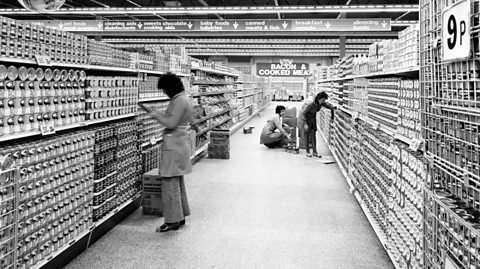
Now we’ve taken a trip back in time, IYKYK have created a fun quiz on how prices of various food items have changed since 1975 – over five decades ago! Courtesy of the ONS (Office for National Statistics), the data is derived from the Retail Prices Index and includes the average price of selected food items from that year.
The results were provided in new pence per kg, unless otherwise stated in the data. The items included are not specific to any particular brand or packaging and are only the average price. Prices looked quite different decades ago and have changed over time due to various reasons, such as inflation.
Take our quiz below and see how many you know or can guess – good luck! For more articles and quizzes, you can visit our IYKYK section.
This article was written in January 2026
Can you guess the price of these food items from 1975?
Learn more about shopping and the economy
- Inflation - The economy and business
- Being an effective consumer when shopping for food
- Shopping online - The impact of ICT on society
- What is a mortgage and how is it affected by interest rates?
- The remarkable items that have been used as currency
- Is 2026 the new 2016? 10 things that are now a decade old
