By Fiona Lean, project co-ordination assistant, World Service Trust Eurasia, 18 May 2004
What do you think of Kuchma? I asked my guide at the Monastery of the Caves. He looked around furtively and said: "That depends on who’s listening."
More positively, he continued: "We’re learning to be an independent state. We’ve always been under the control of someone else. Now we’re going it alone, it’s a different experience."
I’m in Ukraine because it’s in the throes of changing from a totalitarian state to a democracy. No, I’m not Colin Powell or Henry Kissinger but, through the BBC World Service Trust, I’m involved with EU sponsored project Support to Independent Media in Ukraine.
Not all of the Trust’s projects are high profile, as this one proves. Its objective is to strengthen independent media practices and attitudes in Ukraine, so that journalists and managers can improve their skills and make more informed choices.
Training, round-tables, conferences, scholarships, study tours, press club activities and broadcasts are the means of delivery.
Golden age of Kiev
My role is to ensure that the requirements of the activity schedule are met, and the timetable and budget adhered to.
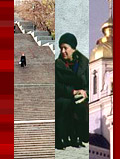
I have a meeting in Kiev with the EU and our project partners. There is so much to see in Kiev you won’t cover it even in a long, long weekend. The Monastery of Caves, with its cathedrals and catacombs, takes you back to the golden age of Kievan Rus – roughly between the 9th and 12th centuries – when what is now Ukraine was a great power.
In 1169 Kiev was ransacked by a petulant prince. Attempts were made to rebuild the great state, but within fewer than 60 years Genghis Khan and his Mongol horde came thundering in from the east.
After the Mongols left, the Poles, Lithuanians, Muscovites and Russians came; the indigenous population kept their heads down and clung to their art and culture.
Chekhov's lady gazed over the sea
Today Kiev is a tribute to them. Its golden-domed colourful churches stand out like beacons against jaded Soviet architecture, and there is a wealth of galleries and museums. Shopping malls are thronged with eager young Kievlens intent on the latest fashions and technology.
My meeting goes smoothly and after a lunch of vareniki, golubtsy and smetana, I fly to Odessa where the implementation proper of the project takes place. Tony Howson is the team leader, helped by seven staff and a driver.
The office teems with activity. Tony’s deputy, Natalia Petrova, a leading media lawyer, is preparing for her master classes, the electronic newsletter is being prepared, courses are being marketed, and there’s a stream of visitors asking about training sessions and using the reference facilities.
A team brief is held. Tony and I meet Odessa Airlines to discuss prices for a study tour to Germany.
I’m trying to write up the minutes of yesterday’s EU meeting. I’m not going to see much of Odessa at this rate. There’s the Potemkin Steps, the promenade where Chekhov’s lady with her lapdog gazed wistfully out over the Black Sea. My flight leaves at 6am tomorrow.... next time maybe.
^
Back to top