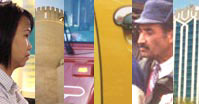
Making it Happen is about changing the BBC into the most creative organisation in the world, putting creativity and all our audiences at the heart of everything we do.
This major internal BBC change initiative was launched in the UK by Greg Dyke on 7 February 2002.
Making it Happen has already consulted with over 10,000 BBC staff in the UK and around the world. They have said what they thought of the BBC, how to make better programmes for today's audiences and how to make it feel better as a place to work.
Making it Happen around the world - MiHW - is a One BBC project, part of the second phase of Making it Happen.
Because people in different parts of the world have different needs, it's especially for BBC staff based all over the world, but it also includes some useful tools for people who travel overseas on behalf of the BBC.
What's happened so far?
During the first year, Just Imagine sessions across the BBC kick-started Making it Happen. The first international Just Imagine session took place in Prague on 20 July 2002, then Delhi on 4 September, the next was Nairobi on 19 September. Moscow, USA, Sydney and others followed around the world.

A little over a year on from the launch of Making it Happen, on 15 May 2003, Greg Dyke announced its progress at The Big Conversation, the largest ever interactive debate to discuss the changes and pose questions to the Executive Committee.
The first Big Conversation, on 15 May, involved Delhi taking part in a live link with London. Many other offices around the world took part on the day, including Dhaka, Nairobi, Cairo and Moscow. Later that same day, feedback from some of the offices was posted in the Live Chat with Greg Dyke.
Since then, Big Conversations have also taken place in New York, Washington, Sydney, Hong Kong and Tokyo.
We hope these sessions around the world have provided a forum for you to have your say. And we have been listening to you.
Because of your feedback, MiHW aims to respond to your specific areas of concern, and work with you to implement new ideas for our global network of staff.
What did you tell us?
The Big Conversation marked the beginning of a new phase of delivering change across the BBC.
MiHW is underpinned by the same overall values, but some of the goals we need to achieve are different from MiH in the UK.
Much of the feedback we received from staff around the world was about working together as One BBC and about Valuing People.
You asked us to take another look at a range of different issues, particularly some that fit in with the People theme.
Some of you raised questions about Conditions of Service; your contracts and your different conditions of employment with the BBC.
What are we going to do?
A team from across different BBC divisions is working towards making conditions more consistent. And where that is not possible, on being clearer about where and why differences will apply.

One thing is clear, that it is likely there will always be some differences. That's because you are in different parts of the world and work for different parts of the BBC, from public service to commercial.
It's a daunting task, because we have to look at the local law of every country in which we operate. So, it will take time.
We're already working towards a Statement of Commitment for our international people which, for the first time, will set out our principles of employment for locally-employed staff around the world.
We're also looking at some other people initiatives to see how these can be made available to staff around the world.
Talk to each other
Communication proved another key area of common concern around the world.
One of our MiHW goals is to open clearer channels of communication within the organisation, to create a dialogue within and amongst BBC staff around the world, and in the UK.
This portal is a 'quick win' to help achieve this goal.
And the MiHW team are also working to raise the profile of our international staff across the organisation as a whole.
Our values are becoming increasingly important in the way we work together. They are the standards which people across the BBC share.
These values represent the things we cherish and aspire to; they guide our day to day decisions and shape our individual and collective behaviour wherever we are in the world.
On this site, we've given you quick links to each of our values, so we can all keep them in mind.
Work together
At this early stage, the divisions of the BBC with the most staff working for them around the world are the main drivers behind MiHW. The key players are World Service, Worldwide, World and News.
As the project evolves, it is expected that other parts of the BBC operating around the world will become more and more involved.
And many others are already starting to get involved now, like BBC Monitoring and WS Trust, Broadcast, Factual & Learning, Drama and Nations & Regions, all of which have staff working for them in different parts of the world.
Mark Byford, BBC's Deputy Director-General, is champion for BBC staff around the world, whatever division you work in.
Mark, together with the MiHW team, will be working with you to get your voice heard, as a vital part of making One BBC happen.
^
Back to top