By Grant Goddard, Radio consultant, Phnom Penh, 11 May 2004
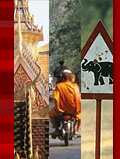
I pull back the bedroom curtains and, from my window, see a huge elephant ambling along the promenade above the Mekong River.
Every morning at 6.30 Sam Bo, the only elephant in Phnom Penh, walks to his day job giving rides around the base of the city’s only hill. The street is already filled with rush hour traffic, since most shops and offices open at 7am.
Weaving in and out between huge 4-by-4s driven by various officials are hundreds of motorbikes, which have replaced the bicycle as Cambodians’ preferred mode of transport.
If there is a highway code, nobody seems to have read it. Confusingly, traffic travels in both directions on both sides of the road and often on the pavement too.
It’s the LA of Asia - nobody walks
You see youngsters riding motorbikes to school, and parents carrying three or four children precariously on a single bike. I’ve seen a motorbike carrying a palm tree, another loaded with an iron girder which could have decapitated someone, and a bike carrying three dogs, one with its paws on the handlebars. Few people wear crash helmets but most wear surgical masks to keep out the dust, pollution and bugs.
Phnom Penh is the LA of Asia - nobody walks. What were once pavements are now clogged with parked cars and bikes, impromptu shops, and families selling petrol in old bottles from the kerb. The few walkers - the very poor and foreigners - are forced to negotiate the gutter, risking being hit by bikes coming from all directions.
I work at the Women’s Media Centre where I’m training four enthusiastic staff to produce a youth phone-in show. They are excited that the centre has been nominated for the One World Broadcasting Trust special award for development media. The team has proudly designated its office the ‘BBC office’ even though they are not BBC staff.
The future will be bright
The only drawback to working in this beautifully airy, purpose-built place is that we are shadowed by a huge transmitter mast in the car park that broadcasts the centre’s radio station, FM 102, to 60 percent of the population. Although customary to remove shoes before entering the building, staff must don flip-flops to use equipment such as the photocopier, or risk electrocution from the mast’s 10kW electrical field.
At lunchtime, almost everyone goes home for a two hour siesta that offers relief from the 35-degree heat. I take lunch at the real BBC office – a villa whose walled garden includes banana and mango trees - with some of the 30 local staff who live too far away to go home.
Malene, one of two BBC housekeepers, buys our food from the plethora of pavement stalls, at less than a dollar each. Dishes always come with boiled rice or noodles, although Malene once proudly gave me chips procured from who knows where.
After a productive afternoon’s work, I walk home past a school when a girl about 11 rushes out, runs across the road and starts talking to me in perfect English. After a minute, a motorbike taxi stops outside the school gates; she bids me farewell, jumps on the back (side-saddle, as is usual for girls) and waves goodbye as she disappears down the street.
She inspires confidence that the future of this country will be bright in her generation’s hands.
^
Back to top