By Joanna Carr, radio producer, Washington, 2 March 2004
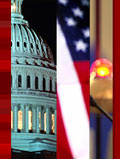
St John’s, Lafayette Square, is the presidential church, a pale yellow building which stands across the square from the White House. Abraham Lincoln prayed here during the Civil War, Bill Clinton once walked through a snow storm to attend services at St John’s, and now George W Bush is often to be found at the 8am service.
It’s enough to make any church nervous about the media, so when I rang to ask if it would be possible to record a service as part of a package on religion and politics I was expecting at the very least some careful bargaining.
What I got was an exceptionally friendly call from Bill Roberts, the church organist. He was, he said, ‘always happy to have the greatest broadcaster in the world’ in his church.
Juggling a burrito and a mobile
The enthusiasm was striking, but not exceptional. One of the gratifying things about my stint here on attachment is the warmth with which the BBC is received in this country.
The strange thing is that people approach you when you’re broadcasting in the most unlikely places – North Dakota, Texas – to say how much they like and rely on BBC news.
In November, reporter Daniela Relph and I were covering the 40th anniversary of John F Kennedy’s assassination in Dallas, Texas. Every time we set up our baby satellite dish for a live, we would draw an interested gaggle of tourists and Dallas-ites.
Hearing our accents, people would ask: ‘Are you the BBC? We love the BBC’ usually followed by a complicated explanation of how they listened (on the internet, or to the World Service via the local public radio station).
Even at lunchtime, as I was juggling a burrito and a mobile phone, the young couple at the table next to me overheard my conversations, and shuffled up to chat. He was a local history teacher, she was a Spanish teacher, and they were taking their new born daughter out for her first public outing.
With much rolling of eyes, they explained that they never felt they really knew what was going on when they listened to the domestic news. And this was not in an Islington drawing room, so beloved of BBC bashers everywhere, this was in a McDonald’s-owned fast food restaurant in Texas.
We make a difference
Colleagues who have been here longer than me tell the same story: waitresses in North Carolina diners, radio hosts in Frederick, Maryland – most people here have a story to tell about BBC fans in the least likely places.
Perhaps this is a reflection of the fact that apparently BBC World news is now carried on 229 public broadcast stations and reaches around 88 percent of US television households.
I can’t pretend this is a blanket response or that such attitudes extend to every echelon of US society. These brief interludes of appreciation contrast sharply with the many unreturned phone calls we place.
But the BBC makes a difference to a lot of people here. They trust us to deliver news which is balanced and fair, and it’s nice to know that in St John’s at least, they’re praying for our collective soul.
^
Back to top