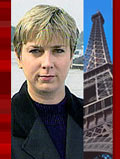
Caroline Wyatt, BBC Paris Correspondent, writes Ariel's first 'Foreign Bureau column, on 24 February 2004
'Parisians – rude? Hah! You haven’t lived in Moscow, have you?' is my irritating refrain to those who complain about life in Paris. It nearly resulted in a fine box being set up at the BBC Paris bureau for every time I responded unsympathetically to complaints about impossible bureaucracy or sullen officialdom.
One of the best things about moving from Moscow to Paris is my gratitude for almost everything: from the food and wine and architecture, to my pleasure as the initial frostiness of my local waiters and concierge melted into cordial smiles.
Those are the small triumphs that make a new city start to feel like home, eight months after moving here.
Even police officers are a model of probity, grace and charm compared with those in Moscow, especially the one who was meant to be guarding the Elysee Palace but left his post to help me pump a bicycle tyre.
However Paris did come as a huge culture shock after Russia.
So many of the stories we covered from Moscow were a matter of life and death: the war in Afghanistan, the Russians dying in -30C temperatures in Siberia because they had no heating, or the Chechen civilians whose menfolk were taken away by Russian soldiers, never to return.
A subtler level of story-telling
It was initially hard to sympathise with French farmers complaining about last year’s drought (‘How many of your sheep have died? None? Hmm.’).
Or respond with a sense of urgency to calls from London asking us to follow up stories about British tourists being mugged on a trip to France (‘They’re still alive? So what’s the problem?’).
I think both Allan Little and I have had to adapt, post-Moscow for me, post-South Africa for him, to a different, subtler level of story-telling. It’s the nuances that matter.
This is a fascinating time to be here, as the country realises it must do more to integrate its mainly north African immigrants. The Islamic headscarf has become an explosive focal point of a wider debate on multi-culturalism.
You can also feel the discontent as the government tries to cut back on the welfare state.
With regional elections coming up in March, I found myself at the political launch of the election campaign by Marine le Pen, Jean-Marie’s daughter who is rapidly becoming the more ‘acceptable’ face of the far right.
Politics, a tribal affair
During the last presidential elections, voters complained they had to choose between Jean-Marie Le Pen and a ‘crook’ – otherwise known as president Jacques Chirac.
One of my favourite stories so far is the rivalry between Chirac and his ambitious interior minister, Nicholas Sarkozy. So ubiquitous is he in the media that one MP has called for a ‘Sarkozy-free day’.
Yet when I managed to barge through his security guards to get close enough to Sarkozy to ask for an interview, he sailed on blithely towards Radio Marseilles’ mic, while treading on my toe.
And that remains one of the biggest problems here – the reluctance of many French politicians to talk to the foreign media. The coverage of politics here is a tribal affair, with most journalists allied to one side or the other.
And, unlike in Russia or my previous posting in Germany, French politicians don’t lose too much sleep over how the outside world perceives them.
^
Back to top