
By Jorge Chabat, Special correspondent, BBC Mundo
End of Section
The war against drugs has been waged for almost a century. This worldwide problem, far from being resolved, has worsened in terms of illegal drug consumption. For the countries involved in the production, transport and sales of drugs, it has cost them dearly.
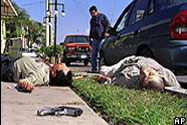
The strengthening of the Mexican cartels brought with it an increase in corruption and violence

More from Narco Mexico
From BBC News
BBC Mundo
These costs are particularly high in some Latin American countries where coincidentally, their security services and justice systems are rather weak, thus allowing effects of drug trafficking to seriously threaten their governability.
Such is the case of Mexico, at least for the last two or three decades.
Although the production and trafficking of marijuana and heroin has been going on in Mexico since the beginning of the 20 century, the problem reached alarming proportions around the mid 80s, when Colombian cocaine began to flood the US market and in order to reach its destination, it used the routes and services of Mexican marijuana dealers.
This caused an enormous increase in the numbers of Mexican drug traffickers who, in the mid 90's, came to fill the hole left when the Colombian cartels were dismantled.
The strengthening of the Mexican cartels brought with it an increase in the two side effects of drug dealing: corruption and violence.
Functional violence
The traffickers began to exert the violence that they needed to operate their illegal business: settling of scores, maintaining discipline within the criminal organisation, and executing those who had trespassed into their territory.
There were two key factors to maintaining this functional violence: a mediator inside the drug world - a role which many attribute to Amad Carrillo, head of the Juarez cartel - and a policy of tolerance by the Mexican government, the aim of which was to avoid the threat of destabilising violence, and which allowed the narcos to operate within certain unwritten rules.
These two elements in turn paved the way for the development of widespread corruption which tainted all the forces involved in the fight against drugs, including the Army.
This "narcocorruption" fitted in very well with an authoritarian political system, for whom the rule of law was not a priority and whose operation depended largely on institutionalised corruption in other walks of life.
In this sense it would be a mistake to say corruption arrived in Mexico with drug trafficking, but it is fair to say it enabled it to flourish and give it a dimension it had not had in the past.
This corruption slotted into a culture of lawlessness prevalent in the population and it remains to this day.
The fight against narcocorruption
When Vicente Fox came to power, the policy of narcotolerance changed and several drug barons were arrested.
This led to a relative reduction in corruption at federal government level, but violence increased, brought about by the imbalance of power within the narco groups.
At the same time, this led to war between the cartels, like the one between Sinaloa and the Gulf cartels in 2005.
The decrease in narcocorruption also led to the arrival of a PAN (Party for National Action) party candidate to the presidency, breaking the monopoly of 71 years in power of the PRI (Institutional Revolutionary Party).
The change in government had an effect on some networks of corruptionwhich had been established through drug trafficking. Paradoxically the political change had the effect of moving corruption out narco circles into state and municipal areas.
The government of Felipe Calderon decided not only to maintain the policy of fighting the trafficking organisations but to intensify it significantly, by means of a series of police and military operations.
This policy sent an open message to the narcos that it was time to stop the war they had started back in 2005.
There appeared to be a truce in 2007, when, according to certain sources, levels of narcoviolence went down, supposedly as a result of a pact between the Gulf and Sinaloa cartels.
New offensive
However, at the beginning of 2008 Calderon launched a new offensive against the structure of the cartels - not just against the bosses, as the Fox government had done.
The offensive has generated a fragmentation of the big cartels and as a consequence, an increase in violence within the narco groups, as well as an increase in attacks on police bodies and the army in Mexico.
The current scenario reveals a substantial lessening of corruption at federal level, though this is not the case at state and municipal levels.
At the same time, drugs related violence has increased alarmingly, which puts the Calderon government in a dilemma as to whether it should continue with this "war", and accept the heavy price it carries, in terms of the number of executions taking place, or to return to the policy of tolerance adopted by previous PRI governments, with the consequential increase in corruption.
A difficult choice indeed.
End of Section
Jorge Chabat is a Doctor of International Affairs at the University of Miami, and a member of staff of the International Studies Division of the Centre of Economic Research and Lecturing in Mexico. He is co-author of "Transnational Crime and Public Security: Challenges for Mexico and the US".

