
The Mexican government is maintaining its fight against drug trafficking.
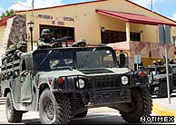
Around 45,00 army personnel have been deployed to fight drug trafficking in 16 states

More from Narco Mexico
From BBC News
BBC Mundo
Two years on from the start of this campaign when 45,000 operatives were deployed, there are positive results. This assurance comes from Facundo Rosas, Under Secretary for Police Strategy and Intelligence, in conversation with BBC Mundo.
According to Rosas, the level of violence in Mexico is wrongly perceived by its citizens, due to a lack of information.
"The results are positive," he said. "They show what has been seized in terms of drugs, weapons, vehicles, communications equipment and of course, the alleged perpetrators of the crime, not only drugs-related directly, but other crimes linked to trafficking."
An opinion poll commissioned by BBC Mundo revealed that 68% of those surveyed are in favour of using the Army in the fight against drug trafficking, but 80% feel that they should seek other alternatives. Is the government exploring other avenues?
Most definitely. In the same way the criminals are doing, the federal government is looking into different ways of tackling this problem.
Work is being carried out on two fronts. One is fighting the criminal structure, with intelligence operations and encouraging the public to report to the police.
The other operation has to do with criminal logistics: the vehicles they use, the weapons and communications equipment, and also combating their financial logistics - money-laundering and everything to do with the movement of their capital.
Drugs related violence has taken the lives of at least 3,000 people so far in 2008, already more than in 2007. What is the government doing about it?
We are investigating the likely perpetrators. There have been some arrests in the last few months.
You have to realise that some of these figures (numbers of violent deaths) also have to do with the fight for territorial control. That´s what we´ve discovered in these past two years: rival gangs are fighting each other and some of these figures are due to that confrontation.
In terms of what the authorities are doing, the results are convincing. The weapons, for instance: we have seized more than 20,000 from those criminal groups known to have used violence in their activities
Many critics of government policy point out that the strategy of deploying forces only serves to increase the violence, rather than control it. What can the government do to convince people?
The best way to resolve the problem is to face it head on. This is precisely what the President underlined - the people of Mexico will face up to this problem.
The decision of the State is not to take a backward step.
While the government´s campaign against violence caused by drug trafficking is supported by some, it is also evident that large numbers of Mexicans feel much less secure that a year ago. According to the BBC Mundo survey, at least 42% of the respondents feel that way. What is the government doing to change that perception?
We are implementing awareness campaigns, particularly aimed at vulnerable sectors of society where this kind of violence has manifested itself, so they can be clearer about the situation.
The problem is there is not enough information. We are encouraging people to report crime and reinforce the law and order culture. As far as kidnappings and other serious crimes are concerned, we are endeavouring to fortify a true culture of security.
So what we are doing is gradually reducing the level of this perception (of violence), because we believe that is what it is, a perception. We want people to stop feeling frightened and to know that the problem can be resolved, and that the authorities are on top of things.
It is very easy to go along with a false perception, the difficult thing is to understand the problem and face up to it.
What is the government doing about this? Although in some cases the violence may be perceived, it is a daily reality for the population in some parts of the country.
We ask them not to be frightened, and work towards a solution to the problem.
One of the maxims of the federal authorities is: nobody is going to be harmed for no reason. For people who are the target of this type of situation, it is because they have committed some sort of crime, and that is why they find themselves exposed.
Nobody is going to be kidnapped off the streets or get their head cut off, just for the sake of it.
There is a logic to everything and as soon as the population understands that, together with the authorities they will find a solution.
The recent attack on Morelia, during the independence celebrations, underlines a marked change in the target of the violence, as it was directly aimed at the civilian population. Following the confirmation that organised crime was behind this attack, what can the government say to those who argue that the war against drug trafficking is only aggravating the problem and causing more loss of life?
The federal government, together with state and municipal authorities have working together to tackle this problem since the start of the current administration.
We cannot give out any specific information at the moment because we are in the process of an investigation. I think it´s fair to say we are doing something positive. These things take time but, I repeat, the Mexican government is tackling the problem.
All the same, this attack was directed at the civilian population, it wasn´t between criminals and police ...
We are not in possession of all the facts. The authorities cannot discuss matters without more concrete evidence. At the moment evidence is being collected in order to make a decision and arrive at a conclusion.
There is insufficient information as to whether it was openly directed at the civilian population or whether the authorities were the target.
In the BBC Mundo survey, 37% of respondents indicated that they would consider leaving the country because of the cartels. What is the government´s response to this?
You can give a lot of credence to surveys but what really interests the authorities is to deal directly with the population.
We have had to attend to people affected by other crimes, not just drug trafficking.
And we ask people to trust the authorities carrying out this work. The easiest way to avoid the problem is to leave the country.
If people want to leave and never return, then it´s probably for the best. But if they go away for a while then have to return, then I think it´s better to stay and tackle the problem together with the authorities.
According to the BBC Mundo survey, corruption is what most worries the population. And many critics of the government point out that the main obstacle to tackling the cartels is the corruption which exists at all levels in institutions and the security forces. What is your view?
I am very positive. I believe there are some elements of corruption, but we cannot always look on the negative side. We have to think more positively, everything seems very negative ... but it isn´t.
With regard to corruption, we have begun a system of "certification" of police officers, using strategies and methodologies, tested all over the world.
First we are evaluating at federal level, and once we have more resources, we´ll look at the state and municipal police forces.We have also provided training, increased their salaries so that we can count efficient officers with decent values and who are motivated.
What timescale is being put on this cleaning up of the police force?
The restructuring will take at least two years. We have to certify every police officer at federal level.
Often police work is not carried out properly, not because of ill will on the part of the officer, it´s down to lack of information and training ...
When people really know what they are doing, there´s less margin for error. What they do could be perceived as acting in bad faith.
The expansion of the cartels has resulted in an economic boom in some areas, fuelled by parallel business. How can the government tackle the problem when people welcome the narco presence as it affords them economic benefits, or it provides them with a job they cannot get anywhere else?
We have a comprehensive undertaking. Not only are we fighting the narco organisations, we are also looking at education, social development and alternatives to the problem when people will no longer have a job because the criminal organisations stop operating.
The federal government is looking at a comprehensive response to these problems, in order to finish with this fictitious economy and people can find alternative employment.
Apart from the Merida Plan, what is the level of support for Mexico from the US government, in the fight against organised crime?
Before the Merida Plan, we worked very closely in terms of exchange of information and other aspects of coordination required to deal with this transnational phenomenon.
We have gone from merely being informants to working very closely with the US authorities, and we have had good results.
When is the Merida Plan being implemented, and when will you get more resources?
It´s still being looked at, it´s just a question of releasing resources: we need to fix the criteria for deploying them, and talk about what we spend where; we also have to define the responsibilities of both sides.
The drug trafficking culture is having a tremendous impact on Mexico, from fashion to music and language. What´s more, in the BBC Mundo survey, 80% of the respondents think that narcoculture is being glorified. How do you view this phenomenon?
We are talking to the press ... Actually, the media are now under certain obligations, as set out in the recent National Security Agreement.
For example, one of them is that they undertake to play down the justification of crime, and they stop giving column inches to those characters who have become successful (allegedly) thanks to the drug traffickers.
We are also insisting on the education aspect, so that children and young people no longer have the trafficker as a role model and that they learn to distinguish between a truly successful person and one who came by his money easily, as is normally the case of the traffickers.
We really must concentrate on the values of education, on the role of the family and the first social circle of contacts of young people growing up now.

