
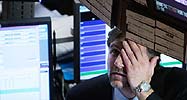
Investors were shocked by the scale of the losses
Global financial crisis
Global case studies
Business programmes
BBC World Service brings you a day of coverage dedicated to the global financial crisis.
Figures released in the UK have shown negative growth in a quarter for the first time in 16 years. The world's stock exchanges, which have fluctuated so much over the last month, suffered deep falls - around 10% in Japan and South Korea.
Economics correspondent Andrew Walker explained the origins of the economic crisis - and how the world woke up to what was going wrong:
Listen Listen to Andrew Walker (3 mins 10 secs)
To get to the heart of the problems, Newshour's Roger Hearing hosted a discussion with Patrick Minford - former government advisor and considered to be one of the founders of the free market Thatcherite policies in the 1980s - and Dr Sumit Roy, the United Nation's former Economic Advisor to Africa.
He started by asking Dr Roy if the picture of the global economy was going to be radically different after the international meeting in November:
Listen Listen to the discussion (6 mins 29 secs)
In Europe's largest economy, Germany,
This week the UK Prime Minister Gordon Brown admitted that Britain was likely to fall into recession soon - while also announcing measures to help people who may be at risk of having their homes repossessed.
In the country's second largest city, Birmingham, home repossession have doubled in the last year. The city has also seen some of the biggest property price falls in the country recently. Naomi Grimley to Birmingham to look at how the economic downturn is hurting homeowners:
Listen Listen to Naomi Grimley in Birmingham (3 mins 27 secs)
While falling house prices may be bad news, there could be some good news for consumers in the falling price of oil, which has halved since July.
But the oil producers, in the form of the Opec cartel, are meeting in Vienna today and facing calls for a cut in production to try to push up oil prices again.
Nick McGregor, oil analyst at stockbroker Redmayne Bentley, explained why a cut in production is coming:
Listen Listen to Nick McGregor (3 mins 17 secs)
The crisis began in the US housing market, but has become truly global. In Germany, Steve Rosenberg visited the town of Oldenburg to find out how Europe's largest economy is coping:
Listen Listen to Steve Rosenberg (4 mins 10 secs)
As bad as things are in Europe, the World Bank's Chief Economist for Africa, Shanta Devarajan, told the BBC that he believes the impact will be four-fold for the least developed continent:
Listen Listen to Shanta Devarajan (2 mins 23 secs)
But it is not all gloom in Africa. Perhaps surprisingly, given recent events, the island nation of Madagascar is planning to open its first stock exchange:
Listen Listen to Christina Corbett in Antananarivo (1 min 52 secs)
Meanwhile in Russia, a browse in the supermarket would indicate the country was escaping the crunch - with supermarkets packed, despite charging the equivalent of $50 for a small packet of strawberries. But Russia's stockmarket has plunged and the last few days have seen a dramatic change for the worse - one that will soon have an impact. Rupert Wingfield-Hayes reports:
Listen Listen to Rupert Wingfield-Hayes (4 mins 19 secs)
At the other end of the scale is Zimbabwe, where there is a grim detailing the grim daily struggle for food in a country that was once Africa's breadbasket but now cannot feed itself. Peter Biles visited a supermarket there to find out what - if anything - was on offer:
Listen Listen to Peter Biles in a Zimbabwe supermarker (5 mins 07 secs)
Peter Biles also reported on the "benign and surreal atmosphere" inside the Zimbabwe capital Harare, as the global crisis impacts on an already crippled local economy:
Listen Listen to Peter Biles in Harare (4 mins 28 secs)
James K Galbraith is the son of one of the world's greatest economic minds. He spoke to the BBC about his father's interpretation of events leading to what is considered the anniversary of the Wall Street Crash of 1929:
Listen Listen to James K Galbraith (4 mins 38 secs)
The World Have Your Say would like to hear from you about how you have been affected by the crisis. Send them your stories by clicking on the link below.
The BBC's business editor Robert Peston has broken a number of the key stories since the crisis started. Here he gives his history of the events:
View Robert Peston's audio slideshow
And you can read the latest thoughts of Robert Peston on his blog here:

