Eye-catching celestial events to look out for in 2025

- Published
If you are a stargazer there are more wonderful celestial events for you to get excited about in 2025.
Astronomers expect there to be more sightings of Aurora Borealis to light up the night sky as the Sun's activity peaks, as well as a total lunar eclipse and three supermoons.
First major meteor shower of 2025
We began 2025 with the annual Quadrantid meteor shower. It's likely to have been one of the strongest meteor showers of the year and reached it's peak on 3 and 4 January in the UK.
Meteors or shooting stars are pieces of debris that enter the Earth's atmosphere at speeds of up to 70km (43 miles) per second, vaporising and causing streaks of light.
The Quadrantids are known for their active peak which can reach a rate of up to 120 per hour for a short period.
The Quadrantids get their name from their apparent point of origin in the sky, the former constellation Quadrans Muralis, and usually have a blue or yellow-white tinge with fine trails.
Remember, the best way to observe any meteor is to move away from light pollution, wrap up warm and let your eyes adjust to the night sky for at least 15 minutes. No equipment is needed though a clear sky and a lot of patience are prerequisites.

Partial solar eclipse
There was a partial solar eclipse visible from the UK, on 29 March 2025, when the Earth, Sun and Moon were in alignment.
The Moon passed between the Earth and Sun, blocking a part of the Sun's rays from reaching Earth. It looked like someone had taken a bite out of it.
The cosmic event began at 10:07 GMT with maximum coverage at 11:03 and ended at midday. Roughly between 30% and 40% of the Sun was covered depending on where you were in the UK.
The UK's last total eclipse occurred in 1999. Cloud cover hindered the view for most but according to news reports it was visible for some lucky people in Cornwall, Devon and Channel Islands.
The next full solar eclipse in the UK is not expected for another 66 years, on 23 September 2090, according to the Royal Observatory in Greenwich.
You should never look directly at the Sun and experts recommend observing a partial solar eclipse safely with special solar filter glasses.

The peak of a partial solar eclipse, seen from Eastbourne, East Sussex, UK, on 29 March 2025
Total lunar eclipse
There will be one total lunar eclipse visible from the UK this year, on 7 September, which is when the Sun, Earth and Moon align. During a lunar eclipse, the Moon appears red because the only sunlight reaching the Moon has to pass through Earth's atmosphere.
A total lunar eclipse can last several hours depending on conditions and the period of totality when the Moon turns red will last for an hour and 22 minutes, making it the longest total lunar eclipse since 2022.
The eclipse's maximum will occur at 19:11 BST when the Moon is below the horizon.
Lunar eclipses are safe to view with the naked eye because they only reflect sunlight. A cloud-free sky is preferable. Minimise light in your vicinity and watch from a spot where your view is not obstructed by tall buildings or trees.

This lunar eclipse of a super blood wolf moon was seen from Liverpool on 21 January 2019
Three supermoons
In 2024 we had four consecutive supermoons. In 2025 there will be three: the Hunter's Moon on 7 October, the Beaver Moon on 5 November and the Cold Moon on 4 December.
Their names originate from native American culture to reflect what was happening in nature and as a method of using the lunar phase for timekeeping.
Supermoons happen when the Moon is at its closest point to Earth in its orbit, appearing up to 15% brighter and 30% bigger than regular full moons.
To get a good view of a supermoon a clear sky is preferable and you can just use your eyes, though a telescope or binoculars will help.
If you want to take a picture make sure you turn off the flash on your phone, activate night mode and use ambient light. Oh, and check the BBC Weather forecast.

This supermoon was seen over Glastonbury on 16 December 2024
Aurora borealis
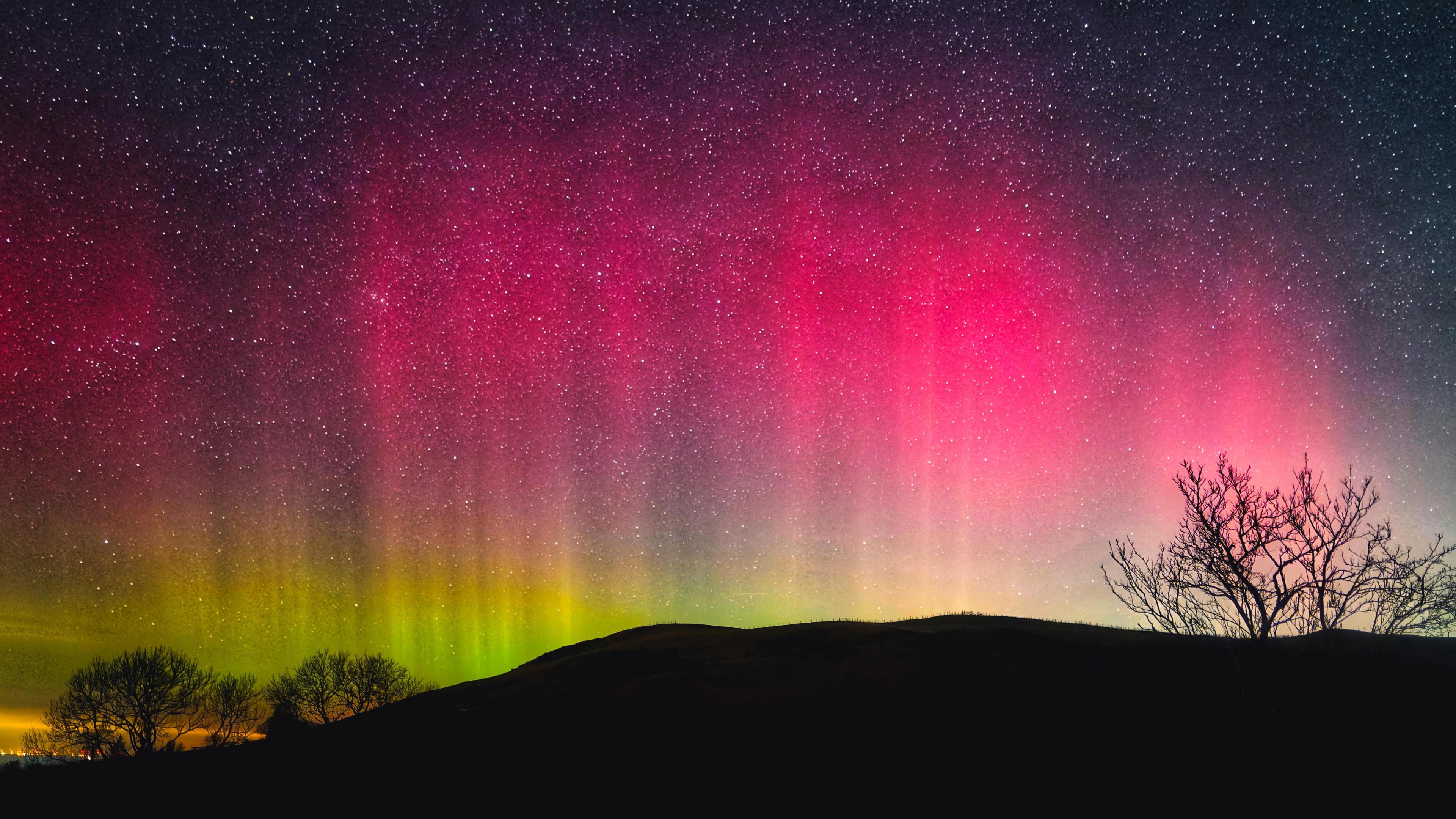
The Northern Lights, or aurora borealis, have graced our skies more than once in 2025 already.
Their beautiful multicoloured light displays were captured spectacularly by BBC Weather Watchers. They appear as bright, swirling beacons of light that range in colour from red to purple and green to blue.
Aurora displays are caused by charged particles from the Sun colliding with gases in the Earth's atmosphere around the magnetic poles. The most vivid auroras occur when the Sun emits large clouds of particles called coronal mass ejections.
As the Sun's 11-year cycle of activity peaks, there could be many more sightings of aurora this year.
Dark and clear nights are the optimum viewing conditions so we can but hope that 2025 gifts us with more spectacles in the night sky.

Aurora borealis as seen over the Firth of Forth
- Published13 February 2025
- Published26 March 2025