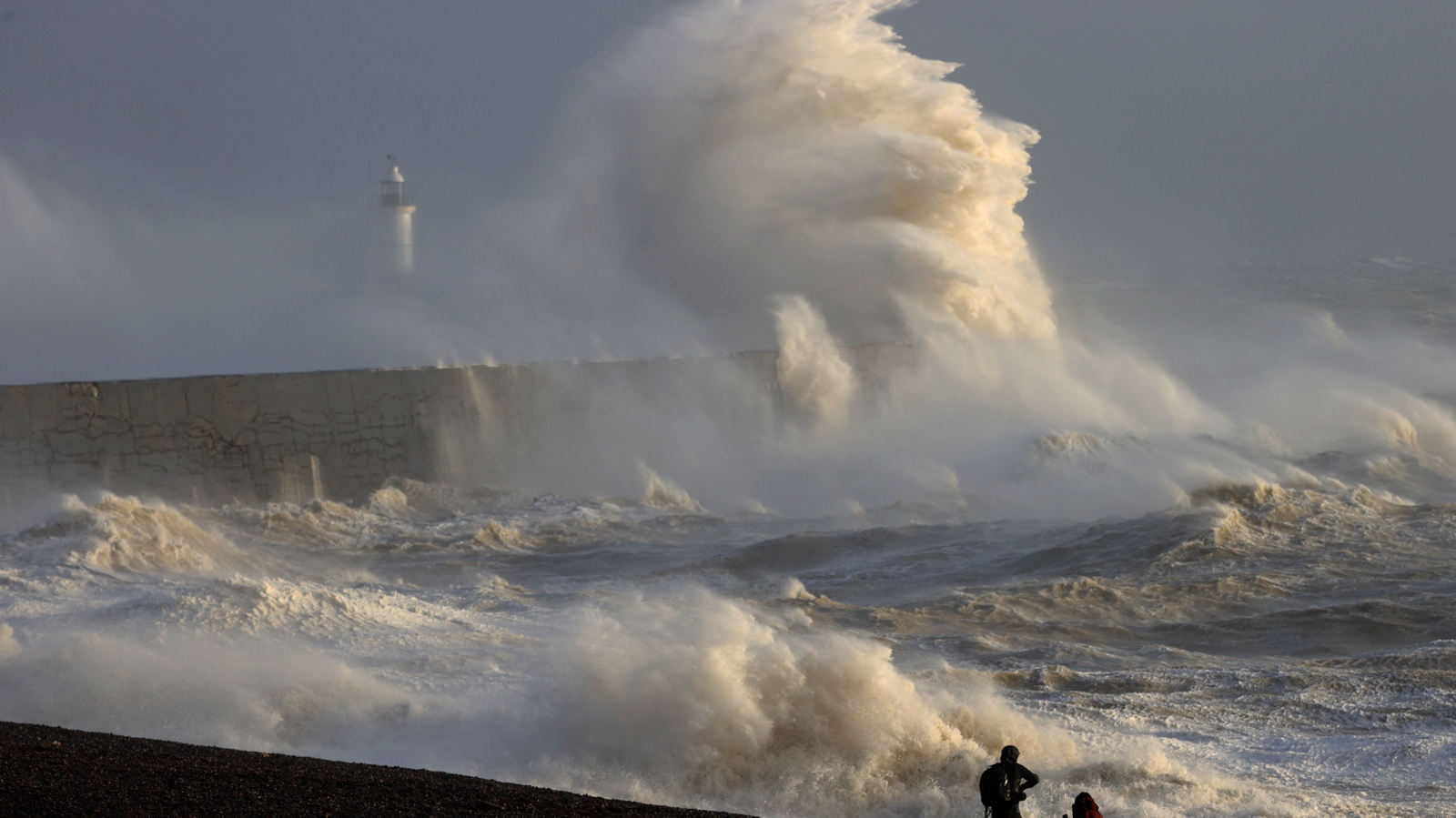
Deadliest, most intense, windiest: Some of the UK's worst storms

- Published
Now we are firmly into autumn, there is an increasing chance we will see strong winds, heavy rain and some flooding this week and over the next few months.
Storm Benjamin has been named by Météo France, bringing wet and windy weather for many across England, Wales and the Channel Islands.
Severe yellow weather warnings for both wind and rain have been issued by the Met Office which could bring travel disruption and minor damage.
The highest number of named storms we've experienced since naming began in 2015 was during the storm season in 2023/2024 when we saw 12.
Here we take a look at some of the worst storms to hit the UK.
1. Biggest loss of life
Well before the UK had a reliable severe weather warning service and the ability to forecast accurately just 24 hours ahead was the Great North Sea flood of 1953.
High spring tides and northerly gales combined to bring a massive storm surge along 1,000 miles of coast, killing 307 people in Lincolnshire and East Anglia, out of a total of 2,551 fatalities in the UK, Netherlands, Belgium and out in the North Sea.
Widely regarded as one of the worst peacetime disasters to hit the country, it eventually led to the construction of the Thames Barrier to protect the City of London from future storm surges.
2. Most intense storm

Storm Ciarán was a deep area of low pressure that brought destructive winds to southern England and the Channel Islands
There are different ways you can classify the strength of a storm, for example the highest wind, the overall size, or how much damage there is.
Storm intensity, though, is a measure of the lowest atmospheric pressure recorded - the lower the pressure, the more intense the storm is.
The most reliable current record is 941.9 millibars on the Isle of Tiree, Inner Hebrides, in January 2025. This was the lowest pressure recorded during Storm Éowyn and the UK's lowest value since storm naming was introduced in autumn 2015.
The previous record was Storm Ciaràn which recorded 953.3 millibars in Plymouth, November 2023.
low pressure record for the month of October with 947.9 millibars recorded during Storm Amy at Baltasound, Shetland.
While there have been instances of lower recorded pressure in the 19th century, these measurements are thought to be have been taken on uncalibrated, and therefore unreliable, instruments.
3. Strongest wind in a storm

Some of the highest wind speeds in recent years have been from Storm Eunice in 2022 that resulted in numerous red severe weather warnings being issued
One of the most notable storms to affect the UK in recent history was Storm Eunice in 2022 when a gust of 122mph (196km/h) was recorded at the Needles Old Battery on the Isle of Wight.
At the time, red warnings for wind were issued for parts of south-west England and south Wales and then across London and the south-east of England.
Storm Eunice brought the highest recorded wind speeds for England since the Great Storm of October 1987 when a gust of 115mph (185km/h) was recorded at Shoreham-by-Sea, West Sussex.
However, the strongest wind recorded in the UK wasn't during a storm.
In March 1986, on the summit of the Cairngorms in the Highlands of Scotland, a wind gust of 173mph (278km/h) was recorded.
While that is exceptional, you would expect mountainous areas to be windier than at sea level which is why meteorologists tend to focus on winds below 1,000ft (300m) - where most of us live.
The highest non-mountainous wind gust was set in February 1989 in Fraserburgh, Aberdeenshire, at 142mph (229km/h).
- Published1 September 2025
- Published3 September 2025