Wolf supermoon rises marking first of 13 full Moons in 2026

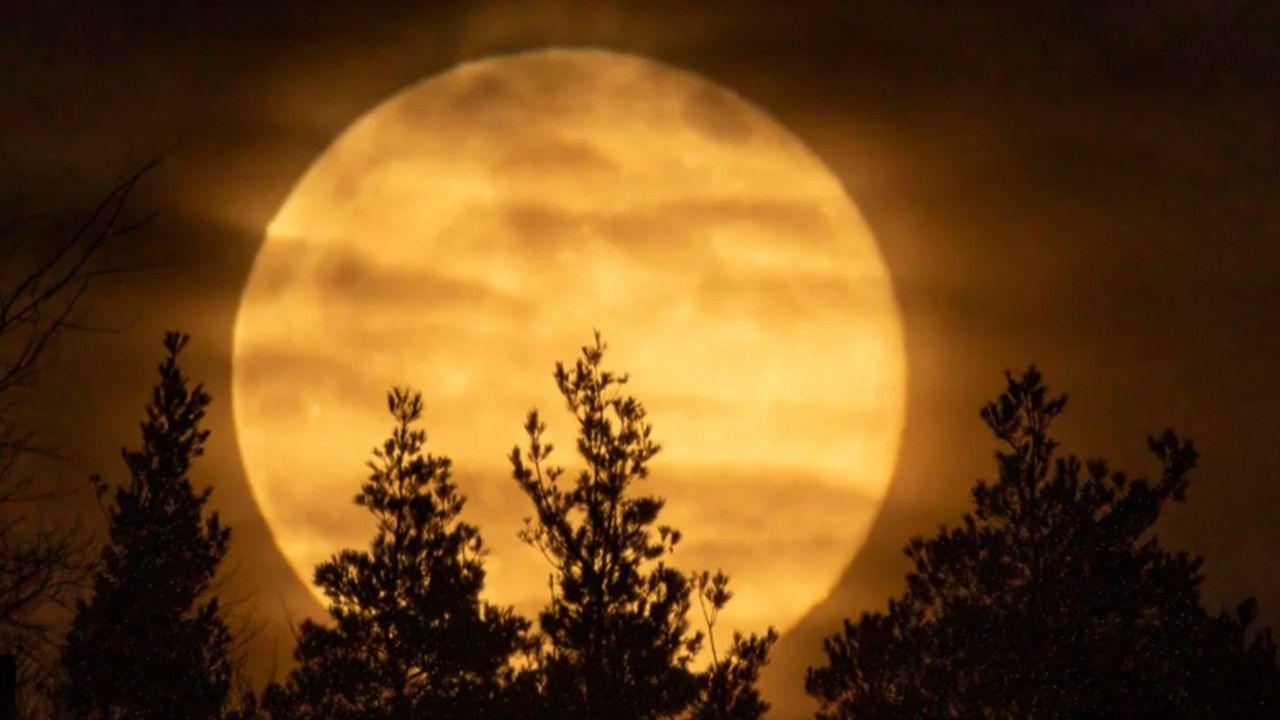
January's Wolf moon over Argyll and Bute on Saturday morning
- Published
The first full Moon of the year is set to illuminate the UK skies on 3 January bringing with it some welcome dazzle to the post-Christmas dip.
Also known as the Wolf Moon, it will be the fourth supermoon in a row following October's Harvest Moon, November's Beaver Moon and the Cold Moon in December.
Viewing is dependent on the weather, but hopefully with largely clear skies it will be a celestial treat to look forward to as the fairy lights are being packed away.
If you miss it, the next chance to see the Moon so large and bright in the sky won't be until November, although there is the extra treat of two full Moons in May making 2026 a rare year with 13 instead of 12 full Moons.

The Wolf Moon in 2022 looking like a bauble above the Shard in London
Why is it called a supermoon?

At its 'perigee' the Moon is 30,000 miles closer to Earth than at its furthest point
The Moon's orbit around the Earth is elliptical - that is not quite perfectly circular - which means its distance from us varies.
When at its closest point the Moon is described as being in "perigee" and if that moment coincides with a full Moon we call it a supermoon.
At the perigee the Moon is about 220,000 miles away from Earth, compared to at its furthest point - or apogee - around 250,000 miles away.
This means that the Moon appears to be larger and brighter in the night sky.
We generally have three or four supermoons every year so they are not rare - but it is unusual to have four in a row.
Why the 'Wolf Moon'?

December's Cold supermoon looks as if it's melting on top of chimney pots
Full Moons have names that hark back to ancient traditions before modern calendars were used.
They were helpful ways to mark the changing seasons and the names tend to relate to significant timely events, for example the Hunter, the Harvest and the Flower Moons.
When can we see it?
The Wolf supermoon will rise on Saturday 3 January and will be at its fullest at 10.03 GMT.
However, it will look at its most impressive when closest to the horizon at evening moonrise.
This occurs at different times across the UK, for example:
15:06 in Aberdeen
15:48 in Belfast
15:51 in Oxford
16:03 in Swansea
There will be two more supermoons to come in 2026 in November and December as well as a blue Moon in May.
This is when there are two full Moons in a single month, meaning a total of 13 full Moons in the year., external As it only happens once every few years, it is where we get the expression 'once in a blue Moon'.
Watch out this weekend for the Quadtrandids meteor shower too which peak on the 3 and 4 January.
Will the skies be clear to see the full Moon?
It looks like there will be plenty of clear sky across the UK to see the Wolf Moon on Saturday evening and overnight.
The exception will be Northern Scotland, eastern England and west Wales where there'll be more cloud and the continuing risk of snow showers moving in.
If you plan on heading outside, it will feel cold with a strong northerly wind with temperatures quickly dropping below freezing in the evening.
Don't forget you can keep up-to-date with the weather forecast where you are at BBC Weather online and on the app.
- Published2 January

- Published20 September 2021
- Published30 December 2025