What and when is the spring equinox?

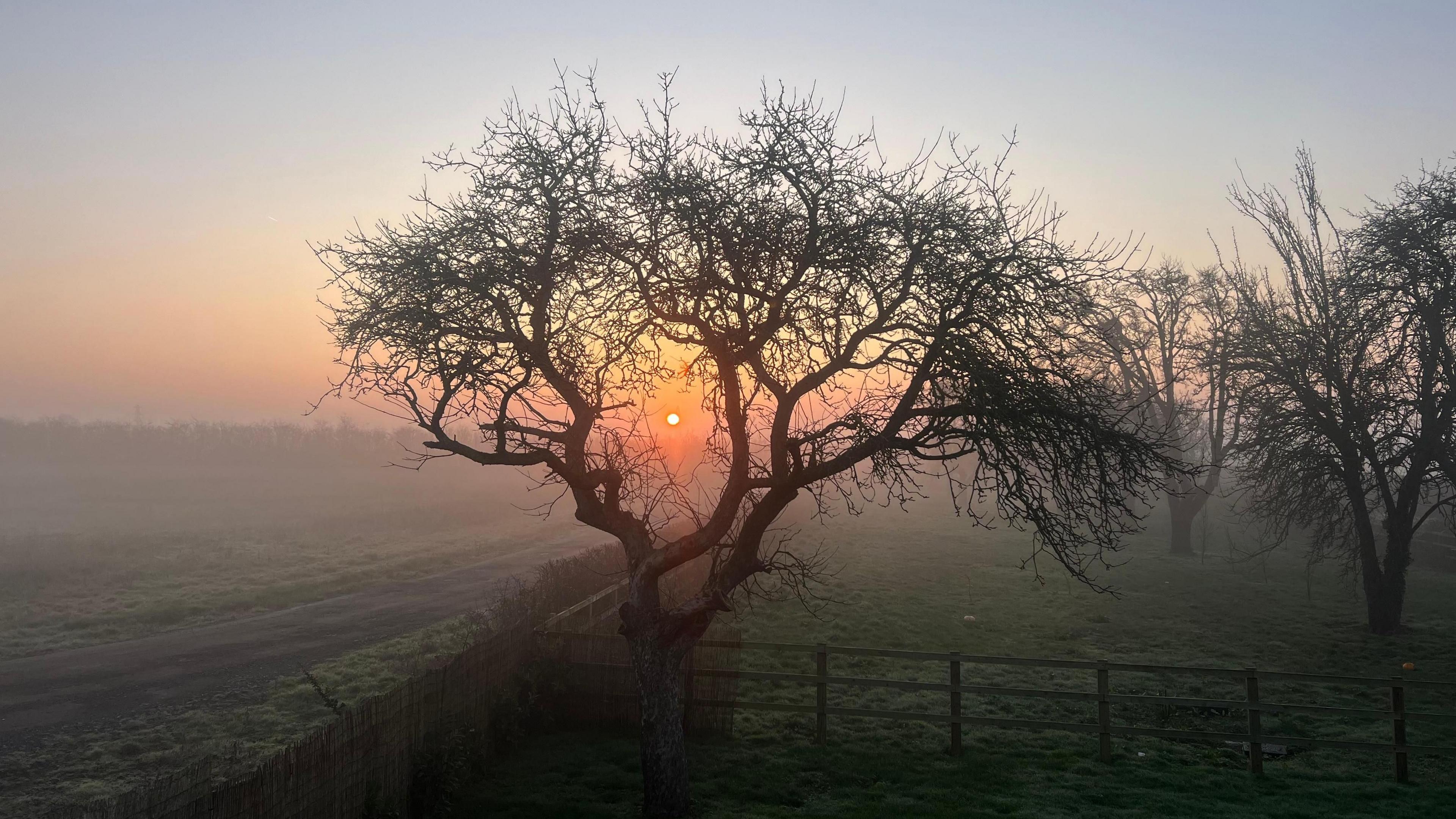
Spring has definitely arrived in Kirkharle, Northumberland
- Published
The spring equinox is almost here and marks the start of astronomical spring.
In the northern hemisphere the spring equinox always happens between 19 and 21 March. This year it will be on 20 March at 14:45.
The date is determined by the Earth's tilt on its axis as it travels around the Sun and it happens twice a year - in March and in September.
It occurs at the same moment wherever you are on the planet and for those south of the equator, where the seasons are reversed, the event will mark the first day of autumn.

At the equinox the Earth's axis (shown by a black line) is neither tilted towards or away from the Sun
The Earth's axis is tilted by 23.5 degrees and that tilt in relation to the Sun changes on its orbit around the Sun.
At the equinox the Earth's reaches a point when the tilt is neither towards nor away from the Sun and we have equal sunlight reaching the northern and southern hemisphere.
The word "equinox" comes from Latin, where equi means "equal" and nox means "night".
On this day it would be easy to assume that day and night would be of equal length of 12 hours each. However, that is not entirely correct.
In the UK, 12 hours of daylight and night time comes a few days before the equinox - the equilux.
What is the Equinox?
What is the equilux?
At the equinox, the measurement is taken from when the centre of the Sun is at the horizon and we have 12 hours between sunrise and sunset.
However, the top edge of the Sun is visible first at sunrise and last at sunset. Due to light refraction, there is still light for a short time even when the sun is no longer visible. This adds a little extra time to daylight hours.
In spring, this means that the date when day and night are actually equal happens before the equinox.
And this will occur in the UK on Wednesday 18 March - the equilux.
What is astronomical spring?
For weather forecasters, spring begins on 1 March. This means that weather observations can be compared more accurately year-on-year.
The spring months are March, April and May.
However, the spring equinox marks the start of astronomical spring, and the date will change slightly each year due to the orbit of Earth around the Sun.
Astronomically, spring ends on 21 June at the summer solstice and summer begins.
- Published1 March
- Published14 August 2025
- Published20 hours ago