Outside of pregnancy, the ‘pelvic floor’ is something we rarely hear about.
Perhaps you’re in your first or second trimester and you’ve been told to ‘strengthen’ or ‘tighten’ your pelvic floor to prepare for birth?
There can be a lot of noise around pelvic floor health, and health during pregnancy in general, so we spoke to pelvic health physiotherapist Clare Bourne to get the facts.
Clare also spoke about pelvic health on the CBeebies Parenting Helpline podcast, with Charlie Hedges. Listen on BBC Sounds here.

What is a pelvic floor?
Let’s start with the basics.
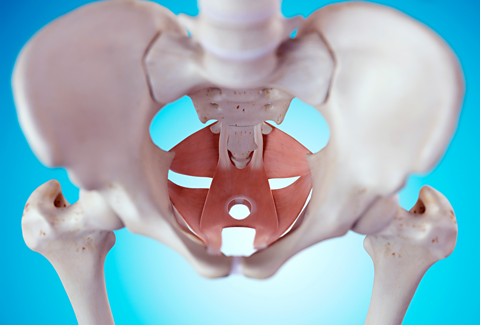
“It's a group of muscles that sit at the base of the pelvis,” Clare explains.
“We often think about it as one muscle, but it's actually a group of little muscles.
“We have a sphincter around our urethra, which is the wee tube, and around the anus which is where our poo comes out. They're little rings of muscles within the pelvic floor as well.
“So pretty important for lots of different functions. We do take the pelvic floor for granted.”
Does everyone have a pelvic floor?
You might hear the most about pelvic health as a pregnant woman, but, “yes, we all have a pelvic floor.”
“Women, men, children, every human skeleton has a pelvic floor,” Clare tells us.
“Pelvic floor health is relevant to everyone, of every age, of every gender.”
Why are pelvic floor exercises important for pregnancy and birth?
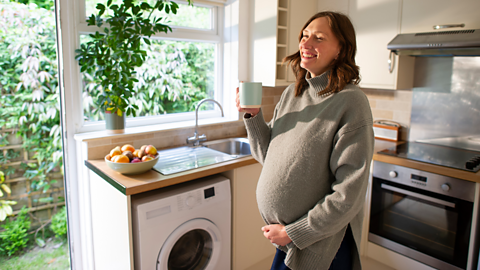
“Being pregnant and having a baby or babies grow within your abdomen puts a lot of pressure down into the pelvis and therefore onto the pelvic floor.
“The muscles can weaken during that time and symptoms can start to occur.”
Clare also explains that there’s a bit of a misconception about the pelvic floor’s role during birth.
"In birth itself, if you're talking vaginal birth, then the muscles don't do much - they're not pushing the baby out, that's your womb.
“But they need to get out of the way. They need to release.
"We often hear a lot around pelvic floor health, ‘you need to be stronger’, but actually the conversation is broader.
“Like any muscle, it needs to be flexible and move, as well as being strong.
“And for birth, we need that flexibility so it can let the baby come out into the world.”
Clare explains why some women have pelvic floor difficulties after birth: “If you imagine stretching your hamstring loads or tearing your hamstring - we need some rehab and some time to recover before we put it through day-to-day tasks like running or jumping or things like that.”
You can read more about the symptoms and signs of a weak pelvic floor later in the article.
When should people start to think about pelvic floor health?
Generally, Clare says we don’t talk about pelvic health early enough in life, but if you’re coming to this article as a pregnant woman, start looking at pelvic floor exercises…
“Essentially, as early as you can in pregnancy.”
Clare explains that research shows us that pelvic floor exercises can help to prevent problems after birth, including incontinence, “which is the leakage of urine or bowel movements when we don't want them”.
“These are really big things that if you have as a woman, can impact your quality of life.”
Is it better to have a tight pelvic floor?
“The short answer would be no," Clare explains.
“There's a real misconception of what tight even means.
“If you think about an arm, if you had a muscle that was tight in your arm, your arm's not very useful because it can't move very well. A muscle that can't relax is also not that useful.
"Muscles need to be flexible.”
“We want a much more dynamic picture of flexibility, strength, coordination and endurance.”

How can you tell if you have a 'weak' pelvic floor?
There might be signs you have a ‘weak’ pelvic floor after you give birth, as the stretching process of pregnancy ‘compromises’ those muscles.
Clare says, “the most common symptoms are leakage of urine, or bowel movements, or an urgency to wee, or an urgency to open your bowels.
Also, "your window of opportunity [to get to the bathroom on time] might feel very small.”
“Weakness can also present as a feeling of heaviness, or like something is dropping within the vaginal area.
“The irony is that sometimes a tighter pelvic floor, or a less flexible pelvic floor can present in a similar way.
“So, we look at symptoms. For someone who maybe is tight or less flexible, you may also have things like pain during intercourse because the muscles can't relax.
“There's are lots of symptoms on a spectrum, but those would be the most common that we would treat.”
Pelvic floor exercises – What's the best place to start?
1. Squeeze your pelvic floor muscles quickly – try not to pull your tummy in
2. Hold the squeeze for 2 seconds
3. Relax the muscles
4. Repeat 10 times
Clare thinks this is a good place to start - "Like all muscles, they need to be contracted and relaxed.”
“The tricky thing about connecting with your pelvic floor is that you can't see its movement.
"It's completely different to our limbs, where you can look in a mirror, you can look at your arm moving, you can look at your technique.
"You can't do the same thing with your pelvic floor. We rely a lot more on feel and visualisation.
“We can be told to squeeze our pelvic floor and most people that come through my clinic have literally no idea what that means or how to do it.
“First of all, we need to understand anatomically what we are aiming at, because it's not our bottom muscles and it's not our abdomen.
"The way I teach it is to think about squeezing around your anus internally and then thinking about, if you're a female, squeezing around the vagina, and then relaxing.
“For men, it's about shortening the penis, and then relaxing.”
As well as contracting and relaxing, Clare also says you can think about holding those contractions to work on endurance.
“We need to work on both of those elements. We've got reactivity in the muscle as well as the ability to hold when we need to pee.”
What do you wish parents knew about pelvic floor health?
“I think around parenting and around pregnancy, there can be a lot of noise and it can feel overwhelming,” Clare says.
“I think what happens with pelvic floor health is it just gets all caught up in the noise.
“It's also not related to your day-to-day life and so it gets shifted.
“And I think what I would love is just for people to just take five minutes to think, ‘Where is this in my body?’
“It doesn't need to feel like another massive thing I've got to fit in.
“We make it too complicated - simplify it, get to know your body better and be honest with yourself about what you can commit to and know that something is better than nothing.
"Even if you did it once a week, I'd recognise the success of that.”
Remember to reach out to your GP if you’re concerned about symptoms – there is help out there.
Watch: Clare explains how you can build a pelvic floor health habit