During WW2, two families were told that their sons had been shot down and killed over Germany - when in fact their bomber had crashed in a field just outside the village of Husborne Crawley in Bedfordshire. Now, 60 years on, aviation enthusiasts are trying to find out what happened to the two crew members who survived, because although they have discovered their names - Sgt E. Morgan and Sgt J. Mitchell - without their first names, all the research avenues to try and track them down have been exhausted. | The story as told by Betty Williams (nee Stapleton) | "In 1941 I was a young girl living at 62 Crow Lane. I remember the occasion of the plane crash in what we called then the "Football Field" just by Horsepool Lane. "It was the middle of the night when a British plane that was in trouble passed over the village. "As it came in low, a couple of the crew managed to bail out, but one poor fellow got his parachute caught up in the top of one of the high elm trees that used be along beside the road, and was left dangling upside down from its branches. "He began calling out for help and his cries were heard right across the fields, "Please help me, please help me" he was calling.
"My father, Bert Stapleton, ran to his aid and climbed right to the top of the tree to release him." You can read more from Betty on the Husborne Crawley Web site: The Changing Times of an English Village Husborne Crawley, Bedfordshire 1900 2000 |
The whole story is proving to be a bit of a puzzle for the Hampden Bomber had successfully completed a mission over Germany and was returning to Lincolnshire when it found itself inexplicably way off course over Bedfordshire. And finding the survivors could help researchers to finally find out what happened. Official records say that the plane crashed due to a lack of fuel but this can be refuted because eyewitness reports report the craft being of fire in the air. The story of the crash, which happened on 9 September 1941, came to light a couple of years ago when Julia Jones began putting together a Web site documenting 100 years of village life in the small Bedfordshire village where she lived. "I came across the story during an interview with a villager who recalled, as a young girl, her father going to the aid of a British bomber that crashed into a field on the edge of the village" she explains. "The plane was a British Hampen Bomber with four crew on board. It came down in flames and two crew members were killed. "The other two managed to bail out but their parachutes became caught in the top of tall elm trees near the crash site. "Their cries for help could be heard across the fields and local villagers went to their aid, cutting them down and bringing them to safety" she adds.
Coincidence
By an extraordinary coincidence the story of the plane crash was spotted by a relative of one of the crew members who was killed and they left a message in the Web site's guest book. As a result, Julia got in contact with the widow and found that sadly they had only been married for a few weeks before he was killed in this crash. But nevertheless, she found that she was getting closer to find out what had happened on that night. "This was quite a breakthrough as it gave us the identity of the first crew member" explains Julia. "His name was Sgt Ford Rowney and he was the pilot of the plane."
 | Ford Rowney: died in the crash |
The story was also picked up by a World War Two aviation researcher, Michael Robinson, who lives in Bletchley, and is a leading aviation expert. Detective
Michael took the story forward and with his experience and skill in this subject area, did extensive research into the crash and after some pretty good detective work, managed to track down the family of the second crew member who had been killed. His name was Sgt Thomas Anthony (Tony) Barker, the plane's Wireless Operator and Air Gunner. "I understand when Michael finally obtained a telephone number for the family, he found himself talking to Tony Barker's sister who, needless to say, was amazed to find herself talking about her long lost brother who had died over 60 years ago" reveals Julia. It transpired that Tony Barker's family had been told he had been killed flying over Germany and so they knew nothing about what had really happened to him. 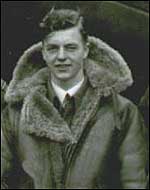 | Tony Barker: died in the crash |
Survived
But frustratingly, Michael has still not been able to track down either the two crew members who survived or their relatives. "This is such a shame as there could be a chance they are still alive and we would have first hand knowledge of what happened that night" says Julia. If not, at least it would be good to have been able to contact their families. It seems that the RAF records don't provide any further clues that we have been able to find." As far as the actual site of the crash is concerned, Michael has been able to identify the exact location and from an initial survey of the scene has found artefacts from the crashed plane, such as small pieces of the instrument panel, windscreen and battery. He has been given permission to make further searches and shallow excavations of the site in August this year, when there will be a surface dig to find fragments left from the crash. If you have any information about what happened to Sgt E. Morgan and Sgt J. Mitchell please let us know using the form below. You can find more stories like this and add your own on the People's War Website. 
| justin wheeler, Sudbury Suffolk | Thursday, 19-May-2005 16:27:36 BST |  | | Hampdens had an unfortunate record for being shot down over friendly territory. On two consecutive nights,RAF Hampdens were shot down, while returning, straying too close to the Felixstowe area. Though the two crew survived the crash, which you are researching, is it possible that they perished on subsequent raids ? I think there were Commonwealth Hampden squadrons(Rhodesia)? |
| Nicholas Mead, Helston | Thursday, 09-Sep-2004 21:12:47 BST | | | I was interested to read this, as I am currently investigating the death, and final resting place, of my Uncle Freddie Angus of Ickleford. Curiously, our family also believed that his plane had been shot down over Germany - although in this case it actually crashed in Lincolnshire. How does one find out if the MoD believes remains may lie on a site? |
| Nick Wotherspoon, Blackburn | Friday, 09-Jul-2004 14:03:52 BST | | | This article does not seem to mention where the deceased airmen are buried - if they were not recovered then it is a war grave. Neither does it mention that the wreck (and all others) is protected under the 1986 Protection of Military Remains Act - the MOD do NOT give permission for even limited "surface" digs on sites where human remains are thought to lie - If the bodies have been recovered any excavation at all will still require an MOD permit. Finally I was not aware that the MOD had any experts on Aviation Archaeology! |
| Michael Robinson, Bletchley | Wednesday, 28-Jul-2004 20:25:12 BST | | | In response to Nick Wotherspoon's comments, I would like to put on record that both bodies were recovered at the time of the crash. Both young men were buried in their home towns. The 1986 Protection of Military Remains Act has, and will, continue to be observed. |
|