One of the really important thingsabout language learning is that it's funand that it involves play.
And we find that a great way of doing thatis by introducing stories and translation.
So all of youhave had some exposure to translation.Storytelling and story acting practicehas been shown to be really helpfulin developing children’s languageand literacy abilities.
It helps them develop their vocabularyand also develop their narrative abilities.
One of the things they learn is thatit’s not always about finding the right answerwith different ways of expressing themselves.If this was the whole storywhat’s this story about?
One of the really good thingsabout the storytelling scenariois that it combines peer to peer interactionand scaffolding from adultsof developing language learningand bringing young peopleinto contact with languages.
'La oca'
– 'La oca'!
'Enorme'
– 'Enorme'!
"We have on the one handthe collaborative work by the pupilswhich is all about this peer to peer interactionproduced by and monitored by the adults.
Mama or mummy or mum?"
– Mummy!
– Mummy.
It’s a really empowering wayof doing language learning.
It’s not just about them regurgitatingsomething that an adult has told themto be creative themselves.
They want to tell the storywith their peers and also with the adults.
When we get to translating the picture bookwe always start by getting the childrento put the images into the right order
What they’re really doing at that pointis translating the imagesabsolutely no words involved at all.
What’s really importantabout that stage of the processis that they’re learning what language is about.
It’s about communicating ideasand communicating meaning to others.
We use those kinds of activities to get them awareof all the different languagesthat they’ve come acrossthat there are in the classroomfor the EAL pupils to show themthat it’s not only about FrenchGerman or Spanishthat they might have access to.
So imagine today that your taskis that you’ve found this Spanish translationof an English book.And you need to figure outEnglish versions of the book.
We then introduce the textbut we also always use glossariesor some other referenceso they can access the words.
So I’m not expecting you to just usethe Spanish you’ve learnt in classlearning Spanish for one or maybe two years.
It’s really important for us to show themthat being a linguist isn’t all aboutknowing all of the wordsand being kind of a living dictionaryto use reference resourcesif they know what the word isand working together to decode something.
So they work with glossaries usuallyto do an initial translationwhich will inevitably be very clunkybecause it’ll be a word for word translation.
Over there not -It’s quite funny sounding to me.So what should it say?
When they read that outand share that with the groupthat that’s not a satisfactory versionthey’ve translated the wordsor the rhythm or the rhyme.
They haven’t really gota sense of the exciting storythat they found in those images in the first place.
We then set them the final taskwhich is to turn that clunky translationinto something that sounds really good.
The flexibility of this approach meansthat it’s very easy to integrate itinto your existing teaching.
You canas a way of teaching grammarreally digging into the original textand thinking about how it worksand how it’s put together.
Put your hands upif you can tell me one thingthat just doesn’t sound likewhat we all know as English.
And if we can instill a love of languagein which we relate to other languages.
If we can instil that in children at a young ageas their language learning developsin the years to come.
Storytelling and story acting practice has been shown to aid children’s language learning and literacy skills, including in vocabulary development and narrative abilities.
It can be integrated into language lessons to help underpin other important elements of language learning including grammar or vocabulary teaching.
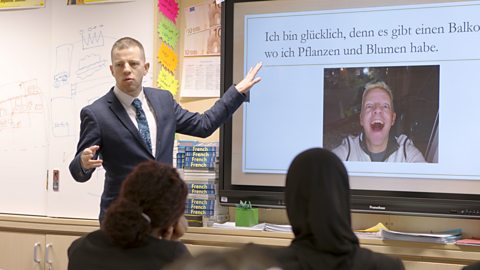
This short film explores the techniques that Charlotte Ryland (Stephen Spender Trust) has developed to promote storytelling practice as a tool in language learning with younger learners. She explains how storytelling and story translation can create a highly motivating, fun environment for pupils, which allows them to explore their own creativity and feel a sense of empowerment through the learning process.
Storytelling and story acting practice combines scaffolded learning with help from adults, with dictation and dramatisation of the stories by children.
In this film, we see practitioner Rahul Bery facilitate a translation and storytelling session, encouraging pupils to explore a foreign language text and discover its hidden meaning whilst encouraging pupils to creatively develop on its content.
Embedding storytelling into a lesson can also be adapted to support the language learning of children with special needs, as a way of encouraging SEND pupils to fully express themselves.
Teachers/parents and children could refer to BBC Bitesize primary MFL content (stories) to direct their storytelling and story acting activity with children.
This film is part of a series of four films designed to promote evidence-based best practice methods for languages teaching at KS2 and KS3.
For student resources that may help you integrate stories into lessons or homework, please see:

More MFL teaching aids:
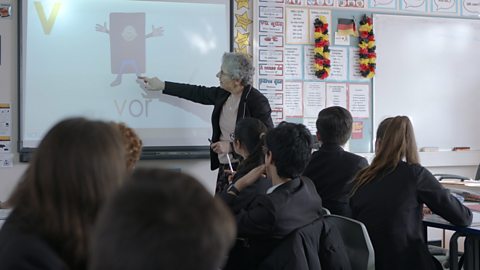
Making phonics an indispensable tool in language learning (KS3) video
This short film offers a guide to integrating phonics teaching into your lesson, and explains why doing so is important and beneficial for the learning process.
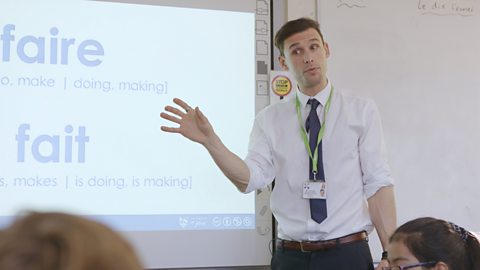
Asking effective questions - grammar building blocks (KS3) video
In this short film specialist languages teacher Joe Fincham explains what research has shown to be the most effective way of teaching grammar at KS3.
Promoting intrinsic motivation in students (KS3) video
This short film offers tips for how best to promote intrinsic motivation in languages students at KS3.