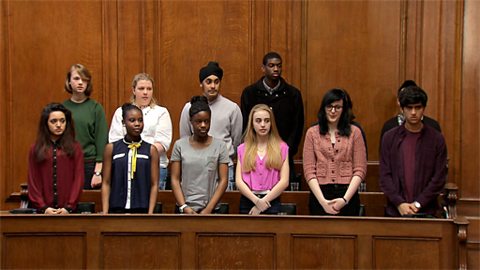
This video shows an entirely fictional 'mock' trial, with all parts played by teenagers. The violent attack shown is fictional and dramatized.
NARRATOR:'The Old Bailey, London. Crowned by the statue of Lady Justice, this is the most famous criminal court in the world.'
BAILIFF:All rise.
NARRATOR:'For the first time ever, cameras have been allowed inside an Old Bailey courtroom, and the case you're about to see is unique. All the key roles, including barristers, the jury, and witnesses will be played by teenagers from UK state schools, who are getting an opportunity to find out for themselves how the legal system really works.'
NARRATOR:'As the trial unfolds, they will gain a unique insight into the anatomy of a court case.'
MALE PROSECUTION MEMBER:You weren't anywhere near to Farley Joseph?
JO SALES:Yes, I was. I saw her have a nosebleed.
NARRATOR:'And overseeing proceedings is a real judge, former Attorney-General, Baroness Scotland QC.'
BARONESS SCOTLAND QC:All questions of evidence and fact are for you alone to decide.
NARRATOR:'Acting as mentors, guiding the students through the trial are two teams of expert barristers. Assisting the prosecution team, from Essex, are Tim Salisbury and Nicola McKinney.'
NICOLA MCKINNEY:You're going to be a lot more aggressive.
NARRATOR:'And aiding the defence team, from London, are Jacqueline Caspi and Lawrence Power.'
LAWRENCE POWER:Practice makes perfect, and it's needed here.
NARRATOR:'The case is fictional, but the battle between prosecution and defence to prove guilt beyond reasonable doubt 'is very real.'
FEMALE DEFENCE MEMBER:You say you heard someone behind you. Did you turn around to see who this person was?
FARLEY JOSEPH:No, I didn't.
FEMALE DEFENCE MEMBER:Would it be accurate to assume that your hearing may have been slightly impaired?
POLICE OFFICER:I don't think that's fair to say at all.
FEMALE PROSECUTION MEMBER:So, you wouldn't like to see her in trouble?
JO SALES:No, I wouldn't.
LAWRENCE POWER:They're going to have to say she's a liar.
FEMALE PROSECUTION MEMBER:In fact, that's why you're here, to lie to protect her?
LAWRENCE POWER:She had to do that.
NICOLA MCKINNEY:She had to.
NARRATOR:'They are the Young Legal Eagles.'
LAWRENCE POWER:When the criminal trial process begins, a defendant is regarded as innocent. The prosecution must prepare their evidence. They must prepare their witnesses and their other physical evidence, and prove the guilt of the defendant to the trial process, if the defendant pleads not guilty to what he's charged with.
NICOLA MCKINNEY:In the courts of England and Wales, we have an adversarial system, so you have two sides in any courtroom. It's gonna be–well, in a criminal court, prosecution and defence. And they're pitted against each other, and the end result is supposed to be a fair result. So, how do you achieve that?
NARRATOR:'Taking on the case for the prosecution are Sam Byrne and Hannah Gladwell.'
BOY IN BLUE SHIRT:I think when you get in there, you've got to remember to keep professional, but I think the adrenaline kicks in, and you kind of almost rely on that a little bit.
GIRL IN BLUE CARDIGAN:Yeah.
BOY IN BLUE SHIRT:To propel you forward.
GIRL IN BLUE CARDIGAN:You prepared well, so you know what you have to say.
BOY IN BLUE SHIRT:Yeah.
GIRL IN BLUE CARDIGAN:It's just being professional about it.
NICOLA MCKINNEY:Before we start, I think it would be helpful just to maybe go through what we think the prosecution actually does in a trial. What's their ultimate goal?
GIRL IN RED TOP:I would say it's to try and get, obviously, the jury to get a guilty verdict at the end.
NICOLA MCKINNEY:Okay.
GIRL IN RED TOP:So… to try and present evidence to show that.
NICOLA MCKINNEY:Any other considerations that the prosecution might have in mind?
BOY IN STRIPED JUMPER:You have to prove it beyond reasonable doubt, as a prosecution barrister.
NICOLA MCKINNEY:Yeah.
BOY IN STRIPED JUMPER:Whereas the defence have just got to present reasonable doubt in a case.
NICOLA MCKINNEY:Every prosecutor also has to bear in mind that they're acting in the interest of justice. So, they're not trying to secure a conviction at all costs.
NICOLA MCKINNEY:The prosecution is presenting a factual picture that… if all the evidence is shown to be accurate, they say is enough for a conviction. The defence is then going to try and pick that apart.
JACQUELINE CASPI:The prosecution, short for the Crown Prosecution Service, work on behalf of the government, and they bring the case against the defendant. It's not the defendant's role to disprove or to prove their innocence, but rather to test the prosecution's case.
NARRATOR:'Representing the defence are Deborah Esendja and Sadie Marshall.'
DEBORAH ESENDJA:And if something doesn't go well, I have to think on my feet. Okay. What am I gonna do? What am I gonna say? All eyes are on me. I have to just go with it. So I think it's brought a lot of confidence to the table.
LAWRENCE POWER:The first thing I want you to understand is when you make your arguments in this case, you'll be making them for a jury. And that's the most important thing to know.
LAWRENCE POWER:The role of the defence is to persuade the jury that there is reasonable doubt in the case that they're hearing. That means that they can't be certain about the prosecution case.
BAILIFF:All rise.
NARRATOR:'Many people take part in making the justice system work. Overseeing the court proceedings is the judge, who is employed by the state.'
BARONESS SCOTLAND QC:The judge has a very different job to the job of either counsel for the prosecution or counsel for the defence. The judge, if you like, is the fair umpire
BARONESS SCOTLAND QC:to make sure a fair contribution is made by all, and the jury has the best chance to understand what actually happened on the day in question.
NARRATOR:'Assisting the judge is the court clerk, who begins the trial by reading out the charge.'
CLERK:What's your name?
JO SALES:Jo Sales.
CLERK:You are charged with assault occasioning actual bodily harm, contrary to Section 47 of the Offences Against the Persons Act 1861, in that you, Jo Sales, on the first day of March 2011, together with Alex Jordan and persons unknown assaulted Farley Joseph, occasioning Farley Joseph actual bodily harm. Do you understand?
JO SALES:Yes.
LAWRENCE POWER:The position is a defendant can either plead guilty, which means that they accept the evidence presented and they accept they've done wrong, and then they will be sentenced, and punished for their offence. The alternative is that a defendant pleads not guilty, says that they didn't do it, and they will dispute, or fight, the case against them.
CLERK:How do you plead, guilty or not guilty?
JO SALES:Not guilty.
CLERK:You may be seated. Could the jury please rise? Could you repeat after me? I will faithfully try the defendant…
JURY:I will faithfully try the defendant…
CLERK:…and give a true verdict according to the evidence.
BARONESS SCOTLAND QC:The reason it's so important to have a jury is that that is where ordinary men and women are able to adjudicate on those facts and we're able to have a trial by people who are just like us.
NARRATOR:'Prior to the trial of Jo Sales, Alex Jordan was found guilty of assault causing actual bodily harm for the attack upon Farley Joseph. In the case of The Queen versus Sales, although there is no allegation that Jo Sales struck the victim, she allegedly filmed the attack, and is being charged under the principle of joint enterprise for the same offense as Alex Jordan.'
NARRATOR:'What you're about to see is a dramatic reconstruction of the attack on Farley Joseph, based on the victim's testimony. On the 1st of March, 2011, Farley Joseph was walking through Hillside Park on her way home from school listening to songs on her MP3 player. Waiting for her inside the park was Alex Jordan,'
NARRATOR:'who intended on teaching Farley a lesson by filming an attack on her and posting it on the internet.'
BOY IN WOLLEN HAT:Here she comes.
ALEX JORDAN:Right, come on.
NARRATOR:'As Alex Jordan and the gang of three others approached Farley, she was also aware of someone else behind her, but did not turn around to see who it was.'
BULLIES:LAUGHTER
ALEX JORDAN:I'm gonna make sure everyone knows that you're a no-good lowlife.
FEMALE BULLY:Loser!
BOY IN WOLLEN HAT:You're a loser, Farley! Loser.
FEMALE BULLY:Loser!
ALEX JORDAN:Jo, you better be getting a good shot of this. Loser!
FEMALE BULLY:Loser, loser.
ALEX JORDAN:When this goes out on the internet, everyone will know what a loser Farley is.
FEMALE BULLY:LAUGHS
FARLEY JOSEPH:GROANS
NARRATOR:'After a few minutes, Farley lay on the ground, dazed and upset. There was a small amount of blood on the floor. As Alex and the gang in front of her left the scene, Farley Joseph caught a glimpse of someone stepping in her blood, who she assumed must have been filming the attack. However, the defendant Jo Sales denies being present at the scene of the assault.'
JACQUELINE CASPI:The Crown's case is that Jo Sales committed actual bodily harm on the basis that she took part in the offense. Not that she actually caused the actual bodily harm, but that she knew that it was going to take place, and that is a concept called joint enterprise.
NARRATOR:'On the next episode of Young Legal Eagles, the prosecution outline the case against Jo Sales in their opening statement.'
MALE PROSECUTION MEMBER:On the 1st of March of 2011, Farley Joseph was walking home through Hillside Park, where she was approached by Alex Jordan and four others. It was then that she was attacked, members of the jury. The Crown argue that Jo Sales was indeed one of those four others, and that she, indeed, filmed the attack.
NARRATOR:'And the victim Farley Joseph gives her evidence.'
FARLEY JOSEPH:Alex came up to me and he grabbed me by my coat, and he started calling me a loser. He spoke to the person behind me, who I assume must have been filming it, and he shouted, "Jo, you better get a good shot of this. When this goes on the internet, everyone's gonna know what a loser Farley is."
ALEX JORDAN:…what a loser Farley is.
A live criminal justice case based on a Joint Enterprise crime committed by a teenager, with all parts played by teenagers.
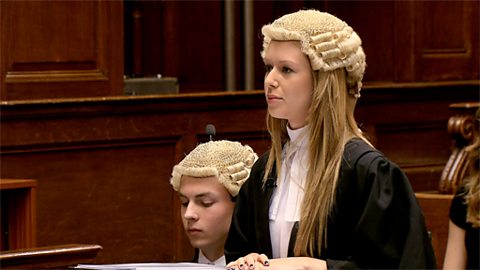
The young people are introduced who will play Defence and Prosecution barristers in the case “Queen Vs Sales”, live at the Old Bailey.
We then hear from the barrister mentors who will help the Prosecution and Defence team.
There is an overview of the judge and the courtroom, who sits where and who does what.
This is followed by a dramatic reconstruction of the crime, setting out the case by the court clerk, swearing in the Jury and the Prosecution's opening statement.
Teacher Notes
Prior to watching the clip, pupils could be asked to draw and label a courtroom in a crown court.
Pupils could then add to and change their courtroom whilst watching the clip.
Pupils could then be asked to draw their courtroom again, changing anything about the process they feel could be improved.
How do courtrooms differ in other courts, such as in county, magistrates and juvenile courts?
Curriculum Notes
This clip will be relevant for teaching classes about law and justice in the UK. It will be suitable for ages 11-16.
Suitable for: KS3, GCSE/KS4 in England, Wales and Northern Ireland and National 3, National 4 and National 5 in Scotland.
More from Young Legal Eagles:
Mock criminal trial (2/6) - Opening statement for the prosecution and first witness video
The victim of the criminal case, Farley Joseph, gives her testimony and is cross-examined. The crime is reconstructed and expert interviews are shown.
Mock criminal trial (3/6) - Court reporting and further witnesses. video
The criminal case continues with the second prosecution witness. There are interviews with a court artist, forensic scientist and a court reporter along with an explanation of contempt of court.
Mock criminal trial (4/6) - Cross-examination of defence witness. video
The judge in this criminal case introduces the ‘innocent until proven guilty’ concept and the defendant, Jo Sayles, is cross-examined.
Mock criminal trial (5/6) - Further witnesses and closing statements. video
Defence witness Bobby Forwood is cross-examined, the expert barristers comment on everyone’s performance and the young barristers give their closing statements.
Mock criminal trial (6/6) - Verdict and sentencing. video
The judge carries out her summing up and the jury are sent from court to make their decision, before the verdict is given. The participants comment on their own and each other’s performance. The process is concluded.