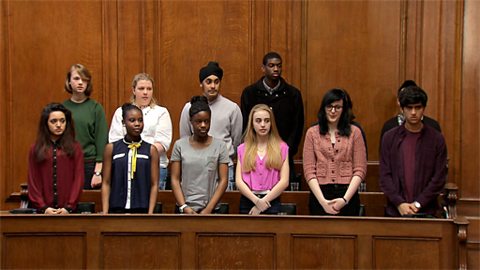
This video shows an entirely fictional 'mock' trial, with all parts played by teenagers. The violent attack shown is fictional and dramatized.
BAILIFF:All rise.
NARRATOR:'This is the trial of the Queen, versus Sales.'
CLERK:How do you plead, guilty, or not guilty?
JO SALES:Not guilty.
NARRATOR:'The case is fictional.'
FEMALE:Loser!
ALEX:You're a loser, Farley!
NARRATOR:'But the battle between prosecution and defence is very real.'
JO SALES:I did not walk through Hillside Park that day.
ALEX:You better be getting a good shot of this!
MEMBER OF THE DEFENCE #1:Is it even possible that you mistook what Alex actually said?
FARLEY JOSEPH:I definitely heard Jo.
NARRATOR:'Guiding the students through the trial are two teams of expert barristers.'
LAWRENCE POWER:It's critical that the jury get that.
MR. BURN:Did you find anything on these sneakers when you examined them?
JANE NOEL:Yes I detected a small amount of blood on the sole of the right trainer.
NARRATOR:'Taking the law into their own hands, they are - Young Legal Eagles.'
NARRATOR:'Previously on Young Legal Eagles. The prosecution outlined the case against Jo Sales…'
MR. BURN:The defendant, Jo Sales, is charged with assault occasioning actual bodily harm, and that she was present and filmed an attack on Farley Joseph. If you believe this to be the case, she may be convicted under the principle of joint enterprise. Let me give you a brief outline of the facts.
NARRATOR:'And the victim gave her evidence in front of the jury.'
FARLEY JOSEPH:He spoke to the person behind me, who I assume must have been filming it. I definitely heard the name Jo.
MEMBER OF THE DEFENCE #1:You say you heard someone behind you, did you turn around to see who this person was?
FARLEY JOSEPH:No I didn't.
NARRATOR:'Inside the courtroom watching the case, are members of the general public, and representatives from the press. Including the court artist and news reporter, who closely follow proceedings and give their take on the trial as it develops.'
BEN ANDO:'Court reporting is absolutely vital.' It's a fundamental principle of our system of justice
BEN ANDO:that it should be open. In theory that means that anybody off the street can come into a courtroom and watch what is happening. 'There are public benches in all courts to allow that to happen.'
PRISCILLA COLEMAN:The thing that reporters need is something visual.
PRISCILLA COLEMAN:Television is so reliant on images. So because they don't have cameras in court, I provide that. The Contempt of Courts Act says that no drawings are allowed to be made in court. It has to do with not wanting to intimidate witnesses, 'or expose a defendant to undo publicity. And the way I do it, is I memorise people's faces.’
PRISCILLA COLEMAN:'I'm allowed to take written notes, and then I go away and do my sketch.'
BEN ANDO:What we can say and what we can do are governed by insuring that the trial is fair and takes place as it should. So for example before a trial begins, there are lots of things that we can't say about the case, 'because that might somehow prejudice the jury. Of course it's a fundamental principal.'
BEN ANDO:Firstly, that someone's innocent until they're proven guilty, and secondly, that in the eyes of society, everybody has a good name.
NARRATOR:'As well as the issues of privacy, prejudice and libel, every reporter needs to be aware of the Contempt of Court Act. That means that if you don't follow the rules of the court, you can be arrested.'
BEN ANDO:The whole point of contempt is that it's designed to stop somebody being unfairly found guilty.
NARRATOR:'Sitting beside news reporter, Ben Ando, is student, Charlotte Islin, who will be reporting on the verdict at the end of the trial.'
JUDGE:Anymore witnesses, Mr. Burn?
MR. BURN:If it pleases you, your Honour, prosecution would like to call their second witness PC Russell.
JUDGE:Very well.
GRAHAM BRIGHTY:'A police witness is just a witness,' they're not necessarily for the defence or for the prosecution.
GRAHAM BRIGHTY:They're a witness, like anybody else, who is there purely to say what they saw, what they observed, what they know about the case, and what they have learnt. The officer is a professional witness, so is expected to obey the rules of the court. No emotional outbursts, no opinions to beat, and don't answer a question that wasn't asked of you.
NARRATOR:'Playing the role of the arresting officer in the case, is Tom Sweeney.'
MR. BURN:For the benefit of the court, can you please identify yourself.
PC RUSSELL:I'm PC Russell, attached to Hillside Police Station.
MR. BURN:And where were you at 7 P.M., on the 1st March of 2011?
PC RUSSELL:Well I received an instruction, via my radio ear piece, to attend the address of one, Jo Sales, in order to make an arrest for the alleged assault on a victim.
GRAHAM BRIGHTY:'Generally, a police officer will be there trying to prove their point,' that what they saw and heard proves that the person is guilty of what they suspected that they were guilty of.
MR. BURN:How did you receive this order?
PC RUSSELL:I received it via a new ear piece that we were trialling.
MR. BURN:And is this the regular way in which you receive orders?
PC RUSSELL:It's not, no, we were actually trialling it for the first time on 1st March. The trial discontinued on 5th March I believe.
MR. BURN:And do you know why it was discontinued?
PC RUSSELL:Actually some officers, on the force, were complaining about the way it affected their understanding of communication with witnesses and the like. I, for one, didn't experience those problems, but I can understand why.
MR. BURN:And you said that you received an order, did you go to Jo's home address?
PC RUSSELL:I did indeed, yeah. I knocked on the door and Jo Sales answered.
MR. BURN:And what did you say to Jo?
PC RUSSELL:I said, "Where's your mobile phone?"
MR. BURN:And how did Jo seem when you asked her this?
PC RUSSELL:Well she actually began to cry, and then, she answered that they'd lost it. I explained why she was under arrest and she was clearly quite distressed at that, but believed she was being… a bit flustered by the whole incident. But she did go on to say that she didn't understand what was going on.
MR. BURN:And was that the end of your conversation with Jo?
PC RUSSELL:It was, yes, but I did go in to search the property.
MR. BURN:And did you find anything?
PC RUSSELL:I was originally there to search for her mobile phone, as used in the assault but, unfortunately, wasn't able to recover that mobile phone. I did however recover a pair of dark blue Sneakers, which I later sent for forensics analysis.
MR. BURN:Would the Usher please show the evidence to PC Russell.
MR. BURN:Are these the Sneakers that you found in Jo Sales' home address?
PC RUSSELL:Yeah these do appear to be the same sneakers.
MR. BURN:If it pleases your Honour, may these be exhibit A.
TIM SALISBURY:Sam's using this time to think about where he's got to in his questioning. What has come out and what he'd like to have come out.
MR. BURN:Now PC Russell, are you familiar with this make of trainer?
PC RUSSELL:I am yeah, they're reasonably common at the Hillside School. It's a school I most generally attend.
MR. BURN:Are they common in any particular colours at all?
PC RUSSELL:They are actually, they're common in the dark blue and black colours.
MR. BURN:Thank you, I've got no further questions, if you'd like to wait there, I'm sure my learned friends have some.
MEMBER OF THE DEFENCE #2:Good afternoon PC Russell.
PC RUSSELL:Good afternoon.
MEMBER OF THE DEFENCE #2:So on 1st March, you was instructed via the ear piece to attend the home of Jo Sales, is this correct?
PC RUSSELL:That's absolutely correct, yes.
MEMBER OF THE DEFENCE #2:And remind the court when you was given this ear piece.
PC RUSSELL:We were given it on the day, it was 1st March just as I came on duty.
NARRATOR:'How will the defence team approach their cross-examination of PC Russell.'
JACQUELINE CASPI:We do want to put him forward as a credible witness. We don't want to make out that he's lying or making things up, but… What we can say is that maybe there was something
JAQCUELINE CASPI:that caused him to write in his statement things he may not have heard accurately.
MEMBER OF THE DEFENCE #2:Sorry remind us again why the ear piece was being used?
PC RUSSELL:It was to receive incoming transmissions, so the centre could instruct the police officers what to do.
MEMBER OF THE DEFENCE #2:And it was being used on the first day, that day?
PC RUSSELL:That's absolutely correct, yeah.
MEMBER OF THE DEFENCE #2:So it was like a trial?
PC RUSSELL:It was a trial yeah, it lasted, I think, five days up until 5th March.
MEMBER OF THE DEFENCE #2:Yeah so it was like an experiment.
PC RUSSELL:Yeah you could say an experiment.
LAWRENCE POWER:She's putting key words like trial period, experiment, which will resonate with the jury.
MEMBER OF THE DEFENCE #2:And so the experiment was discontinued five days later, because officers were complaining that it was difficult to hear what was going on around them?
PC RUSSELL:Yeah some officers were actually experiencing some difficulties understanding.
MEMBER OF THE DEFENCE #2:You say that Jo said they lost it?
PC RUSSELL:Yes she did.
MEMBER OF THE DEFENCE #2:Would it be accurate to assume that you hearing may have been slightly impaired with this earpiece that was discontinued five days later?
PC RUSSELL:I don't think that's fair to say at all.
MEMBER OF THE DEFENCE #2:Take us back to when you searched Jo Sales' property. Did you find the alleged phone?
PC RUSSELL:I didn't, no, I was unable to recover that.
MEMBER OF THE DEFENCE #2:However you did find the blue Sneakers?
PC RUSSELL:Yes.
MEMBER OF THE DEFENCE #2:And you are familiar with these Sneakers?
PC RUSSELL:Absolutely, they're very common.
MEMBER OF THE DEFENCE #2:No further questions your Honour.
JUDGE:Thank you very much.
LAWRENCE POWER:She's really pulled this out and… this is all her own work at very much the last minute.
NICOLA MCKINNEY:Well done.
NARRATOR:'The final prosecution witness to take the stand, is Jane Noel, played by Charlotte Nailer.'
MR. BURN:For the benefit of the court, can you please state your name?
JANE NOEL:Jane Noel.
MR. BURN:Your age?
JANE NOEL:43.
MR. BURN:And your occupation?
JANE NOEL:I'm a forensic scientist.
NARRATOR:'Giving his opinion on the case, expert forensics scientist, Ray Chapman, mentors the prosecution team on Jane Noel's statement.'
PROSECUTION MEMBER #1:In this case that we're doing now, there's some blood on the shoes. How easy would it be for you to determine how the blood actually got there?
RAY CHAPMAN:In the case that we're dealing with, we've got very little information about… what the blood stain looked like. What is more relevant is where it is found, and that the difficulty you've got with this is that both sides are giving the same activity to explain the staining. They're both saying that the trainer stood on a blood stain.
RAY CHAPMAN:I think it's probably right to say that, we can't really distinguish between the stain getting on the shoe at the time of the attack, or at the time of the nosebleed.
RAY CHAPMAN:The vast majority of cases that we do,
RAY CHAPMAN:we produce a statement and we will never have to go to court. If we are required at court then we will be contacted, usually by prosecution's side.
MR. BURN:What were you doing on 3rd March of 2011?
JANE NOEL:On 3rd March, I examined two dark blue Sneakers trainers, belonging to Jo Sales.
MR. BURN:Would the usher please show Jane Noel exhibit A.
MR. BURN:Are these the Sneakers that you examined?
JANE NOEL:Yes they are.
MR. BURN:And did you find anything on the Sneakers when you examined them?
JANE NOEL:Yes, I detected a small amount of blood on the sole of the right trainer.
MR. BURN:Now is this consistent with someone stepping in blood?
JANE NOEL:It is, yes.
MR. BURNNow when you examined the trainers, what were you looking for?
JANE NOEL:I was looking to see if the blood could have come from Farley Joseph.
MR. BURN:And how did you do this?
JANE NOEL:I compared the DNA of the blood on the shoe to the DNA of Farley Joseph.
MR. BURN:And what have you concluded?
JANE NOEL:I have concluded that there is a one in one billion possibility of the blood having not come from Farley Joseph or persons related to her.
MR. BURN:Thank you, I've got no further questions for you. If you would like to wait there, I'm sure my learned friends will have some.
LAWRENCE POWER:'You see, we don’t have a difficulty with your expert witness' and virtually all of her evidences is agreed.
MEMBER OF THE DEFENCE #1:Good afternoon Miss Noel. Could your test identify if Jo Sales picked up the blood at the school or at Hillside Park? It is not possible to say. No further questions your Honour.
LAWRENCE POWER:You can't put that piece of evidence to the park, or the playground.
NICOLA MCKINNEY:Yeah, so the location is still up for grabs.
LAWRENCE POWER:Which is doubt.
JUDGE:Do you intend to call any further witnesses Mr. Burn?
MR. BURN:No thank you, that is the case for prosecution.
NARRATOR:'On the next episode of Young Legal Eagles.'
JUDGE:Case for the defence, Miss Azenga.
NARRATOR:'Jo Sales takes to the witness box, but who will the jury believe? The defence…'
MEMBER OF THE DEFENCE #1:What did Alex say to you?
JO SALES:He asked me to help him teach her a lesson.
MEMBER OF THE DEFENCE #1:And what was your response to this?
JO SALES:Oh I said no, I was having none of it.
NARRATOR:'Or the prosecution?'
MR. BURN:He was confiding in you about a criminal offence he was planning take out wasn't he?
JO SALES:Well I just saw it as his anger and frustration that Farley Joseph had cheated on him.
A live criminal justice case based on a Joint Enterprise crime committed by a teenager, with all parts played by teenagers.
The role of both the court artist and the court reporter are explored and the concept 'contempt of court' is introduced.
The second prosecution witness, PC Russell, gives his testimony and undergoes cross examination.
There is further testimony from a forensic scientist about the case.
Teacher Notes
Students could write a report in the style outlined by the court reporter, about the case presented in the clip.
Students could also be given the option of drawing the court room scene using the information given by the court artist.
Students could then discuss these ways of representing what happens in court. Do the students think that TV cameras should be allowed into all UK courtrooms? Why do students think that cameras are not allowed free access at the moment?
Curriculum Notes
This clip will be relevant for teaching classes about law and justice in the UK. It will be suitable for ages 11-16.
Suitable for: KS3, GCSE/KS4 in England, Wales and Northern Ireland and National 3, National 4 and National 5 in Scotland.
More from Young Legal Eagles:
Mock criminal trial (1/6) - Case and plea video
A criminal case is introduced with the teenage barristers, their expert mentors, the judge, jury and courtroom. We hear the prosecution’s opening statement and are introduced to the main players.
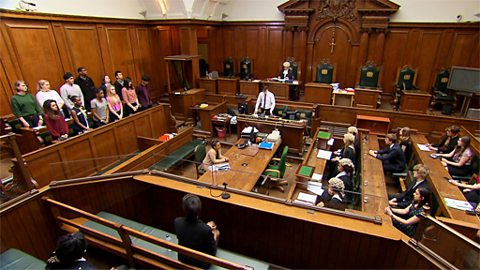
Mock criminal trial (2/6) - Opening statement for the prosecution and first witness video
The victim of the criminal case, Farley Joseph, gives her testimony and is cross-examined. The crime is reconstructed and expert interviews are shown.
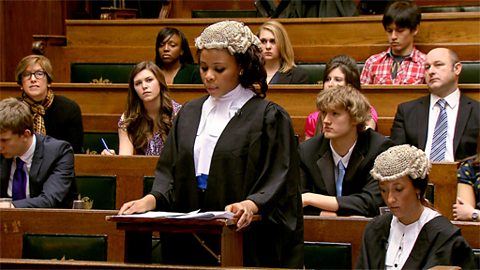
Mock criminal trial (4/6) - Cross-examination of defence witness. video
The judge in this criminal case introduces the ‘innocent until proven guilty’ concept and the defendant, Jo Sayles, is cross-examined.
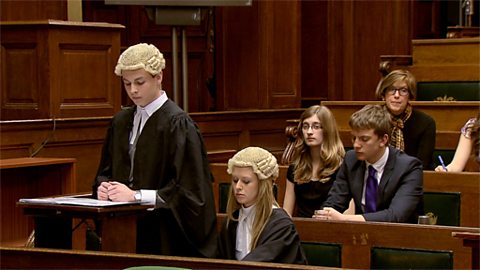
Mock criminal trial (5/6) - Further witnesses and closing statements. video
Defence witness Bobby Forwood is cross-examined, the expert barristers comment on everyone’s performance and the young barristers give their closing statements.
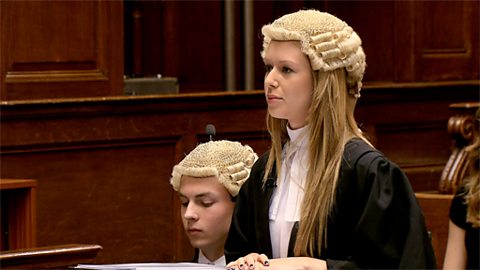
Mock criminal trial (6/6) - Verdict and sentencing. video
The judge carries out her summing up and the jury are sent from court to make their decision, before the verdict is given. The participants comment on their own and each other’s performance. The process is concluded.