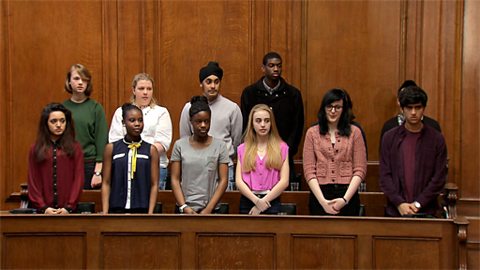
This video shows an entirely fictional 'mock' trial, with all parts played by teenagers. The violent attack shown is fictional and dramatized.
BAILIFF:All rise.
NARRATOR:'This is the trial of the Queen, versus Sales.'
CLERK:How do you plead, guilty, or not guilty?
JO SALES:Not guilty.
NARRATOR:'The case is fictional.'
FEMALE:Loser!
MALE:You're a loser, Farley!
NARRATOR:'But the battle between prosecution and defence is very real.'
JO SALES:I did not walk through Hillside Park that day.
ALEX:You better be getting a good shot of this!
MISS AZENGA:Is it even possible that you mistook what Alex actually said?
FARLEY JOSEPH:I definitely heard Jo.
NARRATOR:'Guiding the students through the trial are two teams of expert barristers.'
LAWRENCE POWER:It's critical that the jury get that.
MR. BURN:Did you find anything on these sneakers when you examined them?
JANE NOEL:Yes I detected a small amount of blood on the sole of the right trainer.
NARRATOR:'Taking the law into their own hands, they are - Young Legal Eagles.'
NARRATOR:'Previously, on Young Legal Eagles. the trial began, and the case against Jo Sales was established.'
CLERK:You are charged with assault occasioning actual bodily harm, in that you, Jo Sales, together with Alex Jordan and persons unknown 'assaulted Farley Joseph, occasioning Farley Joseph, actual bodily harm.'
JAQUELINE CASPI:'The Crown's case, is that Jo Sales committed actual bodily harm,' on the basis that she took part in the offence. Not that she actually caused the actual bodily harm, but that she knew that it was going to take place. That is a concept called joint enterprise.
JUDGE:Now, members of the jury, your role will be to assess the evidence, decide the relevant facts, and in due course deliver your verdict. I'm now going to ask prosecuting counsel to open this case to you.
MR. BURN:Your Honour, members of the jury, along with my learned friend Miss Gladwell, I appear for the prosecution. My learned friends Miss Azenga and Miss Marshall appear for the defence. The defendant Jo Sales is charged with assault occasioning actual bodily harm in that she was present and filmed an attack on Farley Joseph.
MR. BURN:Now, there is no dispute over whether this attack has actually happened because Alex Jordan has already been convicted of assault occasioning actual bodily harm towards Farley Joseph. The Crown's argument is that Jo Sales was present and did indeed film this incident. If you believe this to be the case,
MR. BURN:she may be convicted under the principle of joint enterprise. Let me give you a brief outline of the facts.
NICOLA MCKINNEY:The opening statement for the prosecution is extremely important.
CAPTIONNicola McKinneyProsecution Mentor Barrister
NICOLA MCKINNEY:It is the road map that you're going to use to convince the jury 'of what you're ultimately saying, 'which is that the defendant is guilty.' With an opening speech, you don't want to be too lengthy. It's got to be fairly succinct, so you're not getting into the details of the evidence they're going to hear. 'You're giving them the highlights.'
MR. BURN:On 1st March 2011, Farley Joseph was walking home through Hillside Park, where she was approached by Alex Jordan and four others. It was then that she was attacked, members of the jury. The Crown argue that Jo Sales was indeed one of those four others and that she indeed filmed the attack on her mobile phone.
MR. BURN:The first witness you'll hear from is Farley Joseph, the victim. She'll present to you two pieces of evidence which place Jo Sales at the scene of this attack. Firstly, she clearly heard Alex Jordan call out to Jo. And secondly, members of the jury, she saw a distinctive pair of branded dark blue Sneakers trainers.
NARRATOR:'Outside the courtroom, the mentors are watching the trial proceedings as they unfold.'
LAWRENCE POWER:Look at his eye contact with the jury. He's not looking down, it's all recollection, and that's great in that communication and getting that information over.
MR. BURN:You'll hear, members of the jury, from PC Russell, the police officer who was sent to the home address of Jo Sales. He will inform you of how he found a pair of dark blue Sneakers trainers at Jo's home address which did in fact have Farley Joseph's blood on them. Now Jo Sales claims to have lost her mobile phone on this very day.
MR. BURN:However, the prosecution argue that she deliberately dumped her mobile phone to stop any evidence of her filming the attack being found.
JAQUELINE CASPI:I hope that the defence are taking note of what he's saying, because he's pulling the prosecution case quite high.
MR. BURN:If you believe that Jo Sales filmed this attack, she may be guilty under the principle of joint enterprise. Joint enterprise is simply where a group of people set out together knowing roughly what will happen. Now, if they take part in it or encourage the incident in any way, they may be equally guilty.
MR. BURN:Remember, members of the jury, you are the sole judges of fact. You must take the law from the judge. Thank you.
CROWN PROSECUTOR #1:If it pleases you Honour, the Crown would like to call their first witness, Farley Joseph.
NARRATOR:'After being called, the witnesses are brought into court by the usher. By being questioned under oath, the truthfulness of their statement can be examined by the jury. Playing the role of the victim, Farley Joseph, is Danielle Wright.'
FARLEY JOSEPH:I promise to tell the truth.
USHER:The whole truth.
FARLEY JOSEPH:The whole truth.
USHER:And nothing but the truth.
FARLEY JOSEPH:And nothing but the truth.
LAWRENCE POWER:It's very important that the students stick within their statements,
LAWRENCE POWER:because those statements set out the scene, the story and the other pieces of evidence from the other witnesses.
NICOLA MCKINNEY:What are the main points, as prosecution team, that you want to get in Farley Joseph's evidence?
CROWN PROSECUTOR #2:We're trying to establish whether Jo Sales was actually there at the attack, filming it.
CROWN PROSECUTOR #3:What we're trying to do is present her evidence to what she remembers, what she saw, and make the jury believe that evidence is true. So using her to prove the guilt of Jo Sales.
CROWN PROSECUTOR #1:For the benefit of the court, can you please state your name?
FARLEY JOSEPH:Farley Joseph.
CROWN PROSECUTOR #1:Now I know I'm asking you the questions, but could you please keep your voice up and direct your answers towards the jury.
NICOLA MCKINNEY:'In a courtroom, a witness will almost certainly be directed to deliver their answers to the jury.' Even though they're being asked questions by the barrister, and the natural response is to answer the barrister. But the reason for that is that it's the jury who are going to be making the decision.
CROWN PROSECUTOR #1:Can you remember what happened on 1st March 2011?
FARLEY JOSEPH:I was walking through Hillside Park on my way home from school. I was listening to my MP3 player to try and cheer myself up a bit.
CROWN PROSECUTOR #1:Why were you cheering yourself up?
FARLEY JOSEPH:My boyfriend, Alex Jordan, had dumped me at lunchtime.
CROWN PROSECUTOR #1:And did you talk to him at all about this?
FARLEY JOSEPH:I tried to explain to him that I wasn't cheating on him and that the text from Loz Carr, he's just my friend there was no big deal, but he wasn't listening.
CROWN PROSECUTOR #1:So what was happening as you were walking home?
FARLEY JOSEPH:I saw Alex Jordan and three of his friends approach me from the front. 'I could hear someone behind me but I didn't turn round to see who it was.'
CROWN PROSECUTOR #1:'And what happened after this?'
FARLEY JOSEPH:Alex came up to me and he grabbed me by my coat and said he's going to show everyone what a no-good lowlife I am. 'And he started calling me a loser, and his mates were joining in. They were shouting at me.'
CROWN PROSECUTOR #1:And how were you feeling?
FARLEY JOSEPH:I was quite intimidated and upset.
CROWN PROSECUTOR #1:Did he say anything else?
FARLEY JOSEPH:He spoke to the person behind me, who I assume must have been filming it, and he shouted, "Jo, you better get a good shot of this. When this goes on the internet, everyone will know what a loser Farley is."
CROWN PROSECUTOR #1:And are you sure of what you heard?
FARLEY JOSEPH:I definitely heard the name Jo.
CROWN PROSECUTOR #1:Do you know of any Jo?
FARLEY JOSEPH:The only Jo I know and that Alex knows is Jo Sales.
CROWN PROSECUTOR #1:What happened after this?
FARLEY JOSEPH:'They started punching me and pelting me with eggs. I laid on the floor crying for a bit' and then I saw the four people in front of me run away, and that was including Alex. And the person behind me, ran past me and they stepped in my blood, which was on the floor.
LAWRENCE POWER:The answer's too long. That's the entire point of the identification. It's critical that the jury get that.
NICOLA MCKINNEY:You have to always think about juries as just being real people. 'Their attention is going to flag at times. You need to make sure that you don't rush through' or assume bits of knowledge. Everything needs to be sort of connected together.
CROWN PROSECUTOR #1:And can you remember what they were wearing at all?
FARLEY JOSEPH:As I was only lying on the floor, I could only see their feet, but they were definitely wearing a dark blue pair of Sneakers. 'That's the brand Sneakers.'
CROWN PROSECUTOR #1:So you made your statement to the police, when was that?
FARLEY JOSEPH:On 1st March.
CROWN PROSECUTOR #1:And did they ask you about the attack?
FARLEY JOSEPH:They asked me if there was any point during that day that anyone could've got my blood on their shoes.
CROWN PROSECUTOR #1:And was there?
FARLEY JOSEPH:Yeah. Just before afternoon registration, I had a nosebleed in the playground. I didn't have a tissue, so I had to go to the toilet to get one.
CROWN PROSECUTER #1:Did you see this Jo Sales that day in the playground?
FARLEY JOSEPH:I definitely didn't see Jo Sales in the playground.
CROWN PROSECUTOR #1:Thank you. I have no further questions for you, but if you wait there, I'm sure my learned friends will have some more for you.
LAWRENCE POWER:'When a defence barrister asks prosecution witnesses questions, that's called cross examination.' The purpose of defence cross examination is to test the evidence.
LAWRENCE POWER:That means to see if it's accurate, truthful and reliable or not.
MISS AZENGA:So, Miss Joseph, you were previously dumped that day?
FARLEY JOSEPH:Yes, I was.
MISS AZENGA:And how were you feeling over the break-up?
FARLEY JOSEPH:I was a little bit upset. I mean, he wouldn't listen to me about the text, so I suppose it's his loss, really.
LAWRENCE POWER:What do you think is a proper style of asking questions in this case to this victim?
MISS AZENGA:Obviously they're a victim and they've been through an ordeal, so you have to kind of respect that and ask them not in a badgering way, but a sort of calm way, to actually get the evidence out of them.
MISS AZENGA:Am I correct in saying you were listening to music on your MP3?
FARLEY JOSEPH:Yes, I was.
MISS AZENGA:So you had headphones in both your ears?
FARLEY JOSEPH:Yes.
MISS AZENGA:And you would agree that your ability would be impaired to some extent?
FARLEY JOSEPH:I wouldn't say so, it was just sort of a bit of background music.
MISS AZENGA:You say you heard someone behind you. Did you turn around to see who this person was?
FARLEY JOSEPH:No, I didn't.
MISS AZENGA:So the only identification you had was sound?
FARLEY JOSEPH:Yes.
MISS AZENGA:So you were unable to catch the identity of the person behind you?
FARLEY JOSEPH:Other than their footwear, yes.
MISS AZENGA:What was Alex shouting at you?
FARLEY JOSEPH:He grabbed my coat and shouted, "I'm going to show everyone what a no-good lowlife you are." And then said to the person behind me, "Jo, you better get a good shot of this. When this goes on the internet, "everyone will know what a loser Farley is."
MISS AZENGA:Is it even possible that you mistook what Alex actually said?
FARLEY JOSEPH:I definitely heard, "Jo."
MISS AZENGA:You say you caught a glimpse of the trainer.
FARLEY JOSEPH:Yes, I did.
MISS AZENGA:Are these Sneaker trainers common in your school?
FARLEY JOSEPH:Not really.
MISS AZENGA:Just to remind the court, you had the nosebleed during the day?
FARLEY JOSEPH:Yes, I did.
MISS AZENGA:And the nosebleed took place in the playground, and with no tissue, so you had to walk all the way to the toilet to take care of this?
FARLEY JOSEPH:Yes. I covered my nose and mouth like this to try and stop obviously getting it on my uniform.
MISS AZENGA:Now you must've been in a hurry, distressed I take it. So you weren't looking around the playground to see who was there?
FARLEY JOSEPH:No, I didn't.
MISS AZENGA:But how can you be so sure you didn't see Jo Sales in the playground?
FARLEY JOSEPH:Well I was focusing on my nosebleed.
MISS AZENGA:So therefore you weren't focusing on who was in the playground?
FARLEY JOSEPH:No. On my walk I definitely didn't see Jo.
MISS AZENGA:No further questions, your Honour. Your Honour, may release the witness from the stand.
NARRATOR:'After questioning is over, the witnesses can then choose to stay in court and watch proceedings from the witness bench.'
LAWRENCE POWER:'I think, on balance,' that was a reasonable cross examination.
NICOLA MCKINNEY:It was, yes.
TIM SALISBURY:I mean, regardless of whether the defendant was involved, This is still someone who's suffered a nasty assault.
LAWRENCE POWER:It's a victim.
NARRATOR:'On the next episode of Young Legal Eagles. The prosecution's case against Jo Sales continues.'
MR. BURN:Did you go to Jo's home address?
PC RUSSELL:I did indeed, yeah. I knocked on the door and Jo Sales answered
MR. BURN:And did you find anything?
PC RUSSELL:I did recover a pair of dark blue Sneakers which I later sent for forensics analysis.
MR. BURN:And did you find anything on these sneakers when you examined them?
JANE NOEL:Yes, I detected a small amount of blood on the sole of the right trainer.
NARRATOR:'And the defence team must work hard to prove reasonable doubt.'
MISS AZENGA:And could your test identify if Jo Sales picked up the blood at the school or at Hillside Park?
JANE NOEL:It is not possible to say.
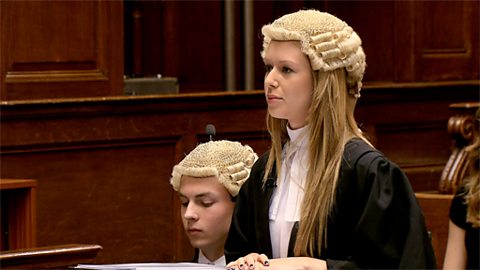
A live criminal justice case based on a Joint Enterprise crime committed by a teenager, with all parts played by teenagers.
The first prosecution witness, victim Farley Joseph takes to the stand to testify and is questioned by the prosecution and cross examined by the defence, using flashbacks to the dramatic reconstruction of the crime.
This is interspersed with mentoring sessions with the defence and prosecution barristers and their teams of young people, and expert interviews with barristers, to show how they prepared for the questioning and cross examination of prosecution witnesses.
Teacher Notes
Students could discuss what they have just seen in the clip.
Did anything surprise them about the opening statement and the account of the first witness?
Were the first witness' answers strong?
Did she cope well with the line of questioning?
What more could or should the witness have said or been asked during the questioning?
Curriculum Notes
This clip will be relevant for teaching classes about law and justice in the UK. It will be suitable for ages 11-16.
Suitable for: KS3, GCSE/KS4 in England, Wales and Northern Ireland and National 3, National 4 and National 5 in Scotland.
More from Young Legal Eagles:
Mock criminal trial (1/6) - Case and plea video
A criminal case is introduced with the teenage barristers, their expert mentors, the judge, jury and courtroom. We hear the prosecution’s opening statement and are introduced to the main players.
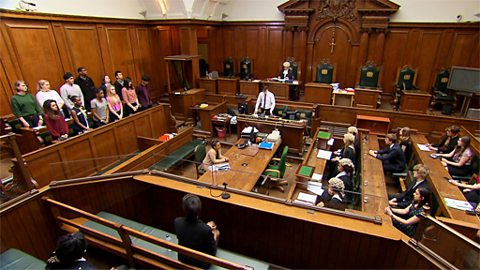
Mock criminal trial (3/6) - Court reporting and further witnesses. video
The criminal case continues with the second prosecution witness. There are interviews with a court artist, forensic scientist and a court reporter along with an explanation of contempt of court.
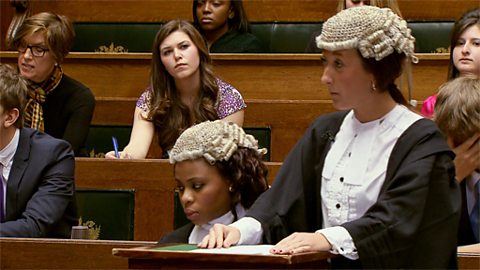
Mock criminal trial (4/6) - Cross-examination of defence witness. video
The judge in this criminal case introduces the ‘innocent until proven guilty’ concept and the defendant, Jo Sayles, is cross-examined.
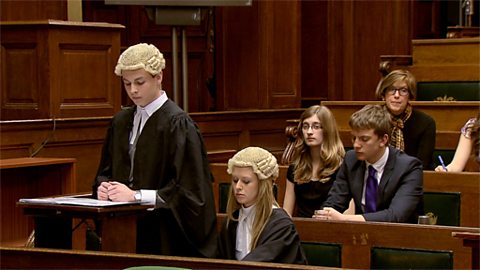
Mock criminal trial (5/6) - Further witnesses and closing statements. video
Defence witness Bobby Forwood is cross-examined, the expert barristers comment on everyone’s performance and the young barristers give their closing statements.
Mock criminal trial (6/6) - Verdict and sentencing. video
The judge carries out her summing up and the jury are sent from court to make their decision, before the verdict is given. The participants comment on their own and each other’s performance. The process is concluded.