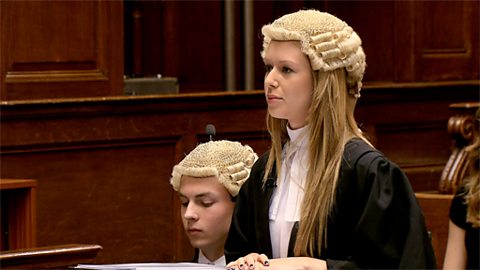
This video shows an entirely fictional 'mock' trial, with all parts played by teenagers. The violent attack shown is fictional and dramatized.
BAILIFF:All rise.
NARRATOR:'This is the trial of the Queen, versus Sales.'
CLERK:How do you plead, guilty, or not guilty?
JO SALES:Not guilty.
NARRATOR:'The case is fictional.'
FEMALE:Loser!
ALEX:You're a loser, Farley!
NARRATOR:'But the battle between prosecution and defence is very real.'
JO SALES:I did not walk through Hillside Park that day.
ALEX:You better be getting a good shot of this!
MISS AZENGA:Is it even possible that you mistook what Alex actually said?
FARLEY JOSEPH:I definitely heard Jo.
NARRATOR:'Guiding the students through the trial are two teams of expert barristers.'
LAWRENCE POWER:It's critical that the jury get that.
MR. BURN:Did you find anything on these sneakers when you examined them?
JANE NOEL:Yes I detected a small amount of blood on the sole of the right trainer.
NARRATOR:'Taking the law into their own hands, they are - Young Legal Eagles.'
NARRATOR:'Previously, on Young Legal Eagles. The final defence witness, Bobbi Forward, gave her evidence.'
MEMBER OF THE DEFENCE #1:Did you notice anything about her?
BOBBI FORWARD:I heard she was upset in the kitchen, so I asked her what was wrong and she told me she'd lost her phone.
CROWN PROSECUTOR #1:Life at home would be pretty hard for you if you were giving evidence against her, let's say?
BOBBI FORWARD:I wouldn't be giving evidence against her because I know I would not lie on behalf of my cousin, so everything we're saying here today is truthful.
NARRATOR:'And the barristers summed up their case in front of the jury.'
CROWN PROSECUTOR #1:Jo Sales was at the attack, and indeed filmed this attack on her mobile phone. If you also believe this, the Crown would urge you to find the defendant, Jo Sales, guilty.
MEMBER OF THE DEFENCE #1:This case is based on if, buts and why - not pure facts. I ask you to find the defendant not guilty.
JUDGE:Now members of the jury. The directions I give you as to the law, you must accept and apply. However, whenever I refer to the evidence the position is quite different. All questions of evidence and fact are for you, and for you alone, to decide. That includes the evidence which has been agreed between the prosecution
JUDGE:and the defence, and placed before you. This case basically boils down to, "Who do you believe?" Do you believe the victim when she says that she was assaulted, and that at the time, she heard the perpetrator of that assault say "Jo", or did, as the defence claim, did he say "Yo"? Do you believe, as the victim says,
JUDGE:that the person who stepped into the blood at the scene, was this defendant? Do you believe that the blue Sneakers that were identified, were the same Sneakers? Or do you believe, as the defence say, that this could have been blood found at the playground, into which the defendant stepped? Now it's important for you to remember, members of jury,
JUDGE:that the prosecution must prove the defendant's guilt. It is not for her to prove that she is innocent. The prosecution must prove that the defendant is guilty beyond reasonable doubt. There are very few things in this world, that we know with absolute certainty. Both the defence and the prosecution agree,
JUDGE:that if you find that Jo Sales was at the scene, when the assault came about, then joint enterprise is made out. I will now ask you to retire to consider your verdict. Thank you very much.
CLERK:I shall keep this jury in a private and convenient place. I shall suffer no-one to speak to them, nor shall I speak to them myself, except with leave of the court, save to ask them whether they have agreed upon their verdict. Could the jury please rise and follow me?
JUDGE:In order for someone to be found guilty, the judge will ask the jury to come to a unanimous verdict.
CAPTIONRt. Hon. Baroness Scotland of Asthal, QC
JUDGE:That means a verdict upon which they are all agreed.
LAWRENCE POWER:I think the trial process is to test the truth. I think people go there, they take the oath, their evidence is to be tested and a jury, the best place to do so, finds out by deliberating between themselves what they believe. And you get a very democratic process, of the twelve then voting.
NICOLA MCKINNEY:This is behind the curtain of secrecy for us, this is uncharted territory. We never get to see this.
JUROR #1:OK, so guys should we just have a quick show of hands as to who wants to elect themselves to be foreman?
JUROR #2:I'll put myself forward.
JUROR #1:OK.
JUROR #2:Anyone else? Alright. Well, the problem I have, is the place of where the blood is found which is on the sole of the shoe. Does that actually mean that she was at the scene of the incident.
JUROR #3:When you look at the blood splot, it's a circle, that's like blood drops from a nose. It makes like a splotch, like that, and that's how it looked on the shoe.
JUROR #1:But then the forensics scientist did say, she could have stepped on it, remember that.
JUROR #4:I mean call it luck, or the lack of it really.
JUROR #5:I don't think she walked past the nosebleed. That doesn't make any sense.
JUROR #3:She said that the trainers aren't popular though, that's what I don't get. Why would she say they're not common in the school, when they are.
JUROR #2:OK, well let's move on to, I think, the victim. She had the MP3 player in her ears, OK. Any comments about that?
JUROR #1:No, other than "Jo" and "Yo" are very similar.
JUROR #5:Someone heard them say Jo do it, you know, it does kind of lean towards–
JUROR #1:That's what I'm saying–
LAWRENCE POWER:This is what I expect a jury room to be - I think this is realistic. Some quiet ones, some strong ones.
JUROR #1:Also, just another point, you know how we say it's very coincidental, don't forget Jo hasn't had a criminal record or any-- She's never been involved in any type of crime. She seems as though she's alright but she didn't want to be part of it.
JUROR #6:Also, we should take into account that the cousin gave her statement two days afterwards. It could be that the cousin tweaked the story, so that it matched and reinforced what her…
JUROR #1:Definitely. I agree.
JUROR #4:She's been living in that house for three years, you become like sisters. You wouldn't let them go to prison, or–
JUROR #6:Yeah.
JUROR #4:Suffer the consequences just like that. You'd obviously back up someone else in your family.
JUROR #2:Is that it, any more points? No, shall we take another count of who thinks that Jo Sales is indeed guilty?
JUROR #2:OK, that's 3 out of 12, and 9 against.
JUDGE:If, after a period of time, the judge comes to the conclusion that it is possible to take a majority verdict, then the judge could accept a verdict about which ten, of the twelve jurors are agreed.
JUROR #2:What stands against the jury here today is that there was no witness for the victim on the scene. And she was attacked, obviously, because we know that. She had an MP3 player, playing in her ears, OK?
JUROR #5:Only thing we have to go on is the fact that there's blood on her shoe, and no one knows when the blood got on the shoe, it could have been either time.
JUROR #2:It is indeed very weak evidence.
JUROR #5:I don't think there's enough to say. Full stop.
JUROR #7:I don't think there's enough to put her away.
JUROR #5:Yeah.
LAWRENCE POWER:And that should be the point to take a vote, is there enough?
JUROR #2:So, can I have a show of hands, of who thinks that Jo Sales is not guilty? Okay, so that means that we have a vote of 11 out of 12
JUDGE:If the jury comes back and finds the defendant guilty, then it will be a matter for the judge to sentence that defendant. In order to decide upon the appropriate sentence, the judge will have to do a number of things. The first thing the judge will have to do is to take into account the facts of the case,
JUDGE:and what happened, and the severity of the allegations made against the defendant. So for example, in this case the judge will have to consider the amount of damage that was caused to the victim. The judge will also take into account, the history of the defendant. The defendant may have lied on their oath, and it's likely
JUDGE:that the defendant will be treated more harshly, than if the defendant simply owned up to it, and pleaded guilty. So finding someone guilty of an offense of actual bodily harm is a very serious thing to do.
CLERK:Would the defendant please stand. Could the foreman please stand. Have you reached a verdict upon which you have all agreed?
JUROR #2:No. We have a majority.
CLERK:What is your verdict?
JUROR #2:Not guilty.
CLERK:You may be seated.
JUDGE:You have been discharged by this jury, you may now leave the dock. Members of the jury, may I thank you for your service, you have discharged your civic duty. Without jurors being prepared to try matters like this, our judicial system would not be that which it is. I thank you very much. You may now leave the court.
NARRATOR:'With the verdict announced, the journalist uses the notes taken during the trial to film her report ready for the evening news deadline.'
CHARLOTTE ISLING:Today at the Old Bailey, a 17 year-old was relieved to be acquitted of the charge of actual bodily harm, for her alleged part in a malicious afterschool attack that took place in Hillside Park, on the 1st March 2011. The defendant, who cannot be named for legal reasons, did not physically assault the victim.
CHARLOTTE ISLING:However, was accused of filming the attack on her mobile phone, and was therefore being tried under the principal of joint enterprise. The prosecution's case was based on circumstantial evidence and a series of coincidences. After lengthy deliberation, the jury returned and there was silence in the court.
CHARLOTTE ISLING:The foreman stood and revealed the not guilty verdict, and the defendant seemed to breathe a sigh of relief. In summing up, Baroness Scotland said that there were very few things in this world that we know in absolute certainty, but it was for the jury to decide. This is Charlotte Isling, BBC London News, at the Old Bailey.
LAWRENCE POWER:Well, let me first say congratulations to both teams today. We've been thrilled at how all of you have performed and I think on balance when you look at what we saw in the jury room, you'll see how the jury got to that decision.
NICOLA MCKINNEY:It was really a debate in there, and I think that is down to the fact that you both did your jobs very well. Don't think of it as a loss, think of the whole experience and the fact that this is the criminal justice system working.
LAWRENCE POWER:What I really enjoyed is the fact that you didn't get side-tracked. That really comes from years of experience but you're already doing it now.
NARRATOR:'So what did the students think of each other's performance in court?'
CROWN PROSECUTOR #1:The way they put forward their case was more friendly, I think, than sometimes I could be.
MEMBER OF THE DEFENCE #1:I think their tone and the way they handled their witnesses, Their witness and them had a really good relationship.
LAWRENCE POWER:Well let's look at how it felt, being the defendant?
JO SALES:I started to think that I was a bit more guilty. I felt that they picked out all of the right points to focus on.
LAWRENCE POWER:I hope that the events have given some of you some enthusiasm, and aspiration to come and do our job as barristers. Because we need you, you're the future, not just of the bar of England and Wales, but of the judiciary and that's a hugely important thing.
CROWN PROSECUTOR #1:Something to look for in the future. It's a nice little taster of what it's going to be like.
JO SALES:Before, I thought law was very boring, not really interested. I got into it and I absolutely-- I love it.
MEMBER OF THE DEFENCE #1:When you're young and you say, "I want to be a lawyer when I'm older", it sounds really like you're not going to do it, and you realise, "Actually, I can do it."
MR. BURN:It's been overall, a good experience.
A live criminal justice case based on a Joint Enterprise crime committed by a teenager, with all parts played by teenagers.
The Judge, Baroness Scotland, sums up the case for the jury and they are sent from the court to carry out their deliberation.
Expert interviewees discuss the role of the jury.
We see the jury discussing the case, interspersed with commentary from expert barristers.
The jury decide on a verdict and are brought back to the court.
They find Jo Sales not guilty.
The mentors congratulate all the participants and discuss the trial with them.
They all comment on everyone's performance and Lawrence Power concludes with some final words about the importance of young people joining the legal profession.
Teacher Notes
Before watching this clip, students could form their own jury and debate whether the defendant is innocent or guilty of the crime.
They could then watch the jury in the clip deliver their verdict and see if they agree with the outcome.
One question that is asked in the clip is whether people might consider a career in the legal profession.
Students could discuss what qualifications they might need to do this, how they might gain them, and the advantages and disadvantages of working in law.
Curriculum Notes
This clip will be relevant for teaching classes about law and justice in the UK. It will be suitable for ages 11-16.
Suitable for: KS3, GCSE/KS4 in England, Wales and Northern Ireland and National 3, National 4 and National 5 in Scotland.
More from Young Legal Eagles:
Mock criminal trial (1/6) - Case and plea video
A criminal case is introduced with the teenage barristers, their expert mentors, the judge, jury and courtroom. We hear the prosecution’s opening statement and are introduced to the main players.
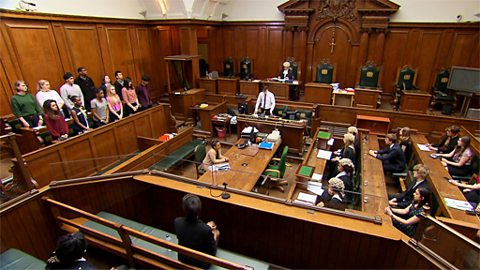
Mock criminal trial (2/6) - Opening statement for the prosecution and first witness video
The victim of the criminal case, Farley Joseph, gives her testimony and is cross-examined. The crime is reconstructed and expert interviews are shown.
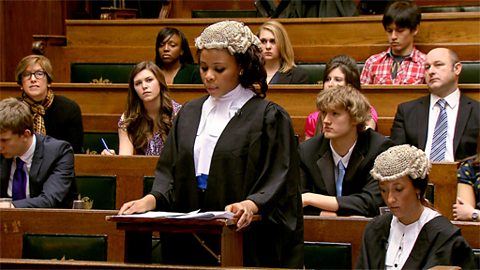
Mock criminal trial (3/6) - Court reporting and further witnesses. video
The criminal case continues with the second prosecution witness. There are interviews with a court artist, forensic scientist and a court reporter along with an explanation of contempt of court.
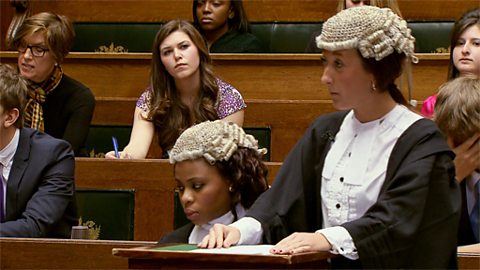
Mock criminal trial (4/6) - Cross-examination of defence witness. video
The judge in this criminal case introduces the ‘innocent until proven guilty’ concept and the defendant, Jo Sayles, is cross-examined.
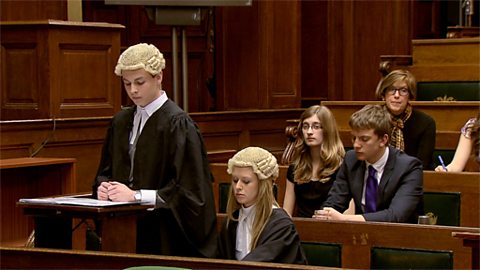
Mock criminal trial (5/6) - Further witnesses and closing statements. video
Defence witness Bobby Forwood is cross-examined, the expert barristers comment on everyone’s performance and the young barristers give their closing statements.