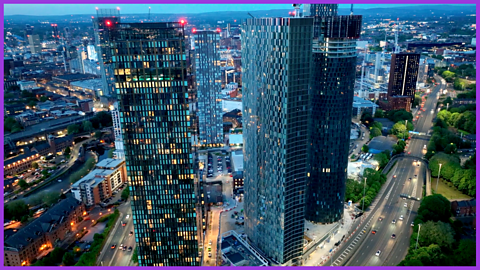
Join EVA ('Earth's Virtual Assistant') to investigate the climate, animals and plants that characterise two of the planet's major biomes: savannahs and tundras.
The video
KS2 Geography: Biomes. Savannahs and Tundras
EVA: Get set for an exciting journey.
I am your guide, ‘Earth’s Virtual Assistant.’ But you can call me E.V.A.
Your mission is to explore the world’s biomes. Biomes are areas of the planet with similar climates, landscapes, animals and plants.
[A MAP OF THE EARTH REVEALS SIX BIOMES]
There are six major biomes found on Earth. Rainforests. Deserts. Savannahs. Tundras. Woodlands. And Grasslands.
Let’s investigate…the savannah biome.
[A GLOBE SHOWS THE POSITION OF THE EQUATOR]
A biome’s climate is mainly controlled by its latitude on Earth - how far north or south it is. Tropical savannahs are one type of savannah biome. Savannahs are usually found near the equator, between the tropical rainforest and the desert biomes.
This part of the world gets plenty of direct sunlight, so the temperature is warm all year; but unlike the rainforest, rain doesn’t fall every day.
[THE GLOBE ZOOMS INTO EAST AFRICA]
It’s time to start this mission so let’s journey to Africa.
Tropical savannahs are flat areas with scattered trees and shrubs. A savannah biome only has two seasons: wet and dry. In the wet season the weather is warm and there’s lots of rain.
But during the dry season, it can be extremely hot, and rainfall is rare.
Tropical savannahs are high in biodiversity.
[ON-SCREEN GRAPHICS - BIODIVERSITY]
Biodiversity is the variety of plant and animal life in a place.
Plants and animals in savannahs - like this giraffe - have adapted to life with varied rainfall and hot temperatures.
This tree is called a baobab. It has long roots that can reach far down into the soil for moisture, and then it can store huge amounts of water in its tall, thick trunk.
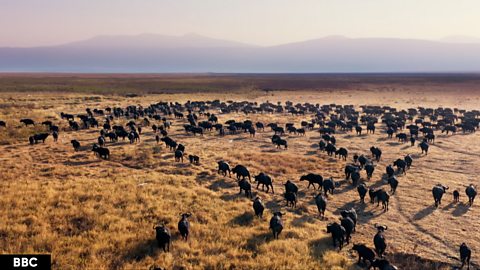
The savannah biome also experiences ‘The Great Migration’. This involves millions of animals moving great distances in search of grazing lands and water as the seasons change.
The rich variety of wildlife in savannah areas attracts tourists on safari. While this is good for a country’s economy the construction of roads, lodges and transport used by the tourists must be managed carefully to avoid damaging plants and scaring the animals.
[DEBRIEF - SAVANNAHS]
1: The climate in the tropical savannah biome is seasonal. 2: Animals often have to travel long distances for food and water. 3: Tourism is a human challenge which has to be managed carefully.
[MAP OF THE EARTH REVEALS THE NEXT BIOME]
The mission continues now and it’s time to look at another biome. Let’s explore the tundra biome.
Tundras are the coldest of all the biomes, but there is very little rain or snowfall here.
Tundras are mostly found in the regions just below the ice cap of the Arctic. They are also found at the tops of very high mountains.
Wrap up, it’s about to get very cold! This is the far north of Europe, close to the North Pole. It’s part of the Arctic tundra.
Tundra biomes only have two seasons: winter and summer.
Winters are long, dark and cold with average temperatures well below zero degrees Celsius and very little rain. In summer, temperatures remain cool.
Tundras are low in biodiversity. Not many species can survive the extreme conditions. In fact, the word ‘tundra’ comes from the Finnish word meaning ‘treeless hill’.
[ON-SCREEN GRAPHICS - PERMAFROST]
The temperatures are so cold that there is a layer of permanently frozen ground called permafrost.
Plants such as mosses and lichens have adapted to grow quickly during the short summer season.
Some animals living in the Arctic tundra, including the Arctic fox, change their coats from thin, brown in the summer to thick, white fur in the winter - for camouflage and to manage body temperature.
But melting ice due to climate change is threatening the balance of this biome.
[ON-SCREEN GRAPHICS - CLIMATE CHANGE]
Climate change is the long-term rise in Earth’s average temperatures, which is making the weather more extreme and unpredictable.
Because the Earth is warming, ice and some permafrost is melting - releasing ‘greenhouse gases’ into the atmosphere and contributing to rising sea levels.
[DEBRIEF - DESERTS]
1: Tundra biome climates are extremely cold and experience very little rain. 2: They are mostly treeless regions. 3: Plants and animals have adapted to survive the freezing and dry climate.
Congratulations! We’ve come to the end of our fabulous journey exploring two of the world’s major biomes. Mission complete!
Savannahs and Tundras
Download/print a transcript of this episode (pdf).
Pupils join EVA ('Earth's Virtual Assistant') to discover the climate, plants and animals that characterise two of Earth's major biomes: savannahs and tundras.
Pupils will discover that savannahs are rich in biodiversity and have two seasons - wet and dry; they will see how plants - such as the baobab tree - have adapted to survive the irregular rainfall, and how savannahs are one of the last places on Earth to witness a mass migration of animals.
The video then explores the contrasting tundra biome. Pupils will discover that tundras are very cold and consequently are low in biodiversity; they will learn how some animals - such as the Arctic fox - have adapted to survive the cold temperatures and permafrost; and how the Earth's warming due to climate change is threatening the tundra biome.
Teacher Notes
Download/print the full Teacher Notes with worksheets for this episode (pdf).
Teacher Notes prepared in partnership with the Geographical Association.
Key geographical vocabulary
Biome - large scale ecosystems.
Climate - the state of the atmosphere over many years or over a large area (ie the ‘average’ of the weather).
Sub-tropical - the region between the tropics and arid hot deserts.
Biodiversity - the variety of plant and animal life in a particular ecosystem.
Ecosystem - a community of living organisms interacting with each other and their environment.
Adaptation - the process by which plants and animals change over time to survive in their environment.
Suggested activities
- Make a mindmap of the location, climate, plants, animals and threats for each biome.
- Create a ‘biome in a box’. Ask pupils to fill a shoebox to visualise one of the biomes - eg for tundra: cotton wool to represent snow and permafrost, small stones and sand for rocky ground, moss and twigs, small animal figures or cutouts, etc.
- Demonstrate desertification: have a shallow tray with hard packed earth beneath and light soil/sand on top, then blow hot air from a hair dryer across the top for a while to show how soil is removed by winds.
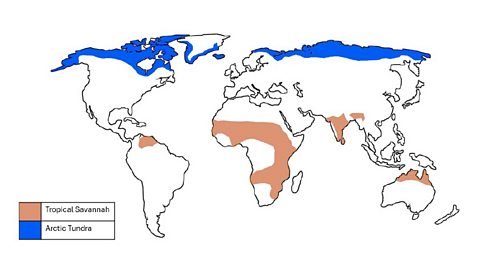
- Have a physical world map on the board. Ask students to come up and point out where they would most expect to see tropical savannahs and tundra biomes.
- Provide pupils with a blank map of the world. Label the equator and tropics, also 60°N and the Arctic Circle. Pause the video where it shows biome location, and ask pupils to shade their map to show tropical savannah and tundra location. Then use an atlas and ask them to find the name of a place that is within that biome. This could turn into a game.
Points for discussion
- Where are tropical savannahs found?
- Why are the savannahs found near the tropics, but it has a dry season?
- Where are the tundras found?
- How difficult is life in the savannahs?
- How do plants and animals adapt to survive in the savannahs?
- What challenges do plants and animals face in the tundras?
- How do plants and animals adapt to survive in the tundras?
- Why do people choose to visit the savannahs on holiday?
- What benefits and what problems can tourism bring?
- How might climate change affect these places?
Curriculum notes
This video is suitable for teaching KS2 in England and Northern Ireland, 2nd Level in Scotland and Progression Step 3 in Wales.
Resources
Teacher Notes
Download/print the Teacher Notes for this episode (pdf).

Transcript
Download/print the transcript of this episode (pdf).
Map showing the tropical savannah and Arctic tundra biomes. image
Click to display the image full size.
Other videos in this series
Biomes: Woodlands and Grasslands. video
Join the mission to investigate the climate, plants and animals of two of Earth's major biomes: woodlands and grasslands.
Biomes: Rainforests and Deserts. video
Join the mission to investigate the climate, plants and animals of two of Earth's major biomes: rainforests and deserts.
See also... Settlements. collection
Join EVA on another mission: to discover different types of settlement - including villages, towns and cities - and to investigate the factors determining land use.