CATRIONA: My favourite Scots word has to be 'feart'. I love the way it sounds. It's a really descriptive and expressive word.
NARRATOR: Catriona Shearer reads the news for the BBC around 30 times a week.
CATRIONA: The first time I ever did a live news broadcast, I was so nervous. My heart was pounding, my palms were sweaty, I had to hook myself up to London and I was really 'feart'.
Nowadays I manage to slip in the occasional 'ocht or 'dreich' into a news bulletin, especially when handing over to the weather presenters. But like most news readers these days, I just 'blether' on in English.
Good morning. Scottish and Welsh nationalists are joining forces at Westminster…
NARRATOR: Scots words are only occasionally heard on television today, but back in the 16th century, Scots was the most dominant national language. It was spoken in Parliament and almost all official documents were written in Scots.
Now these words are rarely written down, except perhaps in poetry. But what if Scots hadn't declined? Would the language still be alive and spoken more widely on the radio and television?
NEWSREADER: The Queen has opened a new Scottish Parliament building…
NARRATOR: Here's a recording of the news on 9th October, 2004. It's in English.
NEWSREADER: The Presiding Officer George Reid said the people, the Parliament and the Palace had come together to mark the Royal opening. Here's our home affairs correspondent, Reevel Alderson.
REEVEL: Officially at home, the representatives of Scotland, the MSPs.
NARRATOR: Now here's that news again in Scots.
SCOTTISH NEWSREADER: Good evening. The Queen has 'jist appened' the brand new Scottish 'Pairlament', beginning with a challenge to 'wir' MSPs to 'mak' sure that Holyrood is seen as a 'lawndmerk' o' 21st century democracy. The Presiding Officer, George Reid, said that the folk, the 'Pairliament', and the Palace had came the 'gither' to 'handsell' in the royal opening. Here's 'wir hame' affairs correspondent, Reevel Alderson.
NARRATOR: Since devolution, Scots has made a tentative return. Very occasionally we hear a hint of the language of the old Parliament.
POLITICIAN: What do the people want of the place? They want it to be filled with thinking persons, as open and adventurous as its architecture. A nest of 'fearties' is what they do not want.
CATRIONA: A nest of 'fearties!'Doesn't that just sound great?
And that's all from us for the moment. Our next update's at 1:30. Hope you can join us then. Bye-bye.
Catriona Shearer, former BBC newsreader, describes how, like other newsreaders, she uses English during broadcasts. She compares this with the history of the Scots language. In the 16th century, Scots was spoken in Parliament and most official documents were in Scots.
The clip goes on to say that now Scots is often just seen in poetry. Since devolution, Scots is increasingly being heard. We see Liz Lochhead reading a poem by Edwin Morgan at the opening of the Scots Parliament in 2000. The original news report in English is contrasted with a Scots language version.
These clips are from the BBC Series, Blethering Scots, first broadcast in 2011.
Teacher Notes
This can be used to support the study of formal language use in the style that is used to present the news.
Students could research language use in news programmes and the main dialects and/ or accents used by the class, then re-write news transcripts so that they are closer to representing the language of the majority of students.
Curriculum Notes
This video clip will be relevant for teaching English at KS3 in England, Wales and Northern Ireland and at third level in Scotland.

More videos on the Scots language:
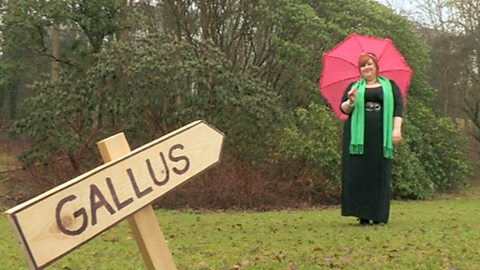
Scots words for weather. video
Presenter and singer Michelle McManus describes the weather in Scots.
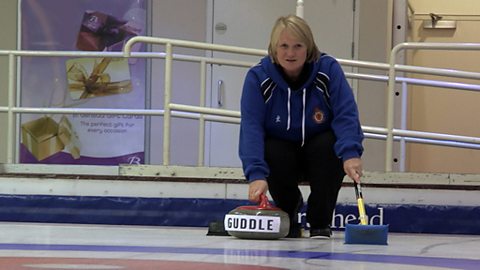
Scots words in the world of curling. video
Rhona Martin, Olympic Gold Medalist and former curler, uses Scots words to describe curling.
Retaining Scots words in our everyday lives. video
Poet Mark Thomson comments on the words and sounds of Scots language.
The power of Scots words. video
Journalist and TV presenter Kaye Adams describes her experiences of using Scots in her professional life.
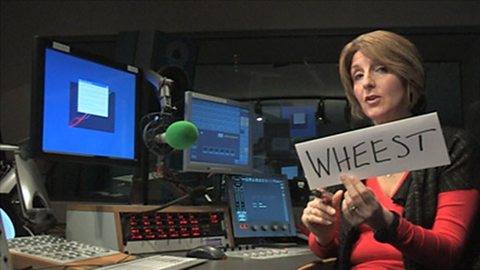
Scots words to describe expressive arts. video
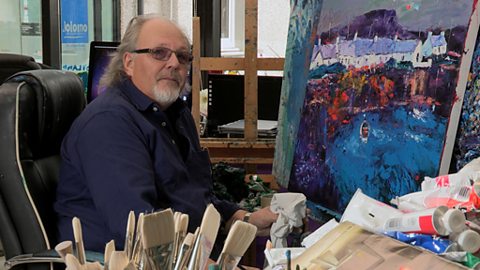
The artist Jolomo explains how Scots words often sums up his thoughts about a landscape.
Scots language traditions. video
How poet Rab Wilson writes, speaks and makes his living from the Scots language.