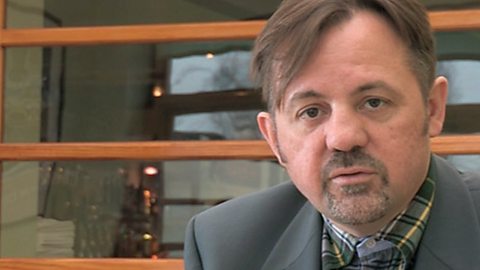
MICHELLE: My favourite Scots word is 'gallus'. Cheeky, bold, mischievous and, let's face it, more than a little bit stylish. That's me. 'Gallus'.
NARRATOR: Singer and television presenter Michelle McManus is wary of the weather, especially when she's 'stravaigin' in the country.
MICHELLE: It's not easy being stylish in the Scottish weather. If you're in the city, even on a 'dreich' day like this, all you have to do is jump in a cab. When you're out in the country, you never know what you're going to get. It can be hot, it can be cold, it can be cloudy, it can be windy, or it could be pouring with rain. And let's face it, nobody wants to get 'drookit'.
Then it gets cold, really cold. I am talking 'chitterin'. When that happens, I like to put on a nice, big scarf, the more colourful the better.
Don't talk to me about the wind. When it is blowing a gale outside and you've spent three hours doing your hair, you're left 'scunnered' by it. But the worst of all is the wind, the cold, and the rain. Nightmare.
In Scotland, it's no coincidence that we have many different words for rain and cold, but not that many for sun. I wonder why. Surely the best Scots word for Scots weather is 'braw'. Fine, beautiful, excellent. Anyway, enough about me. See you later!
Presenter and singer Michelle McManus talks about the Scottish weather and how the Scots language best describes it.
She discusses the flexibility of the word 'braw' and references other words like 'drookit' and 'gallus'. She speculates that the challenging weather has shaped the Scots tongue creating more words for foul weather than fair.
We are encouraged to reflect on how the weather makes us feel.
These clips are from the BBC Series, Blethering Scots, first broadcast in 2011.
Teacher Notes
This can be used as a starting point for creative writing about the weather, encouraging students to reflect on really effective language choices when describing the weather.
Students could reflect on what sort of weather they feel most ‘at home’ with and write a descriptive piece about it.
Curriculum Notes
This video clip will be relevant for teaching English at KS3 in England, Wales and Northern Ireland and at third level in Scotland.

More videos on Scots words:
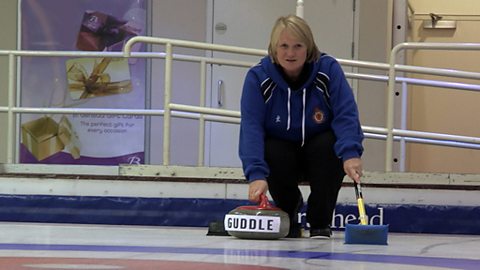
Scots words in the world of curling. video
Rhona Martin, Olympic Gold Medalist and former curler, uses Scots words to describe curling.
Retaining Scots words in our everyday lives. video
Poet Mark Thomson comments on the words and sounds of Scots language.

Scots words in the world of curling. video
Rhona Martin, Olympic Gold Medalist and former curler, uses Scots words to describe curling.
The news in Scots. video
Broadcaster Catriona Shearer compares modern official use of English with the 16th Century uses.

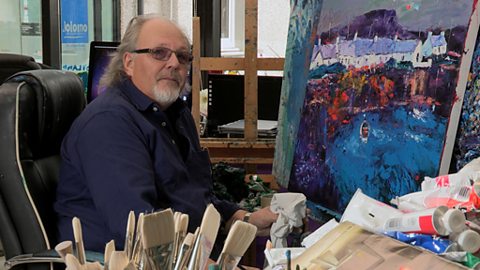
Scots words to describe expressive arts. video
The artist Jolomo explains how Scots words often sums up his thoughts about a landscape.
Scots language traditions. video
How poet Rab Wilson writes, speaks and makes his living from the Scots language.