INSTRUMENTAL MUSIC
This is my village. It is called Stow, which is Saxon for 'special place.' Everybody joins in village life. Some people do useful jobs around the village, like chopping firewood, churning butter, and grinding flour. Aswyn is our main weaver. She weaves material for most of our clothes. Edrig runs the metal forge and makes tools and jewellery. And Kedrig is our master builder. He's working on a new village hall. We have to spend a lot of time repairing our buildings because they are made of wood, which slowly rots, especially after bad weather.
This is my wife, Salwyn, and two of my children, Alfwyn and Enwolf. Now, they don't get a lot of time to play because there's usually too much to do.
Enwolf, what have you been up to today?
I've been out collecting firewood.
Good lad. We use quite a lot of firewood. We have to keep the fires hot to cook our food on, but also, we use the smoke. It helps to keep the insects out and also it helps us to preserve our fish and meat. We hang it up there to smoke it.
Alfwyn, what have you been up to?
I've been feeding the animals and picking plants.
Good girl! We use plants to make dye for our clothes, and we grow them specially here in the village. We have quite a lot of colours we can choose from. Woad makes blue, madder makes red, and weld makes yellow. And this green I'm wearing is made from nettles.
Salwyn, what did you use for the colour of that dress you're wearing?
This colour is madder.
And did you dye it yourself?
I do do the dyeing in the village sometimes, but I prefer to do the weaving or actually making the clothes.
So, you've been keeping busy then?
Busy? What with all the work round the farm and your seven children, I should say so.
Our children all work in the village. We don't teach them to read or write because most Saxons can't.
We're all pagans here in Stow, which means we believe in spells and lucky charms and worship several gods like Woden, the Divine Father, and Thunor, the God of Thunder.
ROOSTER CALLING
These villagers are preparing a pagan grave. When you're a pagan, you're buried with your belongings, a bit like King Rædwald was at Sutton Hoo, but most Saxon graves are full of more ordinary things.
Video summary
In this short clip, the character of Sid the Saxon shows us the typical jobs that would be done in an Anglo-Saxon village, such as this one in West Stowe.
He explains all the roles the members of family would have.
There were many jobs to be done in an Anglo-Saxon village, such as chopping firewood, churning butter and grinding flour.
A typical village would have a blacksmith and a builder.
Children had little time to play as there were lots of jobs to do to help their families.
A lot of Saxons were pagans, believed in spells and charms, and worshiped several gods.
This clip comes from Primary History, Saxon Settlers
Teacher Notes
This could be used in a task to 'design your own Saxon village'.
Pupils could be encouraged to work in pairs across a range of abilities. The task could be split into smaller sections such as making a list of the materials needed, describing how they would be put together, deciding how many people live in the village, what animals would be kept and why, and what jobs people had.
This animation is suitable for teaching History at Key Stage 2 in England, Wales and Northern Ireland, and at 2nd Level in Scotland.
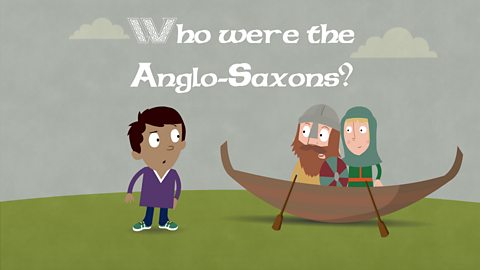
Who were the Anglo-Saxons? video
This short animation introduces the history of the Anglo-Saxons. Find out where they came from, what they were like and what they left behind.
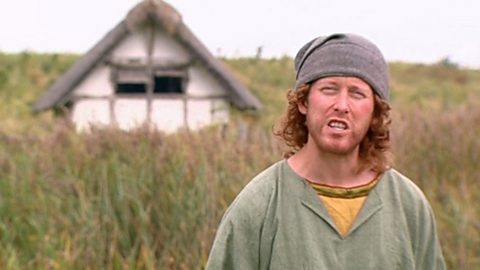
An Anglo-Saxon settlement. video
This short video will help you show students what conditions the Anglo-Saxons lived in and some of the developments they introduced.
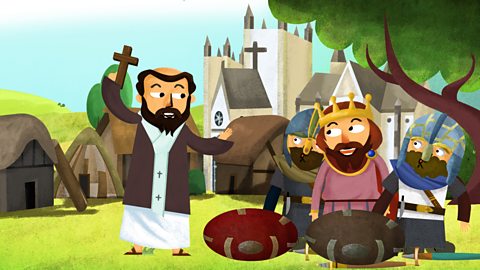
Anglo-Saxon religious beliefs. video
What religion did Anglo-Saxons believe in? This short animation, narrated by actor David Tennant explains how their beliefs changed over time.
Anglo-Saxons travel around Britain. video
Find out how the Anglo-Saxons travelled around Britain and what similarities there are even now.