This is a reconstructed Saxon farm at Bede's World, which is a museum at Jarrow in the North of England. It's called Gyrwe, which is the Saxon word for Jarrow.
INSTRUMENTAL MUSIC
All of the buildings here are very realistic and I should know because I'm a Saxon. They've all been built to look as real as possible, but they're not all made from the same Saxon materials. Some are made from wood, some from wattle and daub, and some from all three. Wattle is made from sticks which you weave together. And daub is the mud that we use to fill in the holes and bind it. Sometimes we'd use manure for daub, which is great at keeping your home warm and dry. But when it was fresh, sometimes it could be a bit smelly.
These buildings were our houses but also served as workshops where we do weaving and other Saxon crafts. Anything which we made which we couldn't actually use in the village ourselves, we traded for things that we couldn't make or grow. All Anglo-Saxon homes were made from natural materials. So they tended to rot over time. Unfortunately, there are no original Anglo-Saxon settlements left in Britain today. Most Saxons lived on villages and farms like this because they provided everything they needed. Food, warmth, shelter for all your family and friends. We were used to living on farms in our homelands. So when we came to Britain, we weren't really interested in the old Roman towns. Places like Cirencester, St. Albans, and London, they were all very busy in Roman times, but during Saxon times, they became much smaller.
Richer Saxons lived in palaces. Archaeologists have found the remains of a wooden palace built for the King of Northumberland at Yeavering. But normal Saxons, the ordinary ones, lived in ordinary houses. In the early days, Saxon buildings were made from wood because it was easy to find. We didn't really use stone because it was much too heavy to transport. But later, some special Saxon buildings were made from stone and some of these can still be seen in Britain today.
MELLOW MUSIC
St. Paul's Church in Jarrow dates back to the year 681 AD. It was a Saxon church, but some parts of it have been rebuilt over the years. But the chancel, this bit here, is from the first building and even has some genuine Saxon stained glass. This is the church where Bede worshipped. He lived at the monastery nearby and wrote about the Saxons in some magnificent handwritten books that still survive in the 21st century.
We Saxons ruled in parts of Britain for over 600 years. We arrived from other countries. We were really called Anglo-Saxons. Saxon is just a shorter way of saying it. Now, I don't mind being called an Anglo-Saxon or a Saxon, but don't call me a Viking, because I'm not!
Video summary
In this short clip, the character of Sid the Saxon gives a tour of a reconstructed Anglo-Saxon village in Jarrow, north-east England.
The uses of different materials like wattle and daub are explained and why they were important to the Anglo-Saxons.
Bede’s World is a reconstructed Anglo-Saxon village. Some houses in the village are made from wood, some from wattle and daub and some from both. The buildings were used for housing as well as workshops.
Teacher Notes
This clip could be used as part of an interactive activity where the class is split into groups and each has to reconstruct an Anglo-Saxon settlement, either as a model or a picture.
Pupils could be asked to note down key features of the settlements, such as the building materials used, whilst watching the clip and then turn this into a set of instructions for themselves to use in their reconstruction.
This short video clip is suitable for teaching History at Key Stage 2 in England, Wales and Northern Ireland, and at 2nd Level in Scotland.
Who were the Anglo-Saxons? video
This short animation introduces the history of the Anglo-Saxons. Find out where they came from, what they were like and what they left behind.
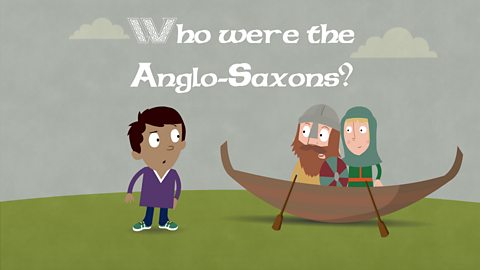
Anglo-Saxon village life and work. video
In this short video, the character Sid the Saxon shows us what a traditional Anglo-Saxon village looked like and some of the key roles people played.
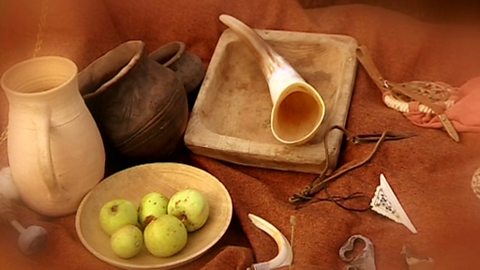
Anglo-Saxon religious beliefs. video
What religion did Anglo-Saxons believe in? This short animation, narrated by actor David Tennant explains how their beliefs changed over time.
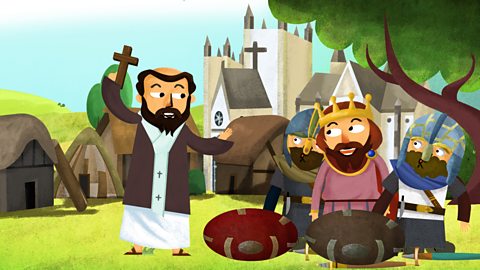
Anglo-Saxons travel around Britain. video
Find out how the Anglo-Saxons travelled around Britain and what similarities there are even now.