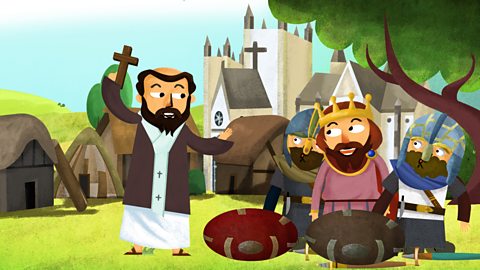
Excuse me. Yes, you! Would you like to learn about the Anglo-Saxons? Great!
Well let's start at the beginning. The Anglo-Saxon age in Britain was from about 410 to 1066 and they originally came from Germany and Scandinavia. Some historians say they were driven from their homes by rising floodwaters. They were not one united people, but lots of warring tribes that settled in different parts of Britain.
The biggest tribes were the Angles, Saxons and the Jutes. But they weren't always at war. They were mostly farmers who lived in wooden huts. Children here would generally not go to school. Girls would help around the home and boys learned the skills of their fathers. I would take a step back if I were you.
The Anglo-Saxons loved making things from wood. And they made intricate jewellery and metalwork. We still see their influence today, with words like, cow, cheese, werewolf and ghost. Plus several place names and even areas that still exist. They even laid the foundation for the creation of England.
There we go, the history of the Anglo-Saxons in a matter of minutes, from invaders to settlers, to makers. How enjoyable was that? Plus you have made a new friend.
Oh…hold on, I think his mother wants a word with you. Fantastic! Another successful day, look what happens when history happens to you!
Video summary
This short, colourful animation describes how the Anglo-Saxons in Britain went from invaders, to settlers, to makers.
Originally from Germany and Scandinavia, the Angles, Saxons and Jutes were lots of warring tribes who settled in Britain from about 410AD.
This animation can help students find out how these farmers lived and what they may have done if students had grown up in an Anglo-Saxon settlement.
What did they make? What words and place names have their origins from the Anglo-Saxons? They even had an influence in the formation of England as a country!
Teacher Notes
Pupils could research where there is evidence of Anglo-Saxons. They could use a map of Britain and the information in the animation, to locate and plot towns and cities which are of Anglo-Saxon origin.
Pupils could list words of Anglo-Saxon origin and write a short narrative to include as many of them as possible.
You could also ask students to research, then write, a description of what it may have been like to experience life as an Anglo-Saxon farmer.
Pupils could even be tasked to build a model of an Anglo-Saxon farm, settlement or dwelling.
Teachers could start a topic with a visit to a living history site or an Anglo-Saxon visitor or theatre group who could come to school.
This animation is suitable for teaching History at Key Stage 2 in England, Wales and Northern Ireland, and at 2nd Level in Scotland.
An Anglo-Saxon settlement. video
This short video will help you show students what conditions the Anglo-Saxons lived in and some of the developments they introduced.
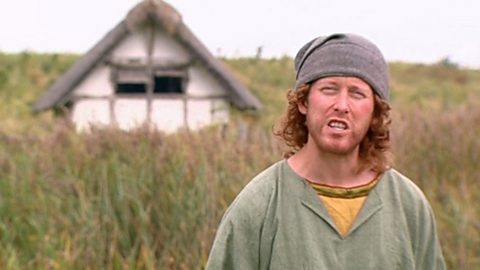
Anglo-Saxon village life and work. video
In this short video, the character Sid the Saxon shows us what a traditional Anglo-Saxon village looked like and some of the key roles people played.
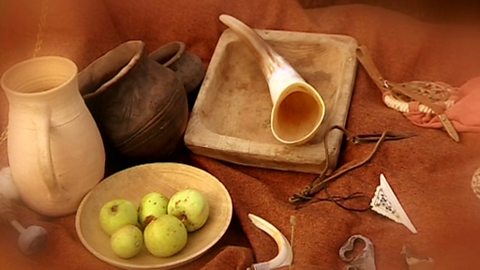
Anglo-Saxon religious beliefs. video
What religion did Anglo-Saxons believe in? This short animation, narrated by actor David Tennant explains how their beliefs changed over time.
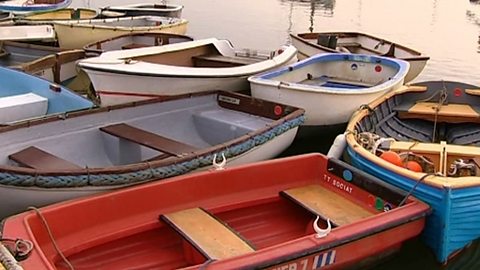
Anglo-Saxons travel around Britain. video
Find out how the Anglo-Saxons travelled around Britain and what similarities there are even now.