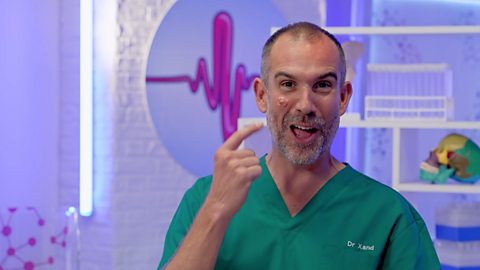
Before watching the video
This series of videos taken from Operation Ouch! link to the statutory relationships and health education guidance, and the non-statutory PSHE programme of study.
As with all PSHE-related content,a safe teaching and learning environment should be established before class viewing. It is important to watch the video before viewing, to ensure it is suitable for your pupils and works within your curriculum planning.
Please ensure you have read the teacher guidance before using in the classroom
Watch the video
Sleep
VOICEOVER [CHRIS]: Are you finding it hard to sleep?
VOICEOVER [CHRIS]: Finding it even harder to get up?
CHRIS: Are your parents constantly having to nag you to either go to bed or wake up in the morn-ing?
PARENT: Chris, get up!
CHRIS: Well, you've come to the right place. This is Dr Chris' One-Stop-Sleep-Shop-Clinic-Place for all your sleep-related needs.
VOICEOVER [CHRIS]: Terms and conditions apply. Monsters under the bed will not be dealt with as a cause of lost sleep. Offer only applies to die hard Operation Ouch fans.
CHRIS: Going to bed late and not getting up on time are things we all do occasionally. But if you're hitting puberty there's actually a scientific explanation. It's not just laziness – well, not most of the time. It's all part of becoming an adult. Now, to show you why, I'm gonna need some spit – and some more sleep. Now leave me alone.
CHRIS: So, Ashleigh, take one and pass it on.
VOICEOVER [CHRIS]: These volunteers are going to demonstrate how puberty changes how you sleep.
VOICEOVER [CHRIS]: Meet Ashleigh and Emma. They're eight years old and they're our young sleepers.
VOICEOVER [CHRIS]: This is Thomas, Megan and Alannah. They're all 13 and they're our teen sleepers. I'm asking them to collect samples of their saliva every hour between 4pm and when they go to bed.
CHRIS: So, does everyone understand?
SLEEPERS: Yes.
GIRL: We need to spit in these pots.
ASHLEIGH: Yay!
VOICEOVER [CHRIS]: The samples our two groups are taking will allow me to monitor levels of a hormone called melatonin.
ASHLEIGH: It's 6pm, so I need to spit now.
VOICEOVER [CHRIS]: Melatonin is a hormone your body releases to make you fall asleep and get some rest.
ASHLEIGH: Good night!
VOICEOVER [CHRIS]: I've come to meet neuroscientist Dr Paul Gringras. He's been analysing our saliva samples for levels of melatonin. What are the results then, Doc?
DR PAUL GRINGRAS: The younger children, their melatonin was starting to be produced about 7:30 or 8 o'clock at the latest.
VOICEOVER [CHRIS]: So, that's why if you're younger you get tired around this time but it changes as you reach puberty.
DR PAUL GRINGRAS: For the teenage group, their melatonin was not even being produced till about 10 or 11.
VOICEOVER [CHRIS]: And that's why they don't feel tired until much later on.But, you have to be careful because some things can stop the melatonin doing its job.
DR PAUL GRINGRAS: So we've actually got a body clock that's sensitive to light. If you start doing things with bright lights you are managing to switch off your own melatonin, which is one of the problems. So, screens like iPads and electronic hi-tech stuff have a lovely, bright, blue light which keeps us alert. And in the evening it's about the very worst thing you could do.
VOICEOVER [CHRIS]: So the best thing to do before bed is to stay away from computer screens. But because you're going to bed much later than you were before puberty and still having to get up at the same time, that can take some adjusting to.
CHRIS: If you yourself are finding it difficult to wake up, well, now you know there's a biological reason for it. You're not just being lazy.
ASHLEIGH: Good night!
Video summary – sleep
In this video, Dr. Chris and Dr. Xand explore how sleep patterns change as children grow older and go through puberty. They compare the sleep needs and habits of 7-8-year-olds with those of teenagers, highlighting how biological changes affect sleep cycles.
To illustrate this, a group of teenagers takes part in a test measuring their melatonin levels – the hormone that helps regulate sleep. The doctors explain how melatonin production changes during puberty, making it harder for teens to fall asleep early.
The video also addresses the impact of screen use at night, showing how the blue light from devices can suppress melatonin production and delay sleep, reinforcing the importance of healthy bedtime routines.
Suggested activities
Discuss what pupils have learned from the video and how sleep starts to change during puberty. Talk about any differences related to sleep that they might have noticed in relation to themselves or people they know – for example, baby relatives that sleep most of the day, younger children having early bedtimes, or going to bed later as they get older.
Some techniques for getting a good night’s sleep were discussed in the video. Can pupils list any more?
- Ask them to draw a picture of or write a description of the ideal situation for a good night’s sleep.
- They could also create a ‘getting ready for a good night’s sleep’ timeline, or do one for differently-aged children (e.g. a baby, a young child, a teenager)
Be aware of and sensitive to those children who may be in living conditions which do not enable ideal sleep situations.
You can watch more Operation Ouch! on iPlayer.
More videos from this series
Grief. video
Dr. Chris and Dr. Xand discuss the topic of grief with a group of schoolchildren.
Anxiety. video
Dr. Xand and Dr. Chris discuss anxiety with a group of schoolchildren.
Stress. video
Dr. Ronx tries out some stress-busting techniques with schoolchildren.

Immune system video
Dr. Xand and Dr. Chris investigate how our immune systems work.
Vomit. video
Dr. Xand and Dr. Chris look at the biological process of vomiting.
Diarrhoea. video
Dr. Xand and Dr. Chris look at the causes and symptoms of diarrhoea.
Food. video
Dr. Xand and Dr. Chris test the energy values of different foods.
Healthy heart video
Dr. Ronx teams up with a group of schoolchildren to explore how to keep the heart healthy.
Spots. video
Dr. Xand and Dr. Chris explain why we all get spots.